


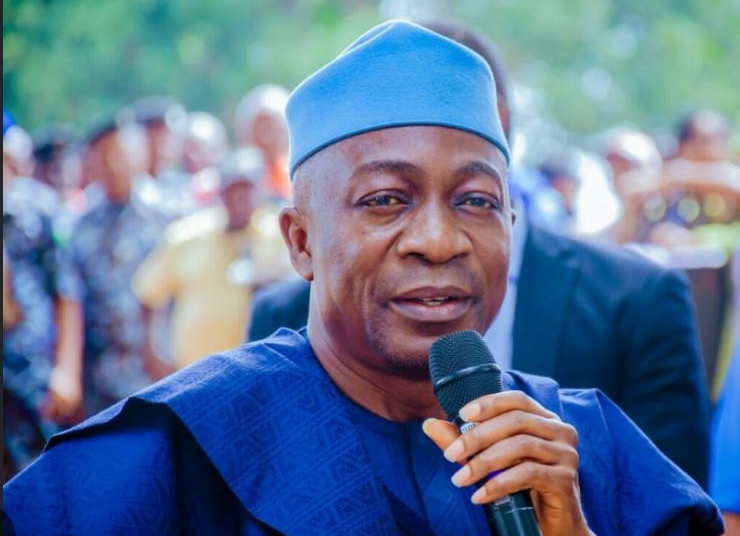
The Senate has dismissed calls for the National Assembly to reconvene over President Bola Ahmed Tinubu’s continued stay abroad, with its spokesperson and Chairman of the Senate Committee on Media and Public Affairs, Senator Yemi Adaramodu, insisting that there is “no reason for such a call.”
Adaramodu, who represents Ekiti South Senatorial District, stated this while speaking with LEADERSHIP on Thursday in Abuja, saying the legislature would not be dragged into what he described as political arguments over the President’s absence.
He stressed that the National Assembly was a lawmaking body and not a political platform.
“There is no reason for such a call,” Adaramodu said when asked whether the Senate should immediately reconvene to address concerns over Tinubu’s absence.
The senator was reacting to a demand by serving federal lawmakers under the aegis of Save Democracy for the National Assembly to urgently reconvene and address what they described as a constitutional uncertainty arising from the President’s continued absence from Nigeria.
The group had expressed concern over the alleged failure to transmit a written declaration under Section 145 of the 1999 Constitution (as amended), which provides for a written declaration by the President to the President of the Senate and the Speaker of the House of Representatives when he proceeds on vacation.
The lawmakers also called on the National Assembly to ensure compliance with Section 145(2), arguing that no declaration had been transmitted within the constitutionally prescribed 21-day period.
The controversy followed the Presidency’s announcement that Tinubu departed Nigeria on August 30, 2026, for a three-week vacation and subsequently extended his stay abroad by a few days.
However, Adaramodu said the matter had already been addressed by Senate President Godswill Akpabio, who spoke on Tuesday in Akwa Ibom State while inaugurating road projects executed by Governor Umo Eno.
Akpabio had dismissed suggestions of a presidential vacancy, insisting that Tinubu remained in charge of the country’s affairs despite being abroad.
“I am not the acting president because the president is still in power. The president is on a working leave. So, there’s no absence in Aso Rock,” Akpabio said.
The Senate President also said Tinubu could continue to discharge his responsibilities while outside the country by issuing directives and conducting government business remotely.
Adaramodu said the President remained in regular contact with Nigerians and questioned why the National Assembly should be expected to respond to every statement made by politicians or civil society organisations.
“Some of these civil society organisations, they are citing Section 145, where some people are playing their politics. The National Assembly is not a political platform. It’s a lawmaking platform,” he said.
He said politicians were entitled to make their comments, particularly as elections approach, but lawmakers would not turn every political statement into a parliamentary matter.
“It is the business of politicians to talk,” Adaramodu said.
The senator also dismissed the argument that the physical location of political leaders automatically determined whether they were performing their constitutional duties.
Asked whether leaders could effectively discharge their responsibilities from wherever they were, Adaramodu said the issue was functionality rather than geography.
“It is not geography; it is functionality,” he said. “It is your functionality that dictates whether you are performing your duties or you are not performing your duties. It’s not your GPS.”
Meanwhile, Adaramodu confirmed that the Senate would resume legislative activities on September 29, saying the October 1 Independence Day public holiday would not affect the resumption.
He said the National Assembly routinely works around public holidays, with only major festive periods occasionally affecting its legislative calendar.
The senator also criticised what he described as disproportionate attention to legislative holidays, noting that other arms of government, particularly the judiciary, also observe vacation periods.
“They went on holidays in July, and they resumed in September. Nobody is talking about it. That is the judiciary,” he said.
Adaramodu said lawmakers understood that, as representatives of the people, their activities would naturally attract public scrutiny.
“We are representatives of the people,” he said. “They have the right to be interested in our affairs.”
He, however, maintained that the National Assembly had legislative business to attend to and would not be distracted by political statements or what he described as insinuations.
“We have a lot to do before us rather than listening to insinuations about operations and all these things from random politicians,” Adaramodu said.