

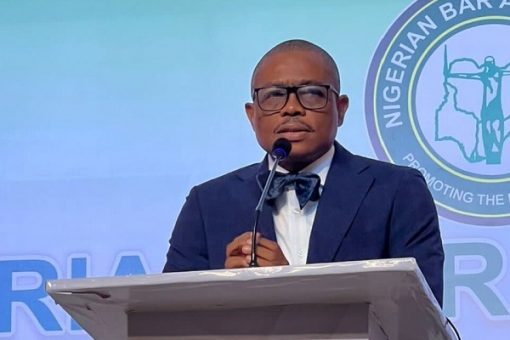
A former President of the Nigerian Bar Association (NBA), Mazi Afam Osigwe (SAN) has warned that lack of independence of the Independent National Electoral Commission (INEC), weak electoral laws and difficult evidentiary rules are undermining Nigeria’s elections.
The immediate past president of NBA disclosed this on Thursday at the 22nd All Nigeria Editors’ Conference of the Nigerian Guild of Editors (NGE) in Enugu, with the theme, “The ballot, the media and the task of keeping democracy alive.”
Osigwe, who spoke on “Election petition in the digital age: Independence, evidence, BVAS,” stressed that the courts had increasingly become involved in determining electoral outcomes, raising questions about whether elections were being decided by voters or judges.
He described the situation as the “judicialisation of the electoral process”, and blamed it partly on the difficulty of proving electoral malpractice.
The senior lawyer added that Nigeria had one of the highest numbers of election petitions because courts were frequently called upon to determine who won elections.
“The courts have gradually and increasingly usurped the role of the voters in determining the representatives of the people. And I couldn’t have agreed with him more.” he stated.
Osigwe further questioned the effectiveness of the Bimodal Voter Accreditation System (BVAS) and the INEC Result Viewing Portal (IReV), pointing out that technologies introduced to strengthen elections had created fresh legal and evidentiary challenges.
The former NBA president noted that petitioners challenging a state-wide election could be required to produce BVAS devices from every polling unit, despite the limited time allowed for election petitions.
“So if you’re challenging state-wide election, and an issue concerns BVAS from every polling unit, you must physically go and carry the BVAS from every polling unit. And yet the court is not a bit hesitant to set time limits,” he said.
He stated that the situation defeated the purpose of using technology to make elections and election disputes easier to resolve.
While criticising the treatment of evidence obtained through subpoenas, particularly in petitions arising from the 2023 general elections, he explained that petitioners were required to file their evidence within 21 days, making documents or testimony obtained later through subpoenas inadmissible.
“Why do we call it a subpoena? Why didn’t they say they are your witnesses?” he queried , referring to the presidential election petitions filed by Atiku Abubakar and Peter Obi.
The senior lawyer stated that the interpretation had weakened the usefulness of subpoenas, especially where petitioners needed documents in the custody of INEC or other public institutions.
Speaking further on IReV, Osigwe said the portal should be given greater evidentiary recognition, even if it was not treated as the primary evidence of an election.
“I’m not saying it should be the primary evidence, but first of all, some recognition should be given to it,” he said.
He also expressed concern over a proposed change to the electoral framework which, according to him, would prevent non-compliance with INEC regulations and guidelines from constituting grounds for challenging an election.
Osigwe warned that such a provision could encourage politicians to focus only on securing declarations, regardless of whether the process complied with the law.
He stated that the popular phrase, “Go to court,” had acquired a negative meaning because of public suspicion about the electoral justice system, noting that some politicians used it in a manner suggesting that they already knew the outcome of any legal challenge.
Osigwe also stated that the process of appointing members of INEC remained a major concern.
The former NBA president also questioned the use of ad-hoc electoral officers, including academics, alleging that some officials recruited for election duties had later faced criminal proceedings.
The senior lawyer also criticised the conduct of some State Independent Electoral Commissions, adding that ruling parties often recorded overwhelming victories in local government elections, thereby reinforcing the perception that electoral bodies were not independent.
Osigwe urged editors and journalists to continue scrutinising INEC, the courts and political actors, saying the media had a crucial role in ensuring that votes cast by Nigerians translated into legitimate political mandates.