

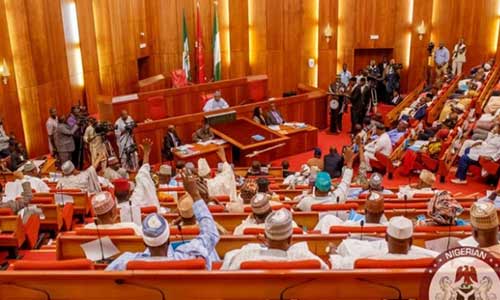
The Women’s Reserved Seats Bill has become a fresh point of pressure on the 10th National Assembly, as the African Centre for Leadership, Strategy and Development (Centre LSD) has urged lawmakers to pass the proposed legislation before the expiration of their tenure, saying it is necessary to address the persistent under-representation of women in Nigeria’s political leadership.
The African Centre for Leadership, Strategy and Development (Centre LSD) has urged the 10th National Assembly to pass the Women’s Reserved Seats Bill before the expiration of its tenure, saying the proposed legislation is critical to addressing the persistent under-representation of women in Nigeria’s political leadership.
The Centre made the call in Abuja on Tuesday through its Founding executive director and Project director of the Women Can Lead (WCL) Project, Dr Otive Igbuzor, during a press conference held as part of a Gender Mainstreaming training for Gender desk officers, faith and traditional leaders, and women’s rights organisations.
Igbuzor said the National Assembly had a historical responsibility to use constitutional and institutional mechanisms to remove barriers that have continued to limit women’s participation in governance and decision-making.
He said the proposed reserved or special seats arrangement could provide women with greater access to legislative positions, stressing that deliberate interventions had been adopted in other countries to address historical inequalities in political representation.
Igbuzor said, “What we all need to do is to appeal to the 10th National Assembly that they cannot close shop if they don’t pass the reserved seat bill.”
He added, “History will hold them in good stead if they pass it and history will also write their names in the ‘white book’. Their names will be written in ignominy if they fail to pass the bill.”
According to him, Nigeria remains one of the countries with very low representation of women in political institutions despite women constituting about half of the country’s population.
“The 10th National Assembly has a historical responsibility to pass the Special Seats Bill to alter this trajectory. To pass the reserved seat bill is a responsibility that must be achieved,” he said.
Igbuzor said the low number of women contesting elective positions should not be interpreted as a lack of interest or capacity among women, arguing that such a conclusion would overlook the historical, economic, institutional and socio-cultural barriers confronting women in politics.
He also cautioned against asking why women were not coming forward to contest presidential and governorship positions, saying such questions could shift the burden of responsibility to women rather than addressing the structures that make political participation difficult.
The Centre’s call coincided with the launch of the Women Can Lead Project, a 24-month initiative supported by the Ford Foundation and focused on Benue State, Kano State and the Federal Capital Territory.
According to Igbuzor, the project was established to create stronger platforms and enabling conditions for women to participate, lead and influence decisions in governance and public life.
“The project brings together three mutually reinforcing areas: gender mainstreaming, meaningful inclusion of women in governance, and feminist strategies for the prevention of gender-based violence,” he said.
He said women across Nigeria continued to face structural, institutional, economic and socio-cultural barriers that limited their participation and influence in governance, adding that even where women were present, their participation did not always translate into voice, influence or power.
“Our starting point is therefore clear: the burden of achieving gender equality cannot be placed on women alone. We must move beyond simply telling women to become more confident, acquire skills and ‘step forward’,” he said.
Igbuzor called on government institutions at all levels to mainstream gender into their policies, programmes, plans and budgets to create opportunities for greater inclusion of women in governance and decision-making.
He also urged traditional and religious leaders to use their influence to challenge harmful norms and practices and promote dignity and equality, while calling on men and boys to become active allies in building more equitable families, institutions and communities.
The Centre further urged civil society organisations and women’s rights groups to continue demanding accountability and creating platforms for women’s voices, while charging the media to go beyond reporting barriers confronting women and deliberately highlight women’s leadership, achievements and contributions.
Igbuzor said the Women Can Lead Project would adopt a feminist, intersectional and community-centred approach, recognising that women experience different forms of exclusion depending on factors such as age, location and disability.
“Women are not a homogeneous group. Young women, rural women, women with disabilities and women experiencing other forms of exclusion encounter different barriers. Our interventions must recognise these differences,” he said.
He said the project would work with women and men, traditional and faith leaders, public institutions, civil society organisations, community actors and persons with disabilities as partners in promoting gender transformation.
“We want women equipped to lead, but we equally want institutions structured to include them and communities prepared to support their leadership,” he said.
Igbuzor stressed that sustainable gender transformation required both institutional and social change.
“We believe that institutional reform without social transformation will be inadequate, just as changing attitudes without changing institutions will be insufficient,” he said.