
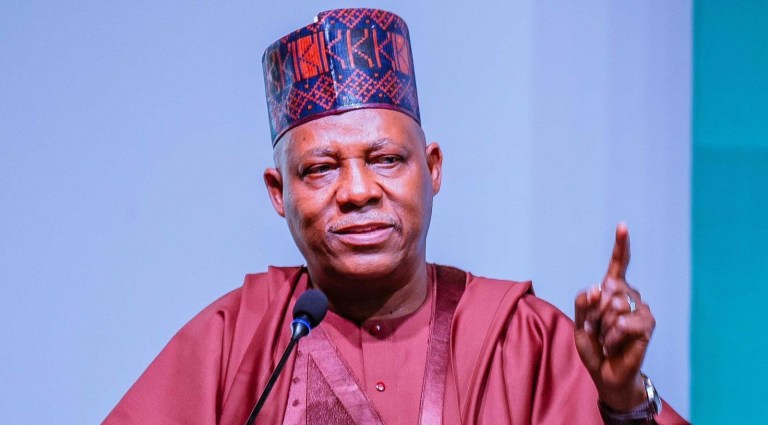
Vice President Kashim Shettima, at the High-level Accra Reset Initiative meeting held on the margins of the ongoing 2026 World Economic Forum (WEF) Annual Meeting in Davos, Switzerland, advocated homegrown solutions to Africa’s economic problems, emphasizing innovative approaches for growth, development and prosperity in the continent.
The vice president was of the view that it is only by building domestic productive capacity that African nations can convert their population and natural talents into real, resilient wealth, adding, instead of expecting prosperity to be parachuted in, “it must be homegrown and earned.”
Shettima observed that Africa is no longer the periphery but the pulse of the world’s demographic and economic future.
Citing Nigeria where the Dangote Refinery is gradually turning the nation into a major exporter of fuel, Shettima stated that Africa can only rise when countries on the continent build their economies.
Underscoring the benefits of modular factories, artificial intelligence, and robotics, the Vice President noted that “Africa can industrialize faster in the 21st century than ever before,” saying the era when the continent is “known only for what it digs or grows” is now giving way for the era when Africa is known for what it builds.
The VP stated that while Africa’s future “depends on letting skills travel, return, and multiply,” prosperity will move at the speed of people.
He recalled that “in 2024 alone, Africans abroad sent home about 95 billion dollars, more than 5 per cent of our GDP and roughly equal to total foreign direct investment.
VP Shettima, on Nigeria, maintained that the experience had been shaped by a simple lesson, that “prosperity is not imported; it is built,” adding that the nation has “seen the prosperity paradox up close.”
The Vice President welcomed the vision of the Accra Reset, describing the initiative as a bold reimagining of Africa’s shared future built through African-led cooperation, and rooted in sovereignty and self-definition.
President John Mahama of Ghana, applauding the presence of Vice President Shettima and other leaders at the forum, decried the existing relationship between African countries and the global north, noting that bilateral relations among nations have become transactional at the detriment of Africa’s genuine transformation.
According to him, “many states and non-state actors are acting unilaterally in pursuing their own national agenda and parochial interests, hence, Africa remains trapped in cycles of conflict and multidimensional poverty, striving on handouts and humanitarian assistance from the developed world.”
Former President Olusegun Obasanjo dwelled on what Africa requires to take its rightful place in the comity of nations, given the “new age of disruption, uncertainty and unpredictability.”
He warned that “as the world is reorganising, with supply chains withdrawn, security and economics fused, and the old development architecture struggling, countries that are not organised for negotiation and execution do not merely fall behind; they become bargaining chips.
On the marginalisation of Africa in value addition and technology, former President Obasanjo said, “Let us be clear: sovereignty is not a flag to be waved about at international forums.”
Former Vice President Yemi Osinbajo noted that the essence of the forum is to galvanise support for governments in Africa to rethink their strategies for transforming economies and address the numerous challenges confronting the people.