
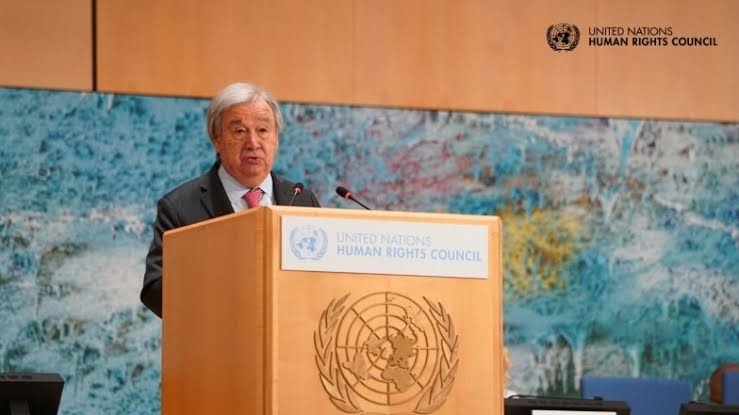
The United Nations Under Secretary General for Global Communications, Ms. Melissa Flemming, has stressed that the world today urgently needs an information ecosystem that would promote peace, sustainable development, and human rights.
According to a statement issued at the weekend by the United Nations information Centre(UNIC) Flemming said this at the official launch of the world’s first UNESCO Category 2 Institute on Media and Information Literacy, the International Media and Information Literacy Institute (IMILI), at the Banquet Hall of the Presidential Villa, Abuja.
“Our world urgently needs an information ecosystem it can trust. One that promotes peace, sustainable development, and human rights,” Fleming said.
While congratulating the Federal Government of Nigeria and the UNESCO General Conference on the establishment centre, Fleming observed that the UN’s first-ever Global Risk Report, launched in July 2025, confirmed that Mis- and disinformation represent a top global vulnerability, one that has been chronically underestimated and is already unfolding around us.
“This is why the Secretary-General launched the UN Global Principles for Information Integrity in 2024 and built around five core commitments: Societal trust and resilience; Healthy incentives; public empowerment, including digital literacy; independent, free, and pluralistic media; transparency and research.” She explained and noted that at their core is an unwavering commitment to human rights.
Fleming further stressed that the global principles envisioned an information ecosystem that delivers choice, freedom, privacy, and safety for all; one in which people everywhere can express themselves freely, make informed decisions, and exercise greater control over the media they concern, their online experiences, and how personal data is used.
The President of Nigeria, Bola Ahmed Tinubu, acknowledged that the launch of IMILI marked a major milestone in Nigeria’s contribution to global efforts aimed at addressing misinformation, disinformation, and promoting responsible communication in the digital age.
Represented by the Secretary to the Government of the Federation, Senator George Akume, the President described the development as a historic achievement for Nigeria, Africa, and the international community.
Tinubu noted that the establishment of IMILI came at a critical time when the spread of false information and harmful content continued to challenge societies worldwide, stressing that media and information literacy remained a vital tool in strengthening democratic institutions and fostering social cohesion.
The President also urged Nigerians, particularly young people, to “embrace media literacy as a critical component of national development and global engagement, expressing confidence that the Institute will serve as a centre for promoting truth, critical thinking, and responsible information use.”
He reaffirmed the federal government’s commitment to support IMILI through funding, institutional collaboration with the National Open University of Nigeria, and ongoing partnership with UNESCO on its legal and operational framework.
UNESCO assistant director General, Communication and Information Sector, Mariya Gabriel, explained that Media and Information Literacy is not a technical skill alone. “It is a civic skill. A life skill. And increasingly, a survival skill for our democracies. Yet the gap remains significant.”
According to her, while 171 countries recognize the importance of Media and Information Literacy, only 17 have fully integrated it into national policies and strategies. In Africa, just 9 out of 54 countries have integrated MIL into national curricula.
She said further, “At the same time a UNESCO Global Survey shows that 62% of digital content is shared without proper verification. These figures are not just abstract statistics. They are a call to action.”
Gabriel called on all stakeholders to address a critical reality, which included persistent inequalities in access to information and digital spaces, as women and girls continue to face disproportionate levels of online harassment and exclusion.
In his remarks, the Minister of Information and National Orientation, Mohammed Idris, described the Institute as a reflection of Nigeria’s leadership in advancing informed citizenship and protecting the integrity of information systems.
He stated that IMILI would function as a global hub for research, training, and policy engagement, bringing together educators, media professionals, policymakers, and youth from across the world.
The minister further assured the government’s commitment to ensuring the Institute’s independence, sustainability, and adherence to international standards.”
The event attracted high-level dignitaries, including government officials, representatives of international organisations, and key stakeholders in the media and education sectors.