


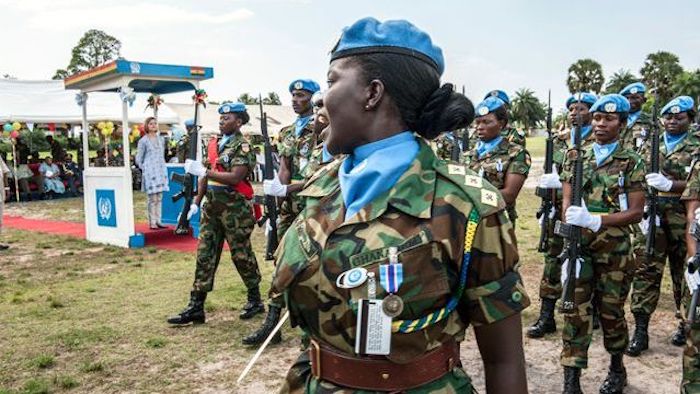
The United Nations Interim Force in Lebanon (UNIFIL) is preparing to withdraw its peacekeepers from southern Lebanon as its mandate approaches its end on December 31, 2026, with uncertainty persisting over who will take responsibility for security in the region.
In the Lebanese border town of Naqoura, only a few buildings remain standing, including an abandoned hotel occupied by Israeli soldiers and the compound housing the headquarters of the United Nations peacekeeping mission. Anti-drone netting covers parts of the hotel’s walls.
Roads through the once-idyllic seaside town, now largely reduced to rubble, are mostly deserted, with only occasional military patrols and convoys of peacekeepers escorting civilians and transporting essential supplies.
As the end of UNIFIL’s mandate approaches, uncertainty remains over the security arrangements that will replace the international force after its departure.
The impending withdrawal comes as Israeli forces continue to occupy parts of southern Lebanon and disagreements persist over the disarmament of Hezbollah, leaving the region’s security future uncertain.
Lebanon wants the United Nations mission to remain. However, the UN Security Council voted unanimously in August 2025 to extend UNIFIL’s mandate for a final time until December 31, 2026, after which an orderly and safe withdrawal is expected to take place over the following year.
Israel has described the peacekeeping mission as unsuccessful, citing Hezbollah’s military expansion over the years. UNIFIL, however, maintains that it helped preserve calm for 17 years before Hamas’ 2023 attack on southern Israel triggered a wider regional conflict.
Three UN Peacekeepers killed in Mali Blast
UNIFIL Commander Major General Diodato Abagnara said the mission was not established to disarm Hezbollah but to support the Lebanese Armed Forces in taking full control of the southern region.
“My mandate is not to disarm Hezbollah,” Abagnara told the Associated Press in an interview.
“My mandate is to support the Lebanese Armed Forces, to create the best conditions for the Lebanese Armed Forces to take full control here in the south. It’s not to fight against Hezbollah,” he added.
The peacekeeping force, which currently has approximately 7,500 personnel, is expected to begin its gradual drawdown and withdrawal from December 31, 2026.
Abagnara stressed the importance of establishing alternative security arrangements, warning that they were necessary to prevent a security vacuum in southern Lebanon after the mission’s departure.
Although UNIFIL was unable to prevent Hezbollah from launching missiles or Israel from carrying out airstrikes during two recent wars, many residents in southern Lebanon say they still feel safer with the peacekeepers around.
One of them, Mohammed Aoun, delayed harvesting his olive groves this year in Halta village, located just outside the Israeli-occupied area.
On the first day of harvesting earlier this month, a UNIFIL patrol stopped at his orchard while an Israeli drone flew overhead. The sound of a distant airstrike also echoed across the valley.
Aoun said he had initially hesitated to begin harvesting but could not afford to lose another season after missing out on the previous two years’ harvests because of the conflict.
He expressed concern about the impending departure of the peacekeepers, explaining that their regular patrols provided residents with a sense of protection.
“Of course we feel more secure when we see patrols coming and going; it’s a sort of protection,” he said.
“Their presence is important with regards to the security situation. We don’t know what will happen after they leave,” he added.
UNIFIL was established in 1978 following an Israeli invasion of southern Lebanon aimed at fighting Palestinian militants. Israel invaded the country again in 1982 and did not withdraw its forces until 2000.
During that period, Hezbollah, an armed group backed by Iran, emerged as a guerrilla force.
Following a month-long war between Israel and Hezbollah in 2006, UNIFIL was assigned responsibility for monitoring violations of United Nations Security Council Resolution 1701, which brought the fighting to an end.
The peacekeeping force also became part of the mechanism overseeing the implementation of the ceasefire agreement that ended another conflict between Israel and Hezbollah in 2024.
Under the planned withdrawal arrangements, the Lebanese Armed Forces are expected to assume responsibility for security in southern Lebanon after UNIFIL’s departure.
However, another conflict between Israel and Hezbollah erupted in March, linked to the wider war involving Iran. Israeli forces now occupy extensive areas of southern Lebanon, where soldiers have emptied and demolished dozens of villages.
Abagnara said approximately 11,000 people remain in a handful of predominantly Christian villages within the occupied territory.
He explained that these communities depend on UNIFIL to escort convoys carrying supplies and maintain their connection with the rest of the country.
Meanwhile, an agreement between Lebanon and Israel that would require Israeli forces to withdraw in exchange for Hezbollah’s disarmament has stalled, with negotiations between the two countries making little progress.
Lebanese President Joseph Aoun said in a statement on Wednesday that Israel continued to carry out hostile activities in southern Lebanon.
He said his government and France, a member of the UN Security Council with close ties to Lebanon, supported extending UNIFIL’s mandate.
Aoun added that any alternative international force should continue operating under the framework of Resolution 1701, although some amendments could be considered.
The United States has expressed willingness to support some form of international presence in southern Lebanon but does not favour retaining UNIFIL in its current structure.
American officials have suggested that a replacement could take the form of a civilian force or private defence contractors.
Israel, however, wants its military to coordinate directly with the Lebanese Armed Forces to remove what remains of Hezbollah’s weapons.
Israel’s Ambassador to the United Nations, Danny Danon, said earlier this month that Hezbollah had taken advantage of the peacekeeping mission’s presence.
“We do not rely on any international force,” Danon said. “We trust only our own soldiers.”
Lebanon has rejected the proposal for civilian security contractors and opposed direct military coordination with Israel.
France is preparing a draft UN Security Council resolution that would authorise a new international force, according to a United Nations diplomat.
A Western diplomat also disclosed that discussions were underway about delaying UNIFIL’s withdrawal and retaining some of its existing operations to prevent a security vacuum in the region.
Both diplomats spoke on condition of anonymity because they were not authorised to discuss the negotiations publicly.
In January, the Lebanese army announced that it had completed the removal of Hezbollah weapons caches from areas south of the Litani River, near the Israeli border.
Although Hezbollah did not actively obstruct the operation, the group has refused to surrender its weapons in other parts of the country and has threatened to resist any attempt to forcibly disarm it.
The Lebanese Armed Forces have remained cautious about taking steps that could trigger an internal conflict.
A Lebanese security official, who spoke on condition of anonymity to discuss sensitive matters, said the military’s current approach was to prevent weapons shipments from being transported around the country.
The official explained that this represented a departure from previous years, when Hezbollah could move weapons freely, but said the army was not conducting raids on the group’s weapons storage facilities.
Hezbollah supporters had previously accused UNIFIL peacekeepers of spying for Israel, with some members of the international force facing attacks.
However, the group has indicated that it would accept the continuation of UNIFIL or another international force operating under a United Nations mandate.
Hezbollah remains opposed to the deployment of private security contractors or any international force it considers supportive of Israel’s occupation of southern Lebanon.
With UNIFIL’s mandate set to expire on December 31, 2026, uncertainty remains over who will oversee security in southern Lebanon as diplomatic efforts continue to establish an alternative arrangement.
AP staff writer Edith Lederer in New York contributed to this report.
Sewell is the Associated Press news director for Lebanon, Syria and Iraq. She joined the AP in 2022 and has been based in the region since 2016, reporting and guiding coverage of some of the region’s most significant news developments.