
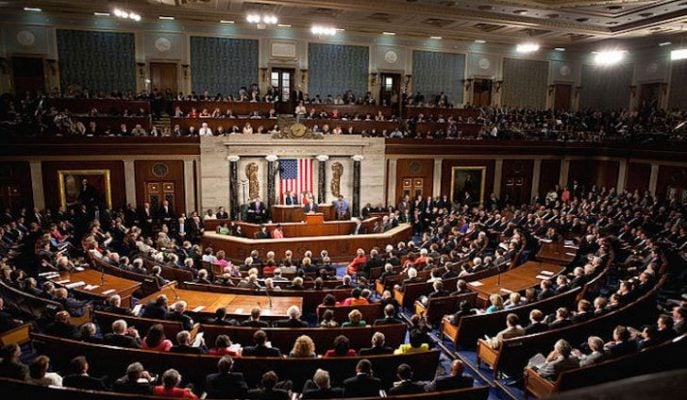
United States lawmakers convened a rare joint briefing on Tuesday as part of a broader congressional investigation into what they describe as escalating and targeted violence against Christians in Nigeria.
The session, led by House Appropriations Vice Chair and National Security Subcommittee Chairman Mario Díaz-Balart (R-Fla.), forms part of a comprehensive report ordered by President Donald Trump on recent massacres of Nigerian Christians and potential U.S. policy responses.
Trump directed Congress, under the leadership of Reps. Riley Moore (R-W.Va.) and Appropriations Chairman Tom Cole (R-Okla.), to probe Christian persecution in Nigeria. He has also floated the possibility of direct military action against Islamist militants.
Vicky Hartzler, chair of the U.S. Commission on International Religious Freedom, told lawmakers that religious freedom in Nigeria is “under siege.”
She cited mass abductions, including the kidnapping of more than 300 children, and attacks in which radical militants “kill entire Christian villages and burn churches.”
Hartzler argued that Christians are disproportionately targeted at a rate of 2.2 to 1 compared with Muslims.
While acknowledging Nigeria’s recent reassignment of 100,000 police officers from VIP protection duties, she warned that the country was entering a “deeply troubling period of escalated violence.” Hartzler recommended targeted sanctions against complicit Nigerian officials, visa restrictions, asset freezes, and conditioning aid on accountability.
Dr. Ebenezer Obadare of the Council on Foreign Relations challenged Abuja’s claim that the violence is not religiously motivated, calling it a “myth.”
He said Boko Haram and other militant groups act solely on religious grounds and described Nigeria’s military as “too corrupt and incompetent” to dismantle jihadist networks without external pressure. He urged Washington to press Nigeria to disband armed groups enforcing Islamic law and to respond swiftly to early warnings of attacks.
Sean Nelson of Alliance Defending Freedom International described Nigeria as “the deadliest country in the world for Christians,” claiming more Christians are killed there than in all other countries combined.
He argued that extremists also target Muslims who reject radical ideology, undermining Abuja’s narrative that the crisis is driven mainly by criminality.
Nelson called for tighter U.S. oversight of aid, greater transparency in ransom payments, and routing assistance through faith-based organizations to reduce corruption.
Díaz-Balart criticized the Biden administration for reversing Trump’s 2020 designation of Nigeria as a “country of particular concern,” saying the decision had “deadly consequences.” Lawmakers on the Appropriations, Foreign Affairs, and Financial Services committees signaled further oversight actions as they prepare the Trump-directed report.
Hartzler noted recent steps by Nigeria’s leadership, including President Bola Tinubu’s redeployment of police officers and public acknowledgment by the Speaker of Nigeria’s House of Representatives that the country faces a “coordinated and deeply troubling period of escalated violence.”
She welcomed these moves as signs of recognition but warned they remain insufficient without transparency, accountability, and swift action against perpetrators.