
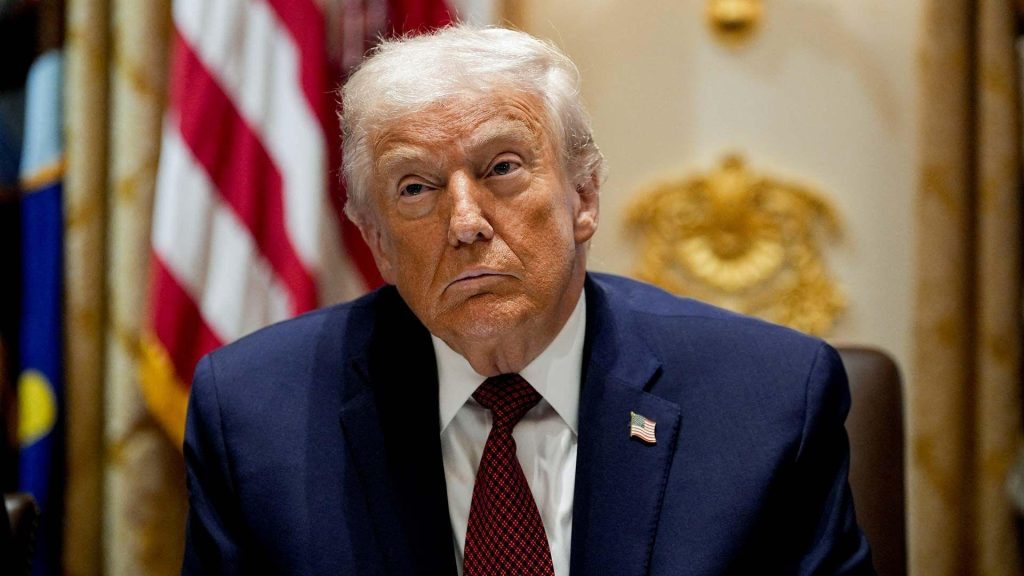
U.S. President Donald Trump’s push to reshape the judiciary with conservative appointments is expected to slow in 2026 as federal court vacancies dwindle, while Democrats look to November’s midterm elections as a chance to gain control of the U.S. Senate, and influence the confirmation process.
Trump concluded his first year back in office with 26 judicial nominees confirmed by the Republican-led Senate, exceeding the 19 he appointed during the initial year of his first term when he shifted the courts’ ideological balance to the right.
But a shortage in vacancies is limiting Trump’s ability to submit additional nominees to the Senate for its consideration. Trump took office on January 20, 2025, with 45 seats on the bench either open or expected to be vacated. Only 30 more seats have become available to fill since then, compared to the 108 vacancies that awaited Trump when he first took office in January, 2017.
“New vacancies have been few and far between,” said John Collins, a law professor at George Washington University.
Collins noted that both Trump and his Democratic predecessor Joe Biden made concerted efforts from 2017 to 2024 to fill as many vacancies as possible, replacing roughly half of the judiciary with younger judges, thus greatly reducing the number of those nearing retirement eligibility.
Judges over the age of 65 who have completed at least 15 years on the federal bench are eligible to take “senior status” – a form of semi-retirement that vacates their seat and allows the president to appoint a new judge.
In an email, Collins added that another factor may be at play: “Some of those retirement-eligible conservative judges don’t trust Trump to appoint a qualified replacement.”
Robert Luther, who worked on judicial nominations while serving in the White House Counsel’s Office during Trump’s first term, pointed to a different reason for why judges are not rushing to leave the bench: It’s a life-tenured job they want to keep.
Luther, who is now a professor at George Mason University’s Antonin Scalia School of Law, noted that about three-fourths of the 26 appeals court judges appointed by Republicans who were eligible to take senior status when Trump retook office had been able to retire during his first term but had not done so.
“I think the conclusion to draw from that is simply that some of these older judges like being active judges,” he said.
White House spokesperson Abigail Jackson in a statement said the administration has been “wildly successful confirming nominees who will uphold the Constitution and rule of law,” even in the face of Democratic opposition.
“With the nominees confirmed, the administration has already surpassed the pace of confirmations from the first Trump administration, and we’re just getting started,” she said.
REDUCED NUMBERS OF APPELLATE COURT NOMINEES
Last year ended with no vacancies on the U.S. Supreme Court, which gained its 6-3 conservative super-majority during Trump’s first term. Opportunities to put his stamp on the 13 influential appeals courts that sit below it were few, with only three appellate judges announcing plans to step down in 2025. Trump appointed six appellate judges last year – half as many as during the first year of his first term.
Trump has also announced 28 district court nominees since returning to office, with the Senate confirming all but eight. Republican control of the Senate has ensured smooth sailing for every nominee that reached the floor.
In 2025, Trump bolstered the conservative ranks of several trial courts, particularly in Southern states like Mississippi and Florida, and turned the federal courthouse in St. Louis into a conservative stronghold by filling vacancies Missouri’s Republican senators held open throughout Biden’s era.
He also gave the Philadelphia-based 3rd U.S. Circuit Court of Appeals a Republican-appointed majority with two picks — including his most controversial nominee Emil Bove – a Trump loyalist who served as his former personal lawyer and top Justice Department official.
Democrats portrayed Bove and others as examples of nominees who were extreme, even if compared to Trump’s first term picks. Yet many had resumes similar to Trump’s 234 judicial appointments during his first term.
BLUE SLIP HURDLE
Despite fewer vacancies, Trump begins 2026 with several opportunities to deepen the conservative hold over key lower courts.
The White House is expected early in the year to nominate a successor to U.S. Circuit Judge Duane Benton on the St. Louis-based 8th U.S. Circuit Court of Appeals, and 10 vacancies exist in three of the district courts in Texas, whose judges frequently blocked Biden’s agenda.
Yet only 49 judicial seats in total are currently empty or soon to be vacant.
Thirteen are in states with at least one Democratic senator who, thanks to the “blue slip” custom, can force negotiations with the White House and effectively veto nominations for lower courts and federal prosecutors who lack their approval.
Senator Chuck Grassley, the top Republican on the Senate Judiciary Committee, has stood by that custom even as Trump has pressured the Senate to remove that hurdle.
The blue slip custom does not apply to appellate court seats. Yet beyond Benton’s seat, no other circuit court vacancies currently exist for Trump to fill after nearly a decade-long focus by the last two administrations to reshape the courts.
“We were very aggressive, and Biden was aggressive as well,” Luther said. “The seats have turned over for the most part.”