


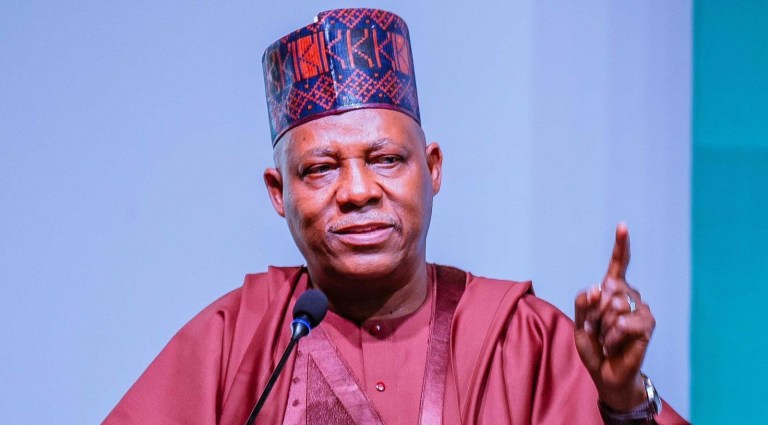
Vice President Kashim Shettima has disclosed that the ongoing comprehensive economic restructuring programme of the President Bola Tinubu’s administration is rebuilding the pillars of Nigeria’s economy every state of the federation can depend on.
He identified the outcome of the restructuring, aimed at reducing subnational dependence on the federal government, largely through fiscal reforms and increased allocations to states, as energy reliability, fiscal balance, tax reform, and a single digital gateway for investment, among others.
Shettima, who spoke on Wednesday in Lafia during the Nasarawa Investment Summit 2026, noted that the ongoing transformation of subnational economies into stronger and more viable entities justifies the choice of states as the focal point of the reform agenda of the Tinubu administration.
According to him: “At the national level, we are rebuilding the pillars every state depends on: energy reliability, fiscal balance, tax reform, and a single digital gateway for investment. The ongoing power-sector reforms are opening new paths for state participation.
“Federal projects connected to the Ajaokuta-Kaduna-Kano gas pipeline and the Abuja industrial corridor will complement Nasarawa’s Gas Master Plan and position this region as a critical energy hub”.
The Vice President said the administration’s decision is further supported by the fact that “all over the world, nations that move fastest are powered by strong federating units and Nigeria is embracing that truth as our subnationals are becoming centres of enterprise, policy innovation, and industrial energy.”
He explained that through the reforms undertaken by the Tinubu administration, states “now have greater room to think, to build, to invest, and to respond to the needs of their people with renewed confidence.”
Shettima said the new compact being built between Abuja and the 36 states of the federation is such “that rewards fiscal discipline, competitiveness, and the courage to reform,” adding that Nasarawa State has earned its place at the forefront of that movement.
Observing that the theme of the Summit could not be more timely, the Vice President said bold transitions are a remind that “development must be transferred from one generation of leadership to the next without rupture,” even as “policy continuity is the soul of investment.”
On the “Lafia Declaration” signed at the Summit, Shettima tagged the pact as ‘an economic covenant, a public assurance that Nasarawa’s progress will outlive elections and endure beyond personalities.”
Speaking further on the gains of the economic reforms, the Vice President said, confidence was returning to the marketplace as “Capital inflows rose from 12.32 billion dollars in 2024 to 23.22 billion dollars in 2025, while the equity market returned 51.19 percent in 2025, with market capitalisation reaching 99.38 trillion naira.
“Investors are beginning to read Nigeria again as a country willing to correct itself, a country prepared to take difficult decisions in defence of its future. Capital follows credibility, stability, and direction.”
Earlier, the Governor of Nasarawa State, Abdullahi A. Sule, explained that the summit was aimed at reinforcing investors confidence by emphasising the continuity of policy, stability of institutions and productability of governance.
Also, Minister of Budget and Economic Planning, Senator Abubakar Bagudu, noted that reforms are not static because the world is evolving and changing daily. This, he pointed out, is the paradigm on which the Renewed Hope Agenda was framed, even as he applauded the wisdom of President Tinubu and Vice President Shettima, for managing the economic disruption.
On her part, Minister of Industry, Trade and Investment, Jumoke Oduwole, said over the last two years, the Tinubu administration undertook bold economic reforms to stabilise the economy.
Managing Director of Nasarawa Investment and Development Agency (NASIDA), Ibrahim Abdullahi also said the agency has attracted over $2 billion investment into the state, adding that the summit was organised to ensure investment inflows to the state.