


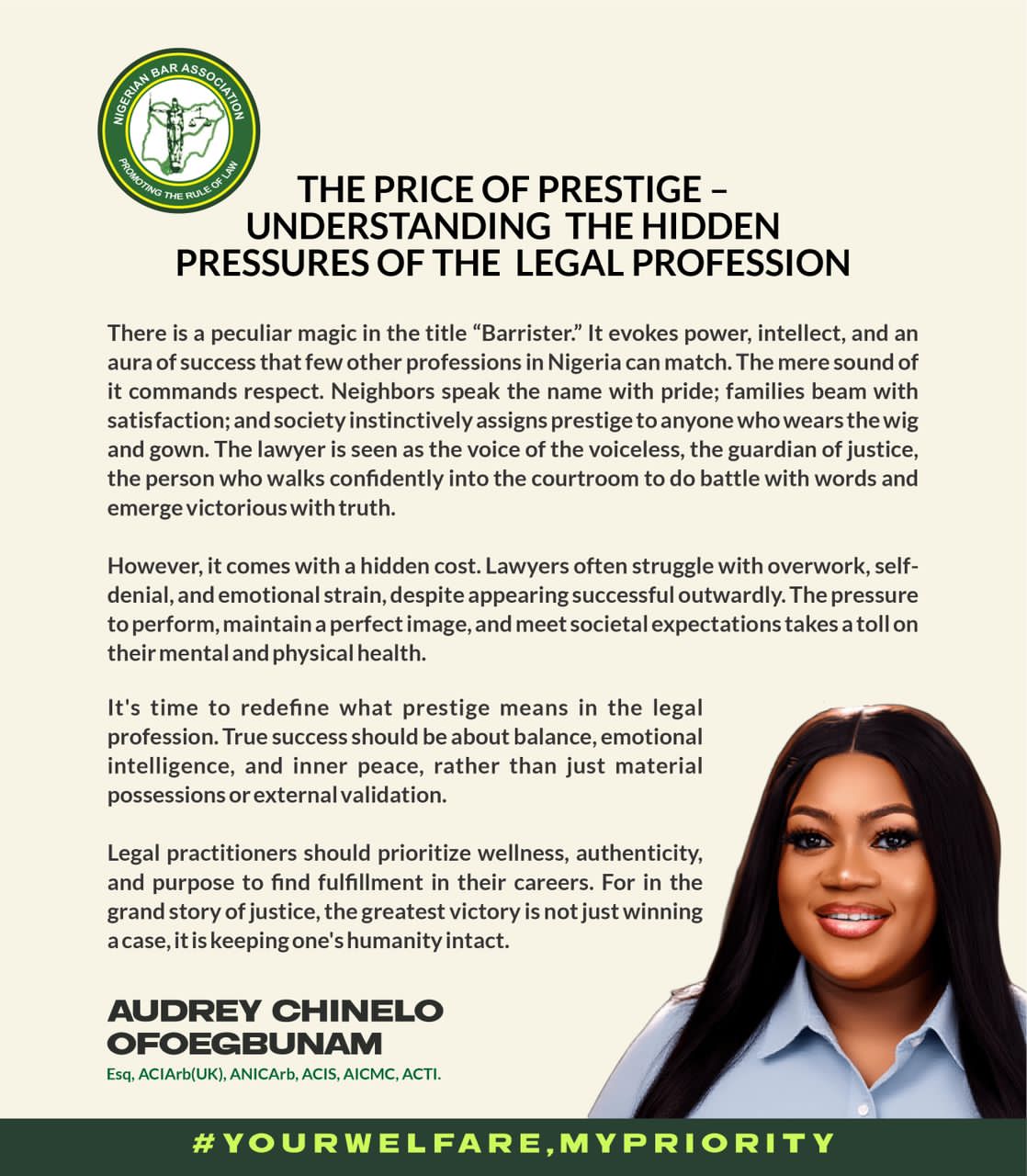
By Chinelo Audrey Ofoegbunam
Introduction
There is a peculiar magic in the title “Barrister.” It evokes power, intellect, and an aura of success that few other professions in Nigeria can match. The mere sound of it commands respect. Neighbors speak the name with pride; families beam with satisfaction; and society instinctively assigns prestige to anyone who wears the wig and gown. The lawyer is seen as the voice of the voiceless, the guardian of justice, the person who walks confidently into the courtroom to do battle with words and emerge victorious with truth.
From the crisp black robes to the sharp diction and poised demeanor, everything about the lawyer’s appearance seems to spell confidence. In public imagination, lawyers live comfortably, argue brilliantly, and move through life with effortless sophistication. They are the ones who seem to know everyone, understand everything, and always have the right thing to say.
But beneath that polished exterior lies a quieter, heavier reality — one rarely discussed outside the profession. Behind the air of prestige is a deep, unspoken pressure to constantly be that image — to live up to the myth that society has created around the law. For every lawyer who wins a high-profile case or earns public praise, there are many more who go home to sleepless nights, self-doubt, and a silent battle with exhaustion.
The truth is that the prestige of the legal profession often comes at a price. Beneath the surface of honor and admiration exists a culture of overwork, competition, and self-denial that few outsiders understand. Lawyers are trained to be articulate but not emotional, brilliant but not vulnerable, tireless but never tired. The same qualities that earn them respect — discipline, precision, composure — can also become their chains.
In Nigeria, where success is loudly celebrated, the lawyer becomes a symbol of aspiration. Yet that same symbol becomes a cage. The pressure to appear successful, even when struggling, can be suffocating. Many lawyers spend their days advocating for justice while quietly neglecting their own peace of mind. They attend to clients’ crises while suppressing their own. They stand tall before judges, even when weighed down by fatigue or financial strain.
To be a lawyer in such an environment is not merely a profession — it is a performance. Every courtroom appearance, every client meeting, every social interaction reinforces the expectation to be flawless, informed, and in control. And yet, beneath the robe and wig, there are human hearts beating — hearts that ache, worry, and sometimes break under the unrelenting demands of prestige.
The irony is profound: a profession built on the pursuit of justice often overlooks the well-being of those who serve it. The lawyer is expected to be the defender of rights, yet must often fight alone for their own sense of balance and fulfillment. Behind the dignified smiles and carefully chosen words lies a world of unspoken strain — the pressure to live up to the title, the weight of expectations, and the fear of not being enough.
To wear the wig is to wear history, honor, and responsibility. But it is also to carry an invisible burden — the need to always stand upright even when the soul bends under the strain. The legal profession is, indeed, noble. But within its nobility lies a quiet truth: sometimes, the weight of the wig is heavier than the pursuit of justice itself.
1. The Illusion of Success – What the Public Doesn’t See
From the outside looking in, the life of a lawyer glitters with the shine of success. The commanding tone, the eloquence, the fine suits, and the poised confidence in courtrooms — all create an image of someone who has it all figured out. To the casual observer, lawyers are the embodiment of achievement: articulate, intelligent, and financially comfortable. Parents beam with pride when introducing their children as lawyers; clients assume that anyone who speaks so confidently in court must be rolling in wealth; and young law students dream eagerly of the day they, too, will don the black robe and bow before the bench.
But beneath that glossy surface lies a reality that rarely matches the myth. Many lawyers, especially those still finding their footing, are quietly fighting battles that the public never sees. Behind the sharp suits are bills left unpaid. Behind the polite smiles are nights without sleep. Junior lawyers work tirelessly — long hours in chambers, endless days in court — often earning stipends that barely cover transportation and lunch. Some go months without pay, told that “the experience” is the reward. Yet, they dare not complain for fear of being branded lazy, ungrateful, or unfit for the profession.
Even senior lawyers are not immune. The big cases that attract media attention are only a fraction of their workload. Many endure months of unpaid retainers, clients who vanish after winning their cases, or corporate firms that delay legal fees indefinitely. The glamour of the courtroom often hides the grinding uncertainty of income.
The greatest irony is that while lawyers are trained to expose the truth in others, they are conditioned to conceal their own struggles. The pressure to maintain appearances — to look successful, no matter the reality — is immense. Many lawyers stretch themselves financially just to keep up with the image of success: the car to match the title, the suit to fit the reputation, the social presence to sustain the illusion.
The emotional cost is profound. Behind every confident lawyer at a seminar, every smiling face in a group photograph, there might be someone battling self-doubt, debt, or despair. Yet, the culture of the profession allows no room for vulnerability. Lawyers must always appear unshaken — as if failure, fatigue, or frustration are foreign concepts.
In the world of law, confidence is currency, and weakness is a liability. And so, many learn to perfect the art of appearing composed even when they are falling apart inside. It is a silent performance that earns applause but drains the soul — a theatre of strength played out daily in courtrooms and chambers across Nigeria.
The public sees the robes, but not the sacrifices. They hear the arguments, but not the quiet sighs of exhaustion after court. They admire the title but know little of the toll it takes to carry it. Behind the illusion of success lies a profession where prestige and pressure are two sides of the same coin — one polished for display, the other hidden in shadows.
2. The Pressure to Perform – When Excellence Becomes Exhaustion
The practice of law has always demanded excellence — but somewhere along the line, excellence became synonymous with exhaustion. From the very first day of law school, lawyers are conditioned to chase perfection. They learn quickly that mistakes are unforgivable, hesitation is costly, and reputation is everything.
Courtroom advocates spend nights poring over authorities, terrified of missing a single precedent that could tilt the case against them. Corporate lawyers sit hunched over contracts till dawn, haunted by the thought that one overlooked clause could cost a client millions. Each error avoided feels like survival; each success, merely a delay before the next test. The work never truly ends — only pauses for the next deadline, the next call, the next demand for brilliance.
It is a world where vulnerability is weakness and rest feels like rebellion. Lawyers push through illness, skip meals, and ignore fatigue, driven by an unspoken creed: always deliver. To admit exhaustion is to risk being seen as unfit. To slow down is to fall behind. The result is a profession where burnout masquerades as dedication and stress is worn like a badge of honor.
This unrelenting drive, though rooted in ambition, often backfires. The same zeal that fuels success can quietly drain joy and purpose. Passion turns into pressure; motivation morphs into anxiety. Lawyers begin to equate their worth with productivity, believing that every moment not spent working is wasted. The chase for excellence becomes an endless race with no finish line.
What makes this even more insidious is that much of the pressure comes not from superiors or clients — but from within. Lawyers are their own harshest critics, their own unyielding judges. They set impossibly high standards for themselves, convinced that their value lies only in constant achievement. It is not enough to be competent; they must be exceptional, flawless, irreplaceable.
Yet, perfection is a mirage — one that keeps moving just beyond reach. And as lawyers strive to attain it, they often sacrifice what truly sustains them: rest, joy, and self-compassion. Over time, the profession’s greatest strength — its discipline — becomes its most dangerous weakness.
The tragedy of the modern lawyer is not that they lack skill or passion, but that they forget they are human. The law demands intellect and stamina, yes — but not martyrdom. True excellence is not found in endless labor but in balance: the ability to serve justice without losing oneself in the process.
3. The Social Burden – When Prestige Becomes a Prison
For many Nigerian lawyers, the pressures of the profession extend beyond the courtroom or office — they seep into personal and social life. The title “Barrister” comes with unspoken expectations. Society expects the lawyer to be eloquent at every event, knowledgeable on every issue, and financially buoyant at every turn.
Family members assume you can solve all their legal and financial problems. Friends expect you to “dash” advice for free. Clients believe that a lawyer’s time is infinite, and their patience, boundless. Even within professional circles, lawyers compare one another’s successes — the number of cases won, the luxury cars owned, the scale of their offices.
It becomes a silent competition, where worth is measured by external symbols rather than internal fulfillment. The prestige that once motivated many to join the profession slowly becomes a prison of expectations. Lawyers begin to curate their lives for public approval — attending every event, posting victories online, and hiding their struggles for fear of appearing weak.
The result? A growing number of lawyers living double lives — successful on paper but emotionally detached, exhausted, and spiritually unfulfilled.
4. The Emotional Cost – The Unspoken Side of Prestige
Law is a profession of intellect, but it is also one of empathy. Lawyers constantly absorb the pain, conflicts, and secrets of others. They defend the accused, console the grieving, and mediate between families torn apart by disputes. Over time, this emotional labor accumulates, leaving little room for personal healing.
In Nigeria, where mental health is still stigmatized, few lawyers seek help. They carry their burdens alone, often drowning them in silence, caffeine, or overwork. Depression and burnout lurk behind many successful faces, but the professional culture rewards endurance, not openness.
The irony is that the very qualities that make a lawyer effective — logic, composure, and resilience — are the same ones that can make them suffer in silence. The pressure to remain “in control” keeps many from admitting when they are overwhelmed.
The true cost of prestige, therefore, is often invisible — measured not in naira or fame, but in missed family moments, sleepless nights, fading friendships, and declining health.
5. Redefining Prestige – Toward a Healthier Professional Culture
It is time to challenge the old definitions of success in the legal profession. Prestige should not be measured by the number of cases handled, the size of one’s office, or the price of one’s suit. True prestige lies in balance — the ability to achieve professional excellence without losing one’s humanity.
Lawyers must learn to see wellness as part of competence. A healthy lawyer is a more effective lawyer — one who thinks clearly, argues persuasively, and relates empathetically with clients. Law firms and chambers can contribute by promoting humane workloads, fair pay, mentorship, and mental health awareness.
Equally important is a shift in mindset. The younger generation of lawyers must understand that fulfillment is not found in imitation but in authenticity. You do not have to look like someone else’s version of success to be worthy of respect.
The next frontier of legal prestige is not material — it is emotional intelligence, adaptability, and inner peace.
Conclusion
Prestige, when stripped of its glitter and illusion, is not about titles, robes, or applause — it is about purpose. True prestige is quiet. It is found in integrity, in resilience, in the ability to serve with compassion even when no one is watching. The lawyer who learns to balance intellect with empathy, ambition with integrity, and service with self-care is the one who truly embodies the nobility of the profession.
The truth is that the law will always be demanding. There will always be deadlines to chase, judgments to prepare for, clients to calm, and targets to meet. The weight of responsibility that comes with advocacy cannot be wished away. But prestige must never come at the cost of peace. It is not strength to suffer in silence; it is courage to acknowledge one’s limits. It is not weakness to rest; it is wisdom to recharge.
Somewhere along the way, the legal profession taught its members that self-denial was the price of excellence. That belief has robbed many lawyers of the joy that once drew them to the profession in the first place. The calling to serve justice should not require sacrificing one’s mental health, family, or sense of self. The true mark of a successful lawyer is not just how many cases they win, but how whole they remain in the process.
It takes courage — profound, quiet courage — to step back and say, “I am more than my work.” It takes strength to choose balance in a profession that glorifies exhaustion. And it takes wisdom to recognize that one’s humanity is not a hindrance to professionalism, but its deepest foundation. For what good is it to fight for justice if one loses personal peace in the process?
The lawyers who will define the future are not those who burn out for prestige, but those who redefine it. They will see success not as endless toil, but as meaningful impact. They will measure worth not by the size of their chambers, but by the steadiness of their spirit. They will understand that true prestige lies not in being admired, but in being authentic.
So, as the gavels fall and the robes are worn, may every lawyer remember this: you are not just a voice in the courtroom, but a human being with dreams, fears, and the right to rest. Prestige should uplift, not imprison. It should inspire excellence, not exhaust the soul.
At the end of the day, when the arguments are over and the crowds have gone, what remains is not the echo of applause but the quiet assurance that one has lived with purpose, practiced with compassion, and stayed true to oneself. For in the grand story of justice, the greatest victory is not just winning a case — it is keeping one’s humanity intact.
X: CIAO Legal
LinkedIn: Chinelo Audrey Ofoegbunam
Instagram: CIAO Legal
Facebook: Chinelo Ofoegbunam