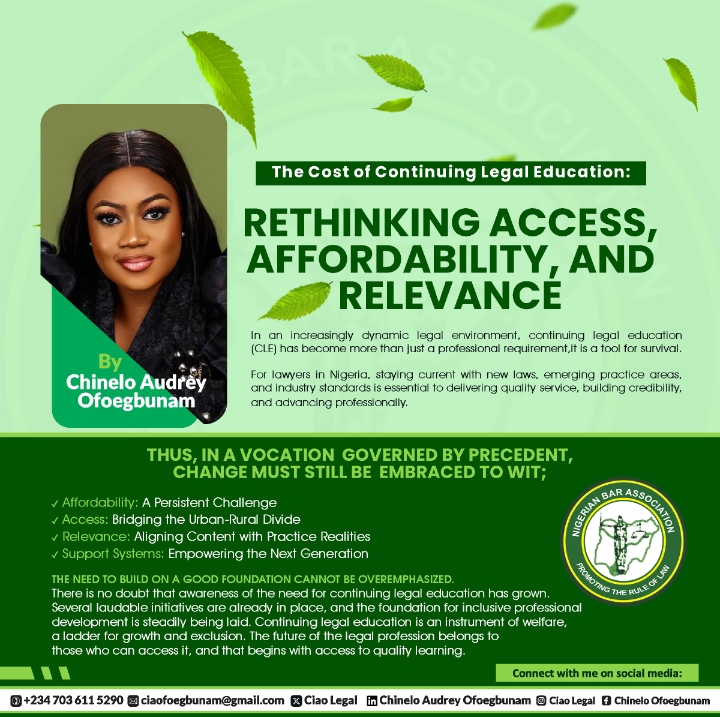
By Chinelo Audrey Ofoegbunam
In an increasingly dynamic legal environment, continuing legal education (CLE) has become more than just a professional requirement, it is a tool for survival. For lawyers in Nigeria, staying current with new laws, emerging practice areas, and industry standards is essential to delivering quality service, building credibility, and advancing professionally.
Encouragingly, strides have already been made toward expanding access to legal training across the country. Workshops, legal summits, and refresher courses have been organized in many jurisdictions, helping lawyers stay connected with new legal trends and reforms. These efforts, particularly in partnership with private educators and public institutions, are commendable and show a growing recognition of knowledge as a pillar of welfare.
Yet, despite these advances, significant gaps remain.
Affordability: A Persistent Challenge
For many lawyers — especially those just starting their practice or working in low-income regions, the cost of CLE could be a barrier. Between registration fees, transportation, accommodation, and work disruption, attending a single training session can be financially overwhelming.
Efforts have been made to introduce subsidized or discounted programs, but scaling this across all regions and income brackets is still a work in progress.
Enhancement Opportunity:
We may need to introduce flexible payment plans, micro-learning bundles, or sponsorship slots (especially for young and rural-based practitioners). A scholarship model, either merit-based or need-based, could create a more inclusive educational landscape.
Access: Bridging the Urban-Rural Divide
The concentration of CLE opportunities in major cities creates uneven access. Lawyers in less-developed regions often miss out on training simply because events are held far from their base or because internet infrastructure makes virtual participation unreliable.
Digital platforms and e-learning portals have emerged in some zones, but there’s room to improve their reach, affordability, and consistency.
Enhancement Opportunity:
Develop a hybrid model that includes physical training in underserved areas alongside a lightweight digital platform that works well even on low-bandwidth mobile devices. Recorded sessions, podcasts, and offline-access materials can further bridge the gap.
Relevance: Aligning Content With Practice Realities
The legal profession is evolving, and CLE content must reflect this. Recent sessions have begun to address modern issues like fintech regulation, Anti-Money Laundering, cyber law, digital rights, and this shift deserves commendation. However, many sessions still lean heavily on broad theory without deep dives into the practical challenges lawyers face daily.
Enhancement Opportunity:
Workshops should be more tailored to specific areas of practice; property law, criminal litigation, startup advisory, public interest law, etc. Including modules on client management, mental health, law firm business strategy, Artificial intelligence and law, ESG compliance, and legal technology and Tax law would further enrich the experience.
Support Systems: Empowering the Next Generation
Mentorship, peer learning groups, and firm-level support for CLE participation are on the rise, particularly in some urban centers. These structures are crucial in ensuring that knowledge is not only acquired but applied. They also offer emotional and professional encouragement in a high-pressure field.
Enhancement Opportunity:
We need to formalize peer-led CLE study circles or regional learning hubs that allow lawyers to support one another through collaborative learning, mock trials, or joint research sessions. These grassroots initiatives can complement formal training and build a stronger community.
Conclusion: Building on a Good Foundation
There is no doubt that awareness of the need for continuing legal education has grown. Several laudable initiatives are already in place, and the foundation for inclusive professional development is steadily being laid.
What is needed now is scale, sustainability, and sensitivity to local realities. Knowledge must not be locked behind paywalls or urban borders. It should be accessible to every lawyer, regardless of location, age, or level of practice.
With the right support and innovation, continuing legal education can become not just a pathway to professional excellence but a true pillar of welfare for lawyers across Nigeria.
Connect with me on Social Media:
X: CIAO Legal
LinkedIn: Chinelo Audrey Ofoegbunam
Instagram: CIAO Legal
Facebook: Chinelo Ofoegbunam