


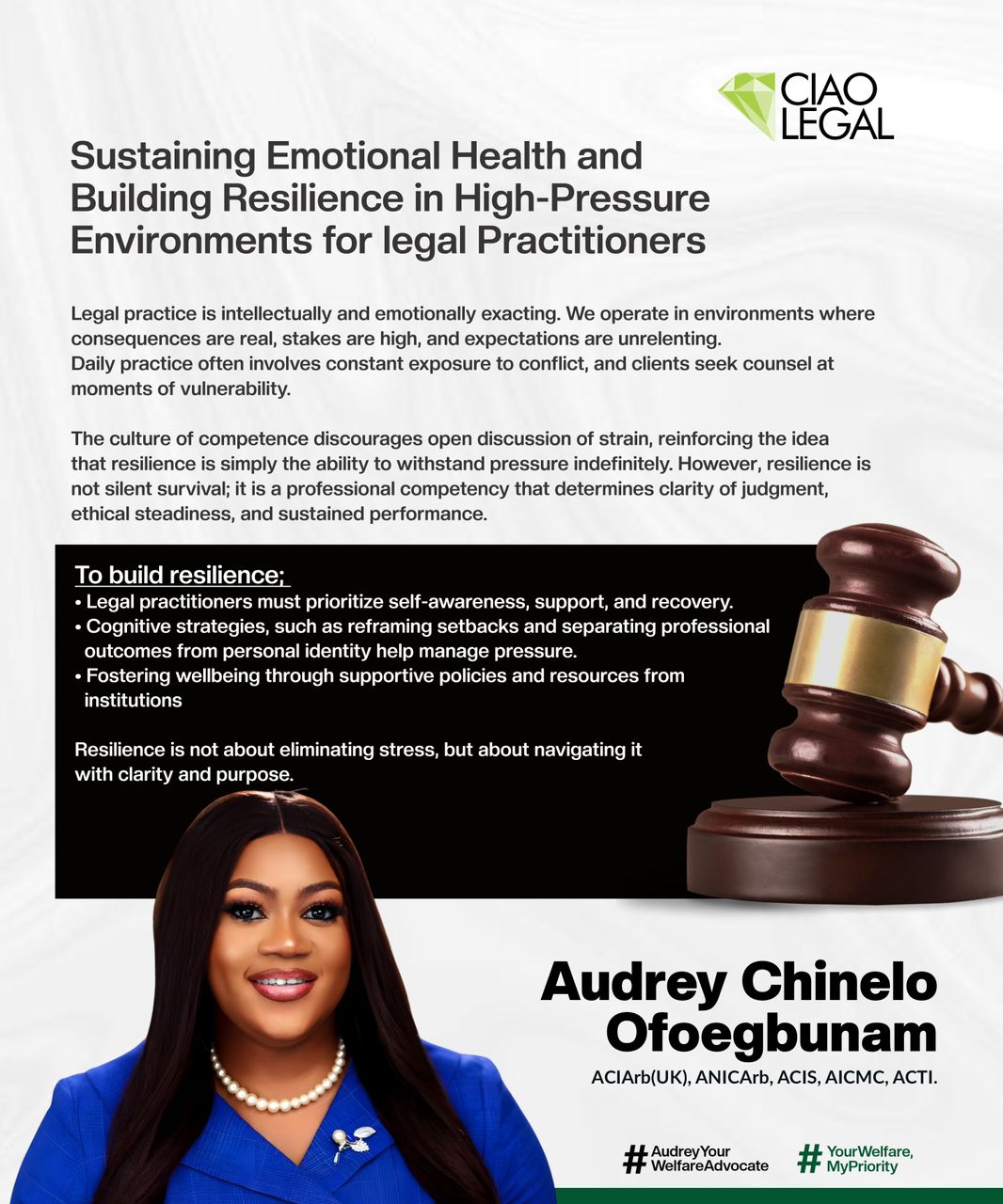
By Chinelo Audrey Ofoegbunam
Introduction
Legal practice is intellectually demanding, but it is also emotionally exacting. Beneath the visible structure of filings, arguments, and advisory opinions lies a psychological weight that is rarely acknowledged openly. Lawyers operate in environments where consequences are real, stakes are high, and expectations are unrelenting.
Daily practice often involves constant exposure to conflict. Litigation, negotiation, regulatory enforcement, and even transactional work frequently revolve around disagreement, urgency, and risk. Clients seek counsel at moments of vulnerability—when businesses face uncertainty, families experience distress, or individuals confront liberty or livelihood concerns. The lawyer absorbs not only legal facts, but emotional intensity.
Yet conversations about emotional health remain muted within the profession. Strength is often equated with endurance. Composure is mistaken for invulnerability. The culture of competence discourages open discussion of strain, reinforcing the idea that resilience is simply the ability to withstand pressure indefinitely.
Resilience, however, should not be framed as silent survival. It is a professional competency—one that determines clarity of judgment, ethical steadiness, and sustained performance. Emotional health is not a personal luxury reserved for quieter seasons; it is foundational to responsible legal practice. Recognizing this shifts the conversation from individual weakness to institutional awareness and proactive care.
1. Understanding Emotional Strain in Legal Practice
Emotional strain in legal practice is often cumulative rather than dramatic. It builds quietly through chronic stress: demanding deadlines, congested court schedules, and clients who expect immediate resolution in inherently complex matters. The adversarial structure of many legal processes intensifies this pressure.
Lawyers are trained to advocate forcefully, but sustained exposure to opposition can gradually erode emotional equilibrium.
Exposure to trauma further compounds the burden. Cases involving violence, family breakdown, financial collapse, or reputational harm place lawyers in close proximity to distressing narratives. Even in commercial practice, high-stakes disputes may carry significant financial or reputational consequences. The emotional residue of these matters does not disappear when the file closes.
Performance pressure adds another layer. The profession demands precision. An overlooked clause, a missed deadline, or a misjudged argument can carry serious consequences. The fear of error—particularly for young practitioners—creates a persistent undercurrent of anxiety. Success becomes not merely a goal, but a perceived obligation.
Over time, unaddressed stress accumulates. What begins as manageable tension may evolve into emotional exhaustion, irritability, or detachment. Without conscious recovery practices, the strain becomes normalized, embedded in daily routine.
Understanding this progression is essential. Emotional fatigue is not a sign of inadequacy; it is a predictable response to sustained high-pressure environments. Recognizing the sources of strain is the first step toward designing systems—and habits—that promote resilience rather than depletion.
2. Recognizing the Early Warning Signs of Burnout
Burnout rarely announces itself dramatically. It often begins subtly—with fatigue that feels routine, irritability that seems situational, or a growing detachment that is easy to rationalize as professional maturity. Because legal practice is inherently demanding, early warning signs are frequently dismissed as ordinary occupational strain.
Emotional exhaustion is often the first indicator. Tasks that once stimulated intellectual engagement begin to feel burdensome. Patience shortens. Concentration wanes. Lawyers who previously approached complex problems with curiosity may begin to approach them with quiet dread.
Cynicism can follow. Clients are perceived less as individuals in need and more as sources of pressure. Opposing counsel become irritants rather than professional counterparts. Court delays feel less like procedural realities and more like personal affronts. This shift in perspective signals depletion rather than resilience.
Professional satisfaction may also decline. Achievements that once felt meaningful begin to feel procedural. Motivation diminishes, not necessarily because ambition has disappeared, but because emotional energy has been depleted. The sense of purpose that drew many into the profession can feel distant.
Physical symptoms often accompany these changes. Persistent fatigue, insomnia, headaches, muscle tension, and difficulty relaxing are common manifestations of chronic stress. The body frequently registers strain before it is consciously acknowledged.
The greatest risk lies in normalization. When chronic stress is accepted as “part of the job,” warning signs are ignored. The culture of endurance may even reward overextension, reinforcing unhealthy patterns. Over time, unaddressed burnout can impair judgment, ethical clarity, and personal relationships.
Recognizing early signs is therefore an act of professional responsibility. Awareness allows intervention before exhaustion becomes entrenched.
3. Redefining Resilience in the Legal Context
Within legal culture, resilience is often equated with toughness—the ability to absorb pressure without visible reaction. Yet endurance alone is not sustainable. True resilience is not the absence of strain; it is the capacity to recover, recalibrate, and continue with clarity.
Redefining resilience requires shifting from passive endurance to adaptive recovery. Instead of simply pushing through exhaustion, resilient practitioners assess strain and respond intentionally. They recognize limits, adjust strategies, and incorporate recovery practices into their routines.
Emotional regulation is central to this reframing. The ability to acknowledge frustration without reacting impulsively, to process disappointment after an adverse ruling, and to remain composed under provocation reflects cultivated skill. Self-awareness allows lawyers to identify stress triggers and respond constructively rather than reflexively.
Resilience can be developed. Like legal analysis or advocacy, it improves with deliberate practice. Techniques such as reflective journaling, structured debriefing after significant cases, mindfulness exercises, and boundary-setting contribute to emotional steadiness. Professional growth includes learning not only how to argue effectively, but how to sustain oneself emotionally.
Balancing strength with vulnerability further strengthens resilience. Acknowledging uncertainty or seeking support does not diminish professionalism; it reinforces it. When lawyers allow space for honest reflection, they prevent strain from accumulating unchecked.
Resilience, properly understood, is not silent suffering. It is an intelligent adaptation. It allows lawyers to maintain competence and integrity without sacrificing emotional health. In redefining resilience, the profession moves closer to sustainability rather than mere survival.
4. Daily Micro-Practices for Emotional Stability
Resilience is not built only during major crises; it is cultivated in daily habits. Small, consistent practices—what may be called micro-practices—create emotional stability over time. In a profession defined by urgency, intentional structure becomes protective.
Structured work routines provide psychological anchoring. Beginning the day with a prioritized task list, allocating realistic time blocks for drafting or research, and anticipating likely interruptions reduce reactive stress. When lawyers move through the day with intentional sequencing rather than constant improvisation, cognitive overload diminishes.
Realistic scheduling is equally important. Overcommitting to deadlines or accepting more matters than capacity allows may initially appear ambitious, but it gradually erodes performance and wellbeing. Sustainable productivity requires honest assessment of time and energy limits.
Mindfulness and stress-management techniques offer additional support. Brief breathing exercises before court appearances, short reflective pauses after difficult meetings, or even structured moments of stillness during the day can reset emotional equilibrium. These practices need not be lengthy; consistency matters more than duration.
Intentional breaks and recovery pauses are not indulgences, they are strategic. Stepping away briefly after intense drafting or contentious negotiation allows the nervous system to recalibrate. Lawyers often remain in high-alert states for extended periods, but sustained activation impairs clarity and judgment.
Setting boundaries around accessibility further protects stability. While responsiveness is a professional virtue, perpetual availability can become unsustainable. Establishing defined communication windows, managing expectations with clients, and safeguarding limited personal time reinforce long-term effectiveness. Boundaries, when communicated respectfully, enhance rather than diminish professionalism.
Daily micro-practices do not eliminate stress. They regulate it. Over time, these small disciplines create a buffer against emotional depletion.
5. Cognitive Strategies for Managing Pressure
How lawyers interpret events often shapes emotional outcomes as much as the events themselves. Cognitive strategies—deliberate ways of thinking—play a central role in managing professional pressure.
Reframing setbacks is one such strategy. An adverse ruling, lost client, or failed negotiation can easily be internalized as personal failure. Yet legal outcomes are influenced by multiple variables beyond individual control. Viewing setbacks as data for refinement rather than definitive judgments preserves perspective. Reflection becomes instructive rather than punitive.
Separating professional outcomes from personal identity is equally critical. When success becomes the sole measure of worth, each loss feels existential. Healthy detachment allows lawyers to remain committed without becoming consumed. Competence involves effort and preparation; outcomes remain partially contingent.
Constructive self-talk reinforces resilience. The internal dialogue that follows mistakes often determines recovery speed. Replacing self-criticism with measured evaluation “What can be improved?” rather than “I am inadequate” supports growth. Lawyers are trained to scrutinize arguments rigorously; applying similar fairness to oneself strengthens stability.
Avoiding perfectionism as a default standard also reduces unnecessary strain. The pursuit of excellence is commendable, but perfectionism can become paralyzing. When minor imperfections are interpreted as unacceptable, stress intensifies and efficiency declines. Sustainable practice prioritizes high standards while acknowledging practical constraints.
Cognitive discipline is as important as technical skill. By consciously shaping interpretation and response, lawyers reduce the emotional volatility of high-pressure environments. Pressure may remain constant, but perspective becomes steadier.
6. The Role of Physical Health in Emotional Resilience
Emotional resilience is inseparable from physical wellbeing. The mind does not operate independently of the body; sustained psychological pressure inevitably manifests physiologically. Lawyers who neglect foundational health habits often find emotional regulation increasingly difficult, regardless of intellectual capability.
Sleep is one of the most critical supports. Chronic sleep deprivation impairs concentration, decision-making, and emotional stability. In a profession that prizes responsiveness and long hours, rest is often sacrificed first. Yet reduced sleep heightens irritability and anxiety, weakening the very composure required in courtrooms and negotiations.
Nutrition and hydration similarly affect cognitive performance. Irregular meals, excessive caffeine, and prolonged periods without nourishment can intensify stress responses. Balanced nutrition stabilizes energy levels, supporting clarity during long drafting sessions or extended hearings.
Regular physical activity further strengthens resilience. Exercise reduces stress hormones and improves mood-regulating neurotransmitters. Even moderate, consistent activity walking, stretching, or short workouts can recalibrate emotional equilibrium. Physical movement interrupts the sedentary patterns common in legal work and restores mental focus.
Understanding the physiological impact of chronic stress underscores the importance of these habits. Prolonged stress elevates cortisol levels, disrupts immune function, and increases vulnerability to fatigue and illness. Over time, unmanaged stress can translate into long-term health complications.
Creating sustainable health routines within demanding schedules requires intentionality. Scheduling exercise as firmly as client meetings, prioritizing sleep despite late-night tasks, and preparing meals thoughtfully are acts of professional discipline. These habits should not be framed as personal indulgences but as performance strategies.
Physical wellness enhances professional effectiveness. Clearer thinking, steadier emotional responses, and improved stamina directly support competent advocacy and sound judgment. In this sense, health is not separate from practice, it strengthens it.
7. Peer Support, Mentorship, and Professional Community
While individual practices are vital, resilience is rarely sustained in isolation. The legal profession can be competitive and demanding, but collegial relationships provide essential protection against emotional fatigue.
The presence of supportive peers creates psychological safety. Informal conversations after court sessions, shared reflections on challenging cases, and collaborative problem-solving remind lawyers that they are not alone in navigating complexity. These interactions normalize struggle and reduce internalized pressure.
Safe spaces for candid discussion are particularly important. In environments where vulnerability is perceived as weakness, stress becomes concealed. Professional communities—whether within firms, bar associations, or informal networks—can foster honest dialogue about setbacks, uncertainty, and emotional strain. Transparency reduces stigma and encourages mutual support.
Mentorship plays a central role in emotional anchoring. Beyond skill development, mentors provide reassurance during difficult periods. Hearing from experienced practitioners who have faced similar challenges reframes adversity as part of professional evolution rather than evidence of inadequacy.
Reducing isolation is especially critical in high-pressure or adversarial practice areas. Solo practitioners and young lawyers may be particularly vulnerable to isolation. Intentional networking, peer discussion groups, and structured mentorship initiatives mitigate this risk.
Community does not eliminate professional demands, but it distributes emotional weight. When lawyers feel connected rather than isolated, resilience becomes collective rather than solitary. In this way, professional relationships serve not only as networks of opportunity but as buffers against burnout.
8. Institutional Responsibility for Lawyer Well-being
While resilience involves personal habits and cognitive discipline, it cannot rest solely on individual effort. Legal institutions, law firms, chambers, public offices, and professional bodies shape the environments in which lawyers operate. Sustainable emotional health requires structural support.
Law firm policies play a decisive role in reducing unnecessary strain. Clear communication channels, realistic billing expectations, and transparent case allocation systems prevent avoidable overload. When work distribution is inequitable or unpredictable, stress intensifies unnecessarily.
Reasonable workload expectations and fair evaluation systems further protect wellbeing. Performance assessments that prioritize both quality and sustainability, rather than sheer volume, encourage healthy productivity. When excessive hours are implicitly rewarded, burnout becomes normalized. Institutions that emphasize efficiency, collaboration, and professionalism foster longer-term stability.
Access to mental health resources and counseling services should be treated as essential infrastructure rather than optional benefits. Confidential support systems allow practitioners to seek assistance without fear of stigma. Workshops on stress management, resilience training, and emotional regulation can further strengthen institutional culture.
Leadership modeling balanced behavior is perhaps the most powerful influence. When senior lawyers demonstrate healthy boundaries, take restorative breaks, and speak openly about wellbeing, they legitimize similar behavior among junior colleagues. Culture is shaped not only by policy, but by example.
Institutional responsibility does not eliminate pressure inherent in legal work, but it reduces preventable strain. Where organizations recognize wellbeing as integral to competence, resilience becomes embedded rather than improvised.
9. Recovery After Crisis or Professional Setback
No legal career is free from disappointment. Lost cases, client complaints, adverse judgments, reputational concerns, or professional missteps are inevitable at some stage. The critical question is not whether setbacks occur, but how recovery is managed.
The immediate aftermath of professional disappointment often includes self-doubt and heightened anxiety. Lawyers accustomed to high standards may internalize outcomes deeply. Without structured recovery processes, these experiences can linger and erode confidence.
Structured reflection transforms setback into instruction. Objective review—examining strategy, preparation, and uncontrollable factors—restores perspective. Reflection should be honest but not punitive. The goal is learning, not self-reproach.
In more severe situations, such as regulatory complaints or significant reputational challenges, seeking professional support becomes essential. Consulting trusted mentors, senior colleagues, or mental health professionals provides external grounding. Early intervention prevents emotional strain from compounding.
Turning setbacks into long-term growth requires reframing adversity as developmental. Many seasoned practitioners attribute their strongest professional lessons to early disappointments. When approached constructively, crisis clarifies values, strengthens preparation habits, and deepens professional humility.
Recovery is not automatic; it is intentional. Lawyers who cultivate structured recovery practices maintain momentum without carrying unresolved emotional burden forward.
10. Building a Long-Term Emotional Sustainability Plan
Emotional health should not be addressed only in moments of crisis. Sustainable practice requires long-term planning just as financial or career progression planning does.
Personal resilience audits offer a useful starting point. Periodic self-assessment examining workload balance, stress levels, sleep patterns, and overall satisfaction identifies emerging risks early. Honest reflection prevents gradual depletion from going unnoticed.
Aligning career choices with personal capacity and values further strengthens sustainability. Not every practice area suits every temperament. Recognizing individual strengths, tolerance for adversarial conflict, or preference for structured environments enables informed professional decisions. Career paths should support both ambition and emotional equilibrium.
Designing rest, renewal, and reflection into professional life is equally important. Scheduled vacations, professional development retreats, spiritual or reflective practices, and time with family or community restore perspective. Recovery should be planned, not postponed indefinitely.
Viewing emotional health as an ongoing investment reframes wellbeing from reactive repair to proactive maintenance. Just as legal knowledge requires continuing education, resilience requires continuous cultivation. Emotional sustainability is not static; it evolves with career stage and responsibility.
Conclusion
Emotional health is not separate from ethical and competent legal practice; it underpins it. Clear judgment, professional courtesy, and responsible advocacy depend on steady emotional regulation. When resilience erodes, so too can professional standards.
The profession often presents toughness and wellbeing as opposing forces. Yet this is a false dichotomy. True strength includes awareness, recovery, and recalibration. Endurance without renewal leads to depletion; resilience integrates both.
Prioritizing recovery as seriously as productivity is not a retreat from excellence, it is a safeguard for it. Lawyers who manage pressure constructively remain effective longer, serve clients more thoughtfully, and contribute more sustainably to the justice system.
A resilient lawyer is not one who never feels pressure, but one who knows how to recover, recalibrate, and continue with clarity. In cultivating resilience intentionally, the profession protects not only its practitioners, but the integrity of the legal system itself.
Connect with me on Social Media:
X: CIAO Legal
LinkedIn: Chinelo Audrey Ofoegbunam
Instagram: CIAO Legal
Facebook: Chinelo Ofoegbunam