


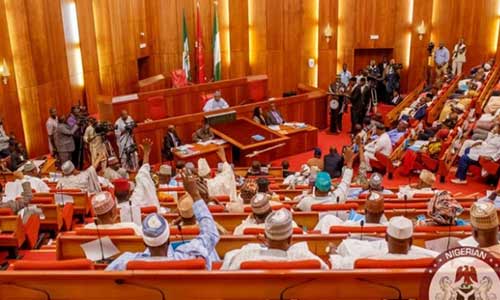
The Senate has commenced legislative work on the establishment of state police, with assurances that the proposed decentralised policing framework will include strong safeguards to prevent abuse by political actors.
Leader of the Senate, Senator Opeyemi Bamidele, disclosed this on Sunday, noting that the National Assembly was prioritising a model that would promote accountability while strengthening internal security across the federation.
He made the disclosure in a congratulatory message issued in Abuja to mark the 74th birthday of President Bola Tinubu, while also commending the administration’s efforts to stabilise the country’s security architecture.
Bamidele, who doubles as Vice Chairman of the Senate Committee on the Review of the 1999 Constitution, said the parliament “is committed to crafting a framework for a decentralised police model that will serve the interests of all regardless of their status.”
The move comes amid renewed calls by stakeholders for a decentralised policing system that reflects Nigeria’s federal structure and enhances the protection of lives and property, particularly in rural and underserved communities.
Tinubu has openly backed the proposal, while the Nigeria Police has already submitted a 75-page framework on state policing to the Deputy President of the Senate, Senator Barau Jibrin, for consideration by lawmakers.
In his remarks, Bamidele commended Tinubu for fostering collaboration with the National Assembly to tackle insecurity, noting that the administration was adopting non-traditional approaches to address the root causes of terrorism, extremism and violent crimes.
He said, “Tinubu has already lent his voice to the creation of a decentralised police model as part of measures to ensure the security of lives, private property and public installations across the federation.
“The essence of the model is to devolve policing powers to the sub-national authorities with a view to ensuring effective governance even in the remotest part of our land. This is one request that the National Assembly has been treating with priority.”
The Senate leader further assured all that the proposed framework would be anchored on accountability and global best practices to curb the misuse of security apparatus by political elites.
According to him, the model will integrate mechanisms to prevent abuse of power, strengthen the justice system, discourage impunity and safeguard fundamental human rights.
“All these initiatives are at the core of shared conviction, which the Presidency and National Assembly have been working on to secure Nigeria better,” Bamidele assured Nigerians that the framework would be anchored to accountability mechanisms and global best practices.
The proposed state policing structure is backed by a comprehensive framework submitted by the Nigeria Police, outlining a phased implementation plan and institutional safeguards.
In the 75-page document, the Inspector-General of Police, Tunji Disu, proposed a 60-month implementation roadmap, beginning with constitutional amendments within the first year and embedding strict measures to prevent political interference.
The proposal also recommends a redistribution of personnel, with about 60 per cent of existing police officers deployed to state commands, while 40 per cent remain under federal control.
Under the plan, Nigeria would operate a two-tier policing system comprising a Federal Police Service and 37 State Police Services, including the Federal Capital Territory.
While the federal police would retain responsibility for national security issues such as terrorism, interstate crimes and protection of federal assets, state police formations would handle localised offences, including armed robbery, homicide, domestic violence and community intelligence gathering.
Highlighting Tinubu’s leadership at 74, Bamidele credited the President with pursuing reforms aimed at economic stability and national cohesion.
The Ekiti senator also praised his longstanding commitment to Nigeria’s development, recalling his role as a pro-democracy advocate who fought alongside others to restore democratic governance.
Bamidele further cited key economic measures, particularly the administration’s macroeconomic reforms, which he said strengthened the naira, boosted foreign reserves from $35.09bn in May 2023 to $50.02bn in March 2026, and attracted increased foreign capital inflows—representing a 42.54 per cent rise in reserves.
The lawmaker added that the Tax Reform Acts, 2025, introduced by the Presidency, have also significantly reshaped Nigeria’s fiscal landscape through far-reaching reforms.
By this initiative, according to him, Nigeria’s fiscal landscape was comprehensively recalibrated, leading to no fewer than 111 per cent increase in statutory transfers to subnational governments, improved business environment and enhanced tax administration across all tiers of government.
He added that the reforms helped Nigeria avert a deepening liquidity crisis that could have led to insolvency.