


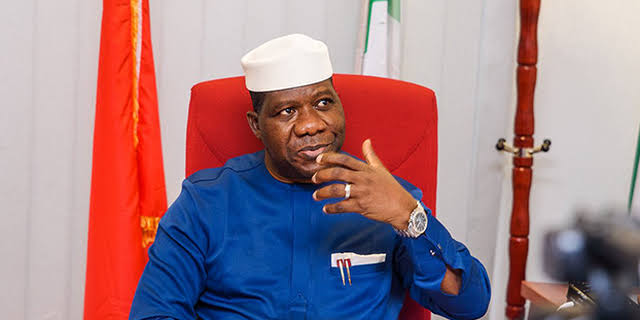
State Police may become legal latest by December, Senate Leader Opeyemi Bamidele declared yesterday.
To him, the idea has ‘moved from rhetoric to reality’.
The Ekiti Central senator said the National Assembly would transmit the Bill to President Bola Ahmed Tinubu for assent before December after concluding the remaining legislative processes on its alteration.
As at last night, 34 states had passed the Bill to ratify the Constitution amendment which paved the way for the removal of State Police from the Exclusive List to the Concurrent List in the Constitution. Only Abia and Katsina were yet to pass the proposed amendment.
Bamidele spoke while delivering a lecture titled: “Improving the efficiency and effectiveness of governance through proactive lawmaking” to participants of Senior Executive Course 48 at the National Institute for Policy and Strategic Studies (NIPSS), Kuru, Plateau State.
The Senate Leader, who doubles as Vice Chairman of the Senate Committee on the Review of the 1999 Constitution, described the development as a significant milestone in efforts to reform Nigeria’s security architecture.
He said: “We are pleased to inform our constituents across the federation that state police have moved from rhetoric to reality.
“We have already received formal reports from the state Houses of Assembly and, as of today, no fewer than 30 states have approved the State Police Constitution Alteration Bill, 2026.”
The assemblies in Bauchi, Jigawa, Sokoto states raised the tally of endorsements to 33 on Wednesday. Kano endorsed the Bill yesterday.
According to Bamidele, the approvals have satisfied the constitutional requirement under Section 9(2) of the 1999 Constitution, as amended, for at least two-thirds of state Houses of Assembly to support a constitutional alteration.
He explained that the National Assembly would collate the reports from the state legislature and pass a resolution by a simple majority in both chambers before transmitting the Bill to the President for assent.
“We have set a clear timeline for ourselves. We intend to conclude all these legislative stages — consideration of reports, passage of resolution, and transmission for presidential assent — on or before December 2026,” Bamidele said.
He described the proposed reform as a major step towards developing a policing system that responds more effectively to local security challenges.
“What this means is that state police is no longer a campaign promise or a subject of endless debate. It is now a constitutional reality,” he said.
He stressed that the reform was not intended to weaken the Federal Government but to strengthen the federation through community-based policing, supported by constitutional safeguards, operational standards, oversight mechanisms and human rights protections.
“It is not about creating state armies, but about creating state-led, community-anchored policing within clear constitutional safeguards,” the senator said.
He added that the National Assembly, under Senate President Godswill Akpabio, remained committed to completing the process.
“We will not falter until every Nigerian, whether in Kuru, in Iyin-Ekiti, in Gusau or in Yenagoa, can sleep with their eyes closed,” he said.
Bamidele also urged Nigerians to assess the National Assembly by the impact of its legislation on citizens rather than the number of bills passed.
He said proactive lawmaking required legislators to anticipate emerging challenges, address institutional weaknesses and create legal frameworks that support economic development and effective governance.
“The 10th National Assembly has passed strategic legislations that will positively impact the lives of Nigerians,” he said.
He cited the Student Loans (Access to Higher Education) Act, 2024; the Minimum Wage (Amendment) Act, 2024; the four Tax Reform Acts of 2025; and the National Social Investment Programme Act among the measures pursued by the current legislature.
Others, he said, included the Electoral Act, 2026, the Cybercrimes (Amendment) Act, the Investments and Securities Act, 2025, the Nigerian Insurance Industry Reform Act, 2024, and legislation establishing regional development commissions.
According to him, these measures demonstrate the role of proactive legislation in addressing national security, economic transformation, education, healthcare, electoral credibility and public financial management.
He, however, cautioned that passing laws was only one part of the governance process, stressing the need for effective implementation, monitoring and periodic review.
Bamidele said: “Good governance requires good laws. But good laws alone do not guarantee good governance. “We require laws that are relevant, evidence-based, implementable, adequately funded, properly administered, effectively monitored, periodically reviewed and ultimately measured by their impact on citizens.”
The Senate Leader called for stronger institutional collaboration between the National Assembly and NIPSS to improve legislative foresight, policy development and governance.
He commended the institute for bringing together professionals from the public sector, military, private sector, academia and other strategic institutions to examine national policy challenges.
Bamidele said the multi-disciplinary nature of NIPSS’s Senior Executive Course positioned the institute to contribute meaningfully to legislative research, strategic planning and evidence-based policy making.
He urged both institutions to deepen their partnership to ensure that legislation responds to emerging challenges and translates into measurable improvements in the lives of Nigerians.
The lecture was attended by the Chairman of the Senate Committee on Employment, Labour and Productivity, Diket Plang; Chairman of the Senate Committee on Tourism, Pam Dachungyang; Director-General of the NIPSS, Prof Ayo Omotayo; and former President of the Nigerian Institution of Estate Surveyors and Valuers, Chief Adekunle Alonge.