

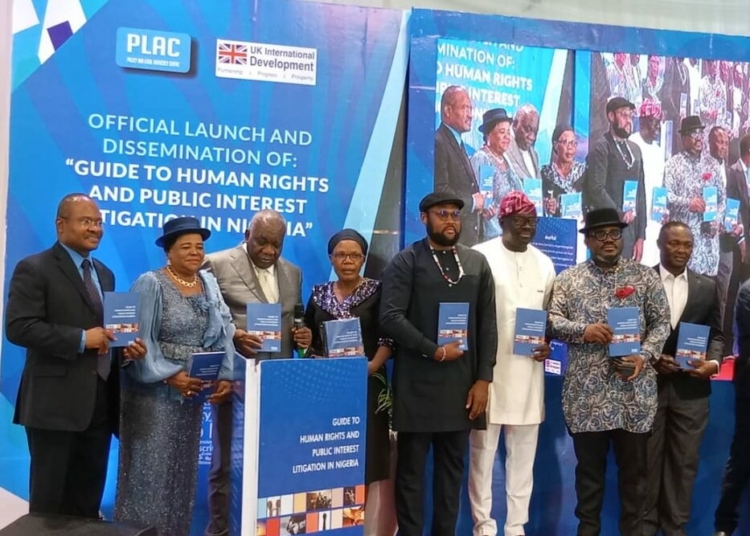
Stakeholders from the judiciary, legislature, Civil Society Organisations(CSOs) and activists, have called for increased access to justice for victims of human rights violation.
They made the call at the unveiling of “Guide to Human Rights and Public Interest Litigation in Nigeria” developed by the Policy and Legal Advocacy Centre (PLAC) with support from the UK Foreign, Commonwealth and Development Office(FCDO) in Abuja on Monday.
The Guide argued that although Nigeria has an extensive legal framework for the protection of human rights, including constitutional guarantees, statutory protections, and regional and international human rights obligations, the existence of legal rights does not always translate into effective remedies in practice.
It noted that barriers such as limited legal awareness, procedural complexity, cost of litigation, delays in the justice system and institutional constraints continue to hinder access to justice for many victims of human rights violation.
In his remarks, chairman of the occasion and Justice of the Supreme Court of Nigeria, Justice Emmanuel Agim emphasised the need for the promotion of constitutional rights, saying fundamental rights do not necessarily cover all constitutional rights.
Agim said without promoting constitutional rights or helping people understand them, the success of promoting fundamental rights may be affected.
He said; “for example, the right to vote is one of the most significant constitutional rights. Without it, many fundamental rights become meaningless.
“Its exercise must therefore be promoted, and the constitutional provisions guiding it must be observed and protected. It is constitutional rights that provide the proper foundation for the observance of fundamental rights.
“Some schools of thought may differ, but I speak from experience. Within constitutional rights are also social rights, which arise from the collective agreement to govern ourselves under the Constitution.
“I therefore urge that this noble initiative, which is already a tremendous success, should also include the promotion of constitutional rights.”
The Supreme Court Justice stated that the guide is a very useful initiative which virtually covered all the areas Nigerian courts have addressed.
He commended PLAC for the project, expressing confidence that as it continue to revise and expand the guide over time, the centre would increase its scope to include areas not yet covered.
Speaking in apparent response to the Supreme Court Justice, a human rights activists and former presidential candidate,
Omoyele Sowore decried a growing phenomenon in the country which he tagged ‘lawfare’ as opposed to ‘warfare’.
Sowore explained that lawfare is when those in power use law to wage war against public participation in democracy and such would be coming to the Supreme Court soon from “those who have been modelled by the government in power to prevent them from participating in democracy through their various parties.”
“The courts are strategically placed to prevent them from participating in the next election. One of the things I love about this is that I’m always the victim of lawfare and when I was given the book, I took a copy of the book, I looked at the part where you could actually file for bail.
“I’m always in police stations trying to get bail out of prison and it’s very important that you’ve done this. When I was growing up, I used to love a book called ‘Where There Is No Doctor. And to me, this is like where there is no lawyer. So that you can defend yourself,” he added.
For his part, chairman of the
House of Representatives Committee on Human Rights in Nigeria, Hon. Abiola Makinde reaffirmed the legislature’s commitment to the principles of democracy and the rule of law which guaranteed human rights.
He said the release of the Guide by PLAC marks a significant milestone in Nigeria’s collective journey towards strengthening access to justice.
“This guide ensures that its content is grounded in practical realities while the case law analysis provides a robust legal foundation for practitioners. Its national validation also reflects a consensus among key stakeholders.
“So, when we talk about empowering the pillars of society, this resource is not merely a document; it is a tool for institutional reform, designed to empower the judiciary and legal practitioners, who will definitely find this guide useful because it provides a clear roadmap for human rights litigation,” Makinde noted.
Giving an overview of the Guide, the executive director of PLAC, Clement Nwankwo said even though human rights are guaranteed in the Constitution, there continues to be abuse of them.
He said through the guide, PLAC seeks to equip practitioners, society actors, and citizens with the tools needed to use the law effectively to protect rights, challenge abuses and promote a more just and accountable society.
Nwankwo observed that one of the rights been talked about and considered in the ongoing Constitutional Review exercise is the right to freedom from indignity.
“If you notice, a lot of times people are arrested and they are paraded on TV and that’s the end of the case. If you watch around the country today, ask yourself how many people are paraded on TV that you ever see the trial happen. I don’t know any, really.
“So those are things that the amendments to the Constitution are saying, stop parading people, try them and if they are free, they are free. If they are convicted, they are convicted,” he said.
Nwankwo also observed that the right to privacy is one of the most abused rights that the country has today.
“If you are walking on the streets, or you are in a car, especially if you are in a public transport, and a policeman stops you and asks you to open your phone, open your bag, prying into your phone, forcing passwords out of you to open.
“These are things that shouldn’t happen in any civilised society but it happens on a frequent basis. So we’ve examined a lot of these rights, and like I said, what we have done is also articulate some process of seeking recourse using the Fundamental Rights Enforcement Procedure Rules,” he said.
Nwankwo added that the manual has a section where the format for filing a case is indicated.
“So if you’re not even a lawyer, you can just simply seek in the name of the applicants and of course, most times the respondents or the defendants are the same. Attorney General, the police, sometimes the Department of State Services, and so on are usually the respondents in these cases,” he stated.