

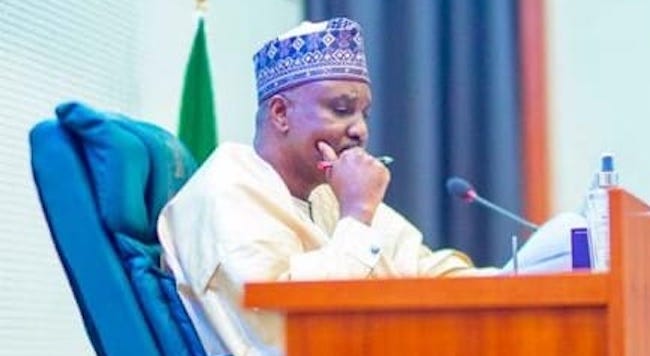
The Speaker of the House of Representatives, Tajudeen Abbas, has explained that the Green Chamber, under his leadership, has consciously chosen a path of dialogue over confrontation with the executive arm on critical national issues. This approach, he asserted, is rooted in the belief that confrontation ultimately “yields no dividends for Nigerians.”
Abbas articulated this strategic shift on Monday while delivering a guest lecture at the 5th Lecture series of the Nasarawa State University, Keffi.
“Under my leadership, the 10th House of Representatives has pursued a more balanced approach. Rather than reverting to subservience or open defiance, we emphasise dialogue, consensus, and inclusive leadership,” the Speaker said.
In his paper titled, ‘Legislating under pressure: The realities of lawmaking in Nigeria,’ the Speaker outlined key reforms being implemented within the 10th House. These include strengthening legislative caucuses, encouraging robust debates on contentious issues before plenary sessions, and cultivating a collegial atmosphere through open and frank discussions and peer mentoring.
“These efforts instil the values of informed participation, shared responsibility, and collective accountability,” he said, underscoring the benefits of their chosen methodology.
A statement signed by the Special Adviser to the Speaker on Media and Publicity, Musa Krishi, quoted Abbas as asserting, “This approach has helped preserve legislative autonomy while ensuring smoother budget processes.”
Abbas, however, was quick to emphasize that despite this collaborative stance, the House remains committed to “Amending or rejecting proposals that do not serve the public interest while also promoting policy coherence in an era of high public expectations and economic uncertainty.”
He further elaborated on the vision for the 10th House: “We are a more confident and forward-looking legislature that values both collaboration and independence. Through structured engagement, performance monitoring, and inclusive dialogue, the National Assembly is redefining its role as a partner in governance and a credible watchdog over the public purse.”
Drawing parallels with other democratic systems, the Speaker noted, “This approach, grounded in persuasion, fairness, and shared ownership, aligns with practices in other hybrid democracies such as South Africa, Canada, and India. By redefining party loyalty as principled coordination rather than blind conformity, the 10th House strengthens Nigeria’s legislative culture and lays the groundwork for a more stable, responsive, and inclusive democratic institution.”
A significant recommendation within the Legislative Agenda of the 10th House, according to the Speaker, is the establishment of a legal framework for constituency projects. He suggested this could take the form of a Constituency Development Fund, drawing insights from other jurisdictions like India and Kenya. This Fund, he explained, would allocate annual resources to each member, distributed based on publicly available criteria and subjected to independent audits.
“Such a fund would not only reduce ad-hoc demands on legislators but also enable them to focus on their core constitutional duties while ensuring that constituents benefit from clear and tangible support,” he said.
Abbas also championed the institutionalization of public participation as a core legislative function. Citing South Africa’s model, he noted that the House has adopted regular legislative town halls in each geo-political zone, with the one for the northern region scheduled for this Saturday in Zaria, Kaduna State.
He also advocated for the promotion of the public education system, stating, “I propose that we adopt South Africa’s model of a state-funded public education office to offer tours, multilingual learning materials, and regular provincial hearings. Plans are underway to expand televised plenaries beyond the current Thursday live transmission,” he posited.
To strengthen oversight functions, Abbas suggested structured collaboration with anti-corruption agencies such as the Economic and Financial Crimes Commission (EFCC) and the Independent Corrupt Practices and Other Related Offences Commission (ICPC). “We can emulate India by establishing formal joint working groups with relevant agencies. This will ensure that investigations are guided by intelligence and yield actionable outcomes,” he added.
To improve public perception of the legislature, Abbas proposed the establishment of a Legislative Communications Bureau staffed with professional media and social media experts, tasked with identifying misinformation and highlighting lawmakers’ contributions.
The Speaker concluded his lecture by acknowledging the inherent pressures faced by Nigerian lawmakers. “It is clear that legislating under pressure is not an abstract idea but a daily reality for Nigerian lawmakers. These pressures are rooted in the country’s political history, institutional limitations, and increasing public demands.” He further elaborated, “Legislators are expected to act as both national policymakers and local development agents, often compensating for inadequate local governance structures and addressing community needs. Representation in Nigeria entails a constant negotiation between constitutional duty and the immediate realities of public expectations.”
Drawing a comparative lesson, Abbas stated, “Comparative insights from countries such as India, Kenya, South Africa, Ghana, and the United States reveal that, while legislative pressure is a common feature of democratic systems, it can be effectively managed through robust institutions. These countries have adopted innovations such as audited constituency development funds, publicly funded constituency offices, educational outreach programmes, and clear rules that promote transparency and accountability. These practices offer valuable lessons for Nigeria to adapt to enhance legislative performance and foster public trust. The 10th House of Representatives has taken significant steps to address the pressures discussed through legislative reforms, enhanced transparency, improved public engagement, and a more structured approach to oversight and budgeting.”