


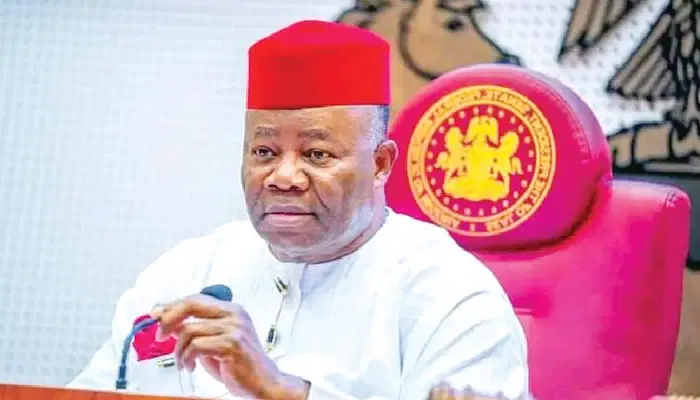
Senate President Godswill Akpabio has declared that lawmakers are in the Senate to make sacrifices for future generations, not to amass wealth, countering public perceptions about their motives. Speaking during a plenary session on Tuesday, Akpabio made the remarks while contributing to the debate on the Electricity Act (Amendment) Bill, 2025 (SB. 862), aimed at addressing critical issues in Nigeria’s electric power sector.
The bill, sponsored by Senator Enyinnaya Abaribe (APGA, Abia South), Chairman of the Senate Committee on Power, seeks to enhance policy and regulatory coordination, strengthen sectoral financing, protect critical electricity infrastructure, and clarify transitional arrangements for transferring intrastate electricity matters from the Nigerian Electricity Regulatory Commission (NERC) to state governments. It also aims to redefine host community engagements by licensees in the Nigerian Electricity Supply Industry (NESI) and address the sector’s debt crisis.
Akpabio emphasized the importance of the bill, stating, “Without electricity, there will be no way for industrial growth in the country. People think we are here in the Senate to make money, not knowing that we are here to sacrifice for future generations.” He expressed optimism about a comprehensive overhaul of the electricity sector to drive national development.
In his lead debate, Senator Abaribe, who noted that the bill was first read on June 25, 2025, outlined its objectives. These include improving coordination between national and state governments to prevent legal disputes, criminalizing vandalism of electricity infrastructure, fostering industrial relations while balancing labor rights, and operationalizing the Power Consumer Assistance Fund to shift from the current subsidy model, which has left the government with trillions of naira in deficits. The bill also seeks to remove ambiguities in the Electricity Act of 2023 for smoother implementation.
The bill scaled its second reading in the Senate, and Akpabio referred it to the Committee on Power for further legislative action, with a directive to report back within six weeks. If passed and signed into law, the amendments are expected to strengthen Nigeria’s electricity sector, enhance infrastructure protection, and improve service delivery for consumers while supporting industrial growth and economic development.