


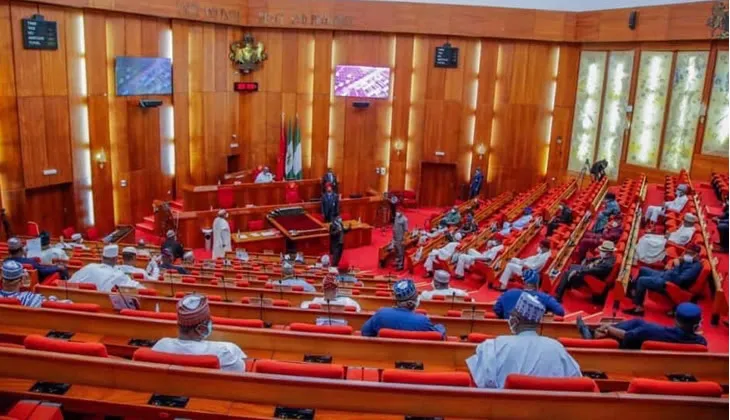
The Senate has been urged to expedite actions on a Bill to further amend the Administration of Criminal Justice Act (ACJA) to among others, hand the responsibility of implementing non-custodial sentences solely to the Nigerian Correctional Service (NCoS).
This call was made in Abuja on Thursday by a criminal justice advocacy group, the Centre for Socio-Legal Studies (CSLS), which noted that the current arrangement was untidy.
The CSLS appealed to the Senate to concur with the House of Representatives by speedily passing the AJC Bill 2023 which enjoyed inputs from leading stakeholders like the Federal Ministry of Justice (FMoJ), the judiciary, Nigerian Bar Association (NBA), Nigerian Institute of Advanced Legal Studies (NIALS), Council of Legal Education (CLE), law teachers, the Judiciary, among other stakeholders.
CSLS’ President, Professor Yemi Akinseye-George (SAN) highlighted the key proposals in the Bill now pending before the Senate and noted that the Bill, as already passed by the House of Representatives, seeks to harmonize the provisions relating to non-custodial sentences with those of the Nigeria Correctional Service Act 2019.
This proposal, Prof. Akinseye-George noted, recognizes the prime position of the Nigerian Correctional Service as the agency responsible for implementing non-custodial sentences in the country.
Another key proposal, he said, in the express abolition of the practice of trial-within-trial, which delays criminal proceedings.
He added: “This procedure, when the new Act is passed, will now be combined with the main trial rather than conducting a separate trial-within-trial.”
“This brings the Federal ACJA in tandem with that of Kaduna State, Plateau State and others that have merged trial-within-trial with the main proceedings in the criminal trial.”
“The Court of Appeal has endorsed this new approach in Muoneke v. The State. Hopefully the Supreme Court will uphold this innovative approach,” he said.
Prof. Akinseye-George also noted a proposal that seeks to allow the continuation of hearing in a case when a trial judge dies, is transferred or posted or otherwise unable to continue with a trial.
He said this idea is meant to avoid trial de novo (afresh) where a judge handling a criminal case is, due to one reason or the other, unable to continue with the trial.
The CSLS’ President equally spoke about a proposed amendment that will allow a Justice of the Court of Appeal to conclude part-heard criminal matter at the trial court.
He added: “Although the original Section 396(7) of ACJA 2015 was struck down by the Supreme Court, this provision has now been amended, the offending paragraph was expunged to reflect the decision of the Supreme Court.”
He said another proposal is contained in Clause 236(1) for the establishment the Sex Offender Register in the Federal Capital Territory (FCT), and Clause 236(2) provides that “upon the conviction of a sex offender, the offender’s particulars shall be entered into the Sex Offenders Registry, which shall be published and kept in the public domain.”
Prof. Akinseye-George said, to further curb delays, another amendment is proposed for the introduction of plea form, which shall be served along with a criminal charge and filed in the court as the plea of the defendant.
“This will be adopted by the defendant during arraignment.
It disposes of the viva voce reading of all the counts of offences in the charge during arraignment in court.
“This will make arraignment of defendants faster and more sensible particularly where the counts of offences charged are many.
“The ACJ Bill 2023 corrects the defects observed by the courts in the Plea Bargaining Provisions of the ACJA 2015.”
He also identified another proposal contained in Clause 380(6) to mandate the defence to file witness deposition to promote speedy trial of criminal cases.
Prof. Akinseye-George added: “When passed, ACJA 2022 makes it mandatory for a trial judge to make notes or such remarks as he thinks material relating to the demeanour of a witness during examination, cross examination and re-examination.
“The aim of this innovation is also to avoid trial de novo when a judge takes over a criminal trial previously conducted by another judge.”
He said another proposal is for the renaming of the existing Administration of Criminal Justice Monitoring Committee as the Administration of Criminal Justice Monitoring Council.
He said the change in nomenclature is intended “to reposition the body to effectively discharge its responsibilities and be able to receive direct budgetary allocations.
Read Also: Senate lauds CBN’s mid-year performance
“Apart from the foregoing there are several other improvements proposed for incorporation in the seven-year old ACJA.
“However, the fundamental principles, and essential elements of the ACJA remain unchanged.
“We commend the National Assembly for the passage of the Tax Reform Act 2025 which brings significant benefits to many families especially the poor.
“We thank the leadership of the Senate in advance for the anticipated speedy legislative action on the Bill.
“We note the commitment of the lawyers in the National Assembly and other reform-minded legislators, Chairman of the Committee on Justice to ensure speedy attention to the ACJ Bill 2023,” Prof. Akinseye-George said.