


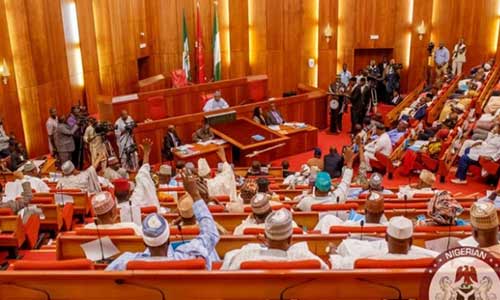
The Senate has stepped down the Agricultural Revolution Bill, 2026, sponsored by the deputy Senate president Barau Jibrin.
This followed objections by some lawmakers over its scope and the circulation of copies to senators.
The bill, which seeks to establish a comprehensive legal framework for transforming and modernising Nigeria’s agricultural sector, was stood down following a disagreement over whether the lawmakers had received copies of the proposed legislation.
Barau, who represents Kano North, had moved the motion for the bill’s second reading, saying it would address challenges such as low productivity, inadequate mechanisation, limited irrigation infrastructure, post-harvest losses, poor access to financing and insecurity in farming communities.
He said the proposed legislation would reposition agriculture from predominantly subsistence production to a modern, technology-driven and commercially viable sector.
According to him, the bill would promote mechanisation, irrigation development, improved seeds, agricultural research, extension services and the adoption of modern farming technologies.
It also seeks to strengthen agricultural value chains through investments in storage facilities, cold-chain infrastructure, agro-processing, commodity markets and linkages between farmers and industrial consumers.
Barau said the legislation would support smallholder farmers, women and young people while promoting climate-resilient farming practices and improved coordination among the different tiers of government.
He urged his colleagues to support the bill, saying a productive agricultural sector could reduce food-price pressures, create rural employment, strengthen local industries and conserve foreign exchange.
Senator Adamu Aliero, representing Kebbi Central, seconded the bill, describing it as timely in light of the need to diversify Nigeria’s economy.
Aliero said agriculture remained critical to economic diversification but was still largely practised at subsistence level, adding that the country needed to embrace commercial farming.
He also identified inadequate mechanisation and low crop yields as major challenges that require investment in agricultural equipment and research and development.
“This bill is very timely; it couldn’t have come at a better time than now,” he said.
However, Senator Abdul Ningi, representing Bauchi Central, questioned the structure of the proposed legislation, arguing that it appeared to cover areas already handled by existing agricultural agencies.
Ningi described the idea behind the bill as commendable but said more work was needed to clarify its objectives and its relationship to existing institutions.
He argued that the proposal did not clearly state whether it intended to establish a new agency or amend the mandates of existing ones.
“This is a brilliant idea, but a lot of work has not been done to capture what the deputy senate president intends to achieve,” he said.
Ningi urged the Senate to step down the bill to allow for further work and clarification.
Barau, however, invoked Order 79(1) of the Senate Standing Orders, arguing that lawmakers were expected to consider the general principles of the bill at the second-reading stage rather than examine its detailed provisions.
He said the bill had been gazetted and uploaded to the Senate’s platform, adding that its specific provisions could be examined during the committee stage.
Senate President Godswill Akpabio initially said lawmakers should confine their contributions to the merits and demerits of the proposed legislation.
He subsequently suggested that the bill be stood down until senators received copies.
Ningi then cited Order 77(3) and (4), which he said required printed copies of bills to be forwarded to every senator as soon as possible.
Akpabio upheld the point of order.
Aliyu Yahaya, another senator who contributed to the debate, also questioned the proposal to provide a single legal framework covering the entire agricultural sector.
Yahaya, who said he had taught agriculture at a university for more than 25 years before joining the Senate, argued that agriculture was too broad to be effectively regulated under one omnibus law.
He said areas such as subsidies, mechanisation and irrigation required specific legislative attention.
“There is nowhere, anywhere in the world that I have seen, with my limited knowledge, where you take agriculture as a whole, and provide it with a legal cover,” he said.
Yahaya said lawmakers should identify specific constraints in the agricultural sector and develop legislation to address them, rather than attempt to cover the entire sector with a single law.
He added that senators needed to examine the provisions of the proposed legislation to understand the areas it intended to address.
Senate Leader Opeyemi Bamidele said the Senate had agreed that bills should be gazetted and uploaded to its platform before consideration.
He explained that printed copies were usually distributed during clause-by-clause consideration, while the second reading focused on the general principles of a bill.
Bamidele, however, said that if the bill had not been gazetted, Barau should be encouraged to withdraw it.
Following the disagreement, Barau said he was willing to provide senators with printed copies and redistribute the bill before presenting it again.
“I am the deputy senate president; I always try to please everyone. I will find time, give it to him, and redistribute it and then present the bill,” he said.
The bill was subsequently set aside pending the distribution of copies to senators.