


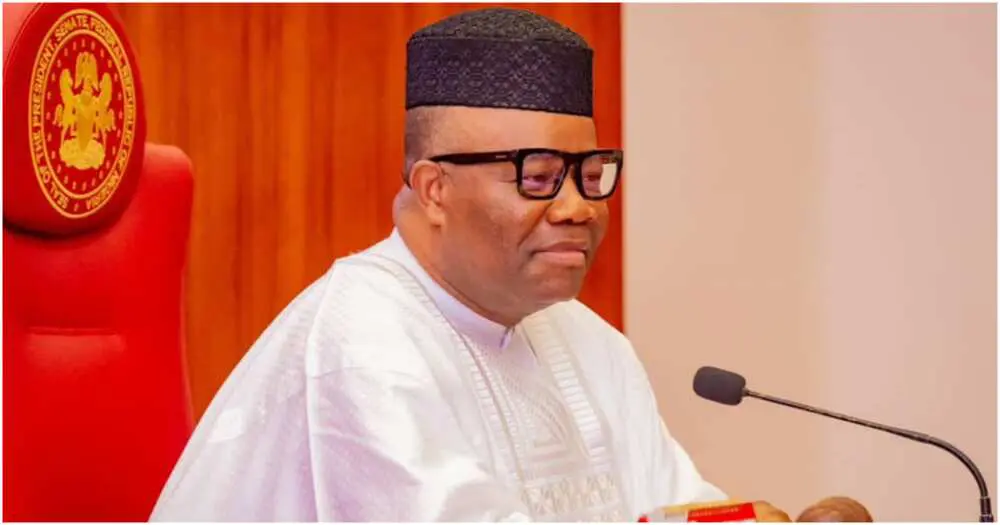
Senate President Godswill Akpabio has affirmed that the National Assembly’s decision to pass President Bola Tinubu’s landmark tax reform bills was guided by a shared commitment to national development, not partisan advantage.
In a statement released on Thursday through his media aide, Eseme Eyiboh, Akpabio described the bills as “critical pillars” of Tinubu’s Renewed Hope agenda, crafted to restructure Nigeria’s tax system for greater equity, transparency, and efficiency.
“These bills are foundational to the president’s economic reforms,” Akpabio said. “When signed into law, they will strengthen Nigeria’s revenue generation and overhaul tax administration to better reflect fairness and accountability.”
The legislation, comprising the Nigeria Revenue Service (Establishment) Bill, Joint Revenue Board (Establishment) Bill, Nigeria Tax Administration Bill, and Nigeria Tax Bill, was first submitted in November 2024 and passed last week after months of rigorous deliberation.
Behind the scenes, the journey was anything but straightforward.
One of the most contentious provisions proposed allowing tax-generating states to retain up to 60 percent of collected Value Added Tax (VAT). While proponents argued the measure would incentivize internal revenue growth and local accountability, it was met with fierce resistance, especially from lawmakers in Nigeria’s northern states, who feared it could widen economic disparities.
The Senate, led by Akpabio, negotiated a compromise: the retention rate was scaled back to 30 percent, and language around “derivation” was replaced with the more neutral “place of consumption.”
“There were moments of intense disagreement, even among the leadership,” Eyiboh noted. “But the Senate President’s capacity for calm engagement and consensus-building helped shepherd the process.”
Akpabio also acknowledged early opposition from state governors and some members within both chambers of the legislature. However, he said persistent dialogue and mutual concessions ultimately led to a unified front.
“Their eventual cooperation was a game changer,” he said. “By calming tensions in their regions and supporting the revised proposals, the governors helped pave the way for broader buy-in.”
Akpabio extended praise to Speaker of the House of Representatives, Tajudeen Abbas, for rallying support, particularly from younger lawmakers who initially had reservations about the depth and pace of the reforms.
Public hearings and stakeholder consultations were central to the legislative process, which Akpabio emphasized was “deliberate, transparent, and inclusive.”
“This wasn’t just about policy, it was about building a structure that reflects the aspirations of everyday Nigerians,” he said.
With the bills now awaiting presidential assent, Akpabio described the passage as a defining moment in President Tinubu’s administration.
“As we move into the second half of this administration, this is a milestone worth celebrating,” he said. “Credit must go to everyone who set aside personal interest to put the country first.”