

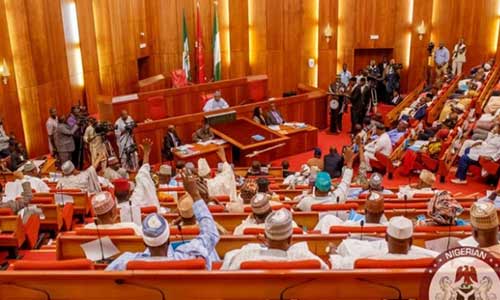
The Nigerian Senate on Thursday suspended further consideration of the bill seeking to repeal the Electoral Act No. 13 of 2022 and enact a new Electoral Act 2025, following calls for more extensive consultation and understanding of the proposed reforms.
The decision came after a motion moved by Senate Leader, Opeyemi Bamidele (APC–Ekiti), and seconded by Senate Minority Leader, Abba Moro (PDP–Benue), during plenary.
Explaining the rationale behind the motion, Bamidele said the timing was not appropriate for the Senate to move into an executive session on such a critical piece of legislation.
He emphasised the need for broader consultations and a deeper grasp of the bill’s far-reaching implications before proceeding. “It is my conviction that there is the need for further consultations on the bill before proceeding further,” Bamidele said. He added that lawmakers must fully understand the general principles and detailed provisions of the legislation, hence the decision to postpone its consideration to another legislative date.
Earlier, the Chairman of the Senate Committee on INEC, Sen. Simon Lalong (APC–Plateau), had presented the general principles of the bill, describing it as a major overhaul of Nigeria’s electoral law rather than a simple amendment.
According to Lalong, “The bill is not a mere amendment, but a comprehensive reform, repeal and enactment, intended to provide Nigeria with a strong, more credible and more inclusive electoral framework.”
He explained that although the Electoral Act 2022 brought about significant innovations and progress, it also exposed serious weaknesses within the electoral system. “It also exposed deep flaws in the country’s electoral system,” he said, citing issues such as delays in the release of election funds, disputes over voter registers, conflicting interpretations of result transmission, and the prevalence of litigation from party primaries.
Lalong added that Nigerians expect the National Assembly to respond not with minor corrections but with sweeping reforms that would rebuild trust in the electoral process. “Nigerians expected the Senate to respond, not with mere corrections, but with a holistic law that would restore faith in the country’s elections, going forward,” he said.
Outlining the objectives of the proposed Electoral Act 2025, Lalong noted that it seeks to improve transparency, efficiency, and integrity in Nigeria’s elections while promoting fairness among political parties. “The legislation is aimed at ensuring free and fair competition, where all political parties would have equal rights and ensuring that the outcomes of elections reflect the will of the people,” he said.
He explained that the bill also seeks to strengthen the Independent National Electoral Commission (INEC) by shielding it from political interference and introducing key innovations such as continuous voter registration, digital result registers, QR-coded voter IDs, and clearer procedures for electronic result transmission.
“It sets stricter timelines and clearer rules for party primaries, candidate nomination and replacement in cases of death or withdrawal,” Lalong added. “It is about strengthening the very foundation of democracy. If we get it right, we will restore public trust, reduce post-election disputes and empower INEC to function without interference.”
With the Senate’s decision to stand down the debate, further deliberations on the Electoral Act repeal and enactment bill are expected to continue after broader consultations and review among lawmakers and stakeholders