


By Chinelo Audrey Ofoegbunam
Introduction
The legal profession demands presence, precision, and resilience. Every day, lawyers show up for clients, courts, and causes, often placing the needs of others ahead of their own. In the urgency of briefs, hearings, deadlines, and negotiations, the future can feel distant—something to be addressed “when things settle down.” Yet, for many lawyers, that moment rarely arrives.
Legal practice is inherently unpredictable. Income fluctuates, workloads surge and dip, health is strained by stress, and careers are vulnerable to forces beyond personal control. Despite this reality, long-term security is frequently overlooked. Health insurance is delayed, pension planning is postponed, and social protection is treated as optional rather than essential.
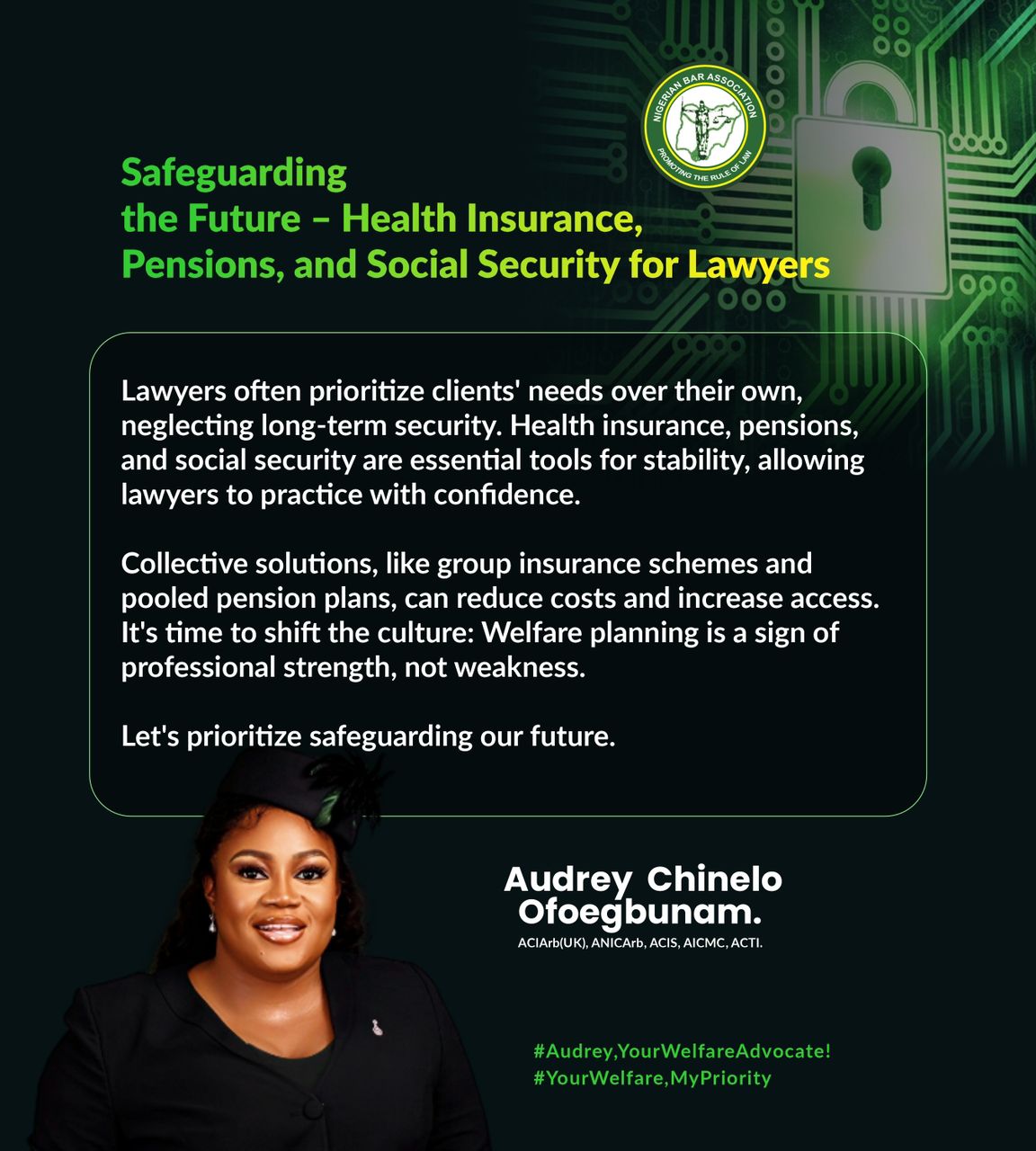
Safeguarding the future is not about pessimism; it is about foresight. Health insurance, pensions, and social security are not signs of professional weakness but tools of stability. They allow lawyers to practice with confidence, knowing that illness, age, or unexpected disruption will not erase decades of hard work. In a profession dedicated to protecting rights and securing justice, protecting the lawyer must also be part of the equation.
1. The Hidden Vulnerability of Legal Professionals
From the outside, lawyers are often perceived as insulated from hardship. The professional title, courtroom presence, and intellectual authority suggest security and control. However, beneath this perception lies a quieter vulnerability. Many lawyers operate without meaningful safety nets, relying almost entirely on continued physical health and active practice to sustain their livelihoods.
Legal work exposes practitioners to unique risks. Stress-related illnesses, burnout, and mental fatigue are common, while accidents, chronic conditions, or sudden health crises can abruptly disrupt practice. For self-employed lawyers or those in small firms, a single illness can mean total income loss. Unlike salaried professions with built-in benefits, many lawyers must independently arrange their protection—yet few do so adequately.
This vulnerability is often masked by professional pride. Admitting the need for insurance or social protection can feel inconsistent with the image of strength lawyers are expected to project. As a result, many delay planning until a crisis forces the issue. Recognizing vulnerability is not a sign of failure; it is a necessary step toward building a sustainable legal career.
2. Health Insurance as Professional Protection
Health insurance is one of the most immediate and impactful forms of welfare for lawyers. Medical emergencies do not announce themselves, and treatment costs can quickly overwhelm even financially disciplined professionals. Without insurance, illness becomes not only a health crisis but a financial one, draining savings and destabilizing practice.
Beyond emergency care, health insurance supports preventive medicine—routine check-ups, early diagnosis, and ongoing treatment. For lawyers working long hours under constant pressure, preventive care is essential. It preserves energy, focus, and professional longevity. A healthy lawyer is better equipped to serve clients, meet ethical obligations, and sustain consistent productivity.
Health insurance should therefore be viewed as professional protection, not personal indulgence. Whether through individual plans, cooperative schemes, or group coverage, having structured medical protection allows lawyers to practice with peace of mind. It transforms health from a silent risk into a managed aspect of professional life, reinforcing dignity and stability in an otherwise demanding career.
3. Pensions and the Myth of Endless Practice
One of the most persistent myths in the legal profession is the belief that lawyers never truly retire. There is a quiet assumption that intellectual work can continue indefinitely—that experience compensates for age, and that the law will always provide an income stream for those who remain mentally sharp. While this belief offers comfort, it can also be dangerously misleading.
Legal practice is physically and emotionally demanding. Long hours, sustained concentration, travel, and courtroom pressure take a cumulative toll. Over time, energy levels change, health priorities shift, and professional stamina declines. Even for the most respected practitioners, there comes a point when active practice must slow down or stop altogether. Without a pension or retirement plan in place, this transition can be financially destabilizing.
Pensions are not about withdrawing from relevance; they are about preserving autonomy. A lawyer with a pension is free to choose when and how to reduce active practice, whether to focus on mentorship, advisory roles, or personal pursuits. Without that safety net, many lawyers are forced to keep working out of necessity rather than choice, compromising wellbeing and, in some cases, professional judgment.
Early pension planning spreads financial responsibility across the length of a career rather than compressing it into later years. Small, consistent contributions—started early—can grow into meaningful security. By reframing pensions as a tool for independence rather than an admission of aging, lawyers can reclaim control over the later chapters of their professional lives.
4. Income Gaps, Irregular Earnings, and Retirement Risks
Unlike professions with predictable monthly salaries, legal income is often uneven. Fees arrive late, retainers fluctuate, and some months are significantly more profitable than others. For many lawyers, particularly sole practitioners and small-firm partners, financial planning becomes reactive rather than structured.
This irregularity creates a major barrier to long-term security. When income is uncertain, savings and pension contributions are often treated as optional—something to be addressed during “good months.” Unfortunately, those good months may be followed by long stretches of financial unpredictability, reinforcing a cycle where long-term planning is continuously postponed.
The risk is not merely reduced savings but total dependence on active practice. Lawyers who rely solely on future earnings assume that they will always be able to work at the same pace and command the same fees. This assumption leaves little room for illness, market changes, or personal transitions. Retirement, under such conditions, becomes a source of anxiety rather than relief.
Building retirement security amid irregular income requires intentional structure. Allocating a fixed percentage of every fee received, separating professional income from personal spending, and treating pension contributions as non-negotiable obligations can gradually stabilize the future. Even modest, consistent planning reduces vulnerability and transforms uncertainty into preparedness.
In a profession defined by foresight and risk assessment, addressing income gaps and retirement risks is not just prudent—it is aligned with the very skills lawyers practice daily.
5. Social Security Beyond Old Age
When lawyers think about social security, retirement is often the first—and sometimes only—scenario that comes to mind. Yet, the most immediate threats to professional stability rarely arrive at the end of a career. Disability, illness, accidents, and unexpected life disruptions can occur at any stage, abruptly interrupting a lawyer’s ability to work and earn.
Legal practice is heavily dependent on personal capacity. Unlike businesses that can operate independently of their founders, many legal careers are inseparable from the individual lawyer’s presence. A prolonged illness, temporary disability, or mental health challenge can therefore result in sudden income loss, client attrition, and reputational strain. Without social protection mechanisms in place, such disruptions quickly escalate from health concerns into financial crises.
Effective social security should address these realities. Disability coverage, income protection plans, and emergency support systems are essential components of professional welfare. They provide breathing space—time to recover without the pressure of immediate financial survival. Such safety nets preserve dignity, allowing lawyers to prioritize healing without sacrificing long-term stability.
Viewing social security as a comprehensive shield rather than a retirement-only tool encourages earlier and more thoughtful planning. It reframes welfare as a continuous process that supports lawyers through vulnerability, transition, and recovery, not just old age.
6. Cultural Attitudes Toward Financial Planning in Law
Despite their training in foresight and risk management, many lawyers struggle with proactive financial planning. Discussions about money, illness, or aging are often avoided, perceived as uncomfortable or even unprofessional. Within the culture of law, strength is associated with endurance, and vulnerability is quietly discouraged.
This mindset contributes to delayed decisions around insurance, pensions, and social protection. Many lawyers tell themselves they will plan “later”—after the next case, the next promotion, or the next financial breakthrough. Unfortunately, emergencies rarely respect timing. By the time planning feels urgent, options may be limited or more expensive.
There is also a subtle stigma attached to preparation. Talking openly about pensions can be misinterpreted as a lack of ambition, while health insurance may be seen as unnecessary for those who consider themselves resilient. These cultural attitudes create a false divide between success and preparedness, when in reality, the two are deeply connected.
Shifting from reactive to preventive welfare planning requires a cultural reset. Financial planning should be normalized as part of professional responsibility, not personal weakness. When lawyers embrace early planning as an act of self-respect and professionalism, welfare becomes embedded in the fabric of legal practice rather than an afterthought.
7. Collective Solutions – Strength in Shared Protection
While individual planning is essential, the long-term sustainability of lawyer welfare cannot rest solely on personal effort. The realities of health care costs, retirement security, and income protection demand collective solutions that reduce individual burden and expand access. Professions that thrive over generations do so not because every member plans perfectly, but because systems exist to support them when life becomes unpredictable.
Collective welfare arrangements—such as group health insurance schemes, pooled pension plans, and cooperative savings structures—offer significant advantages. They reduce costs through scale, spread risk across a larger base, and make quality coverage accessible to lawyers at different income levels. For young lawyers, collective plans lower the barrier to entry. For mid-career practitioners, they provide stability. For senior lawyers, they offer continuity and peace of mind.
Beyond affordability, collective solutions foster a sense of professional solidarity. They communicate a powerful message: that the profession values its members not only for their productivity, but for their humanity. When lawyers know that illness, disability, or aging will not immediately push them into financial distress, they are more likely to practice ethically, sustainably, and without fear.
Importantly, collective welfare systems also encourage consistency. Rather than fragmented, informal arrangements that leave gaps in coverage, shared frameworks create minimum standards of protection. These standards help reduce inequality within the profession, ensuring that welfare is not a privilege reserved for the few, but a baseline for all.
8. The Role of Collaboration – Building a Culture of Preventive Welfare
Effective welfare systems do not emerge by chance; they are built through collaboration. Lawyers, firms, insurers, financial planners, and policymakers all have roles to play in shaping a protective ecosystem that anticipates risk rather than merely reacting to crisis.
At the individual level, collaboration begins with conversation. Open discussions about health insurance, pensions, and income security help dismantle stigma and misinformation. When lawyers share experiences—both positive and challenging—they normalize planning and encourage collective awareness. These conversations transform welfare from a private concern into a shared professional value.
At the organizational level, law firms and professional groups can serve as catalysts for preventive welfare. By facilitating access to group plans, hosting financial literacy sessions, and integrating welfare considerations into workplace culture, they shift the focus from short-term output to long-term sustainability. Collaboration here is not about control, but about coordination—making it easier for lawyers to make informed, timely decisions.
On a broader scale, partnerships with financial institutions and insurers allow the profession to shape products that reflect its unique realities. Legal work is intellectually demanding, emotionally taxing, and often unpredictable. Welfare solutions must therefore account for fluctuating income, career interruptions, and extended professional lifespans. Collaboration ensures that protection is not generic, but tailored.
Ultimately, collaboration builds resilience. It transforms welfare from a fragmented afterthought into a structured system of support—one that recognizes that safeguarding the future of lawyers is inseparable from safeguarding the future of justice itself.
Conclusion
The conversation around health insurance, pensions, and social security for lawyers is not merely about financial planning; it is about dignity, continuity, and professional survival. A career built on service to others should not end in uncertainty or vulnerability.
By embracing preventive planning, collective solutions, and collaborative frameworks, lawyers can redefine welfare as an integral part of professional life. Protection against illness, disability, and aging should not depend on luck or timing, but on thoughtful systems that value the lawyer beyond their billable hours.
Safeguarding the future of legal practice begins with safeguarding those who sustain it. When lawyers are protected, they practice with confidence. When they plan without fear, they serve with clarity. And when welfare becomes a shared responsibility, the profession moves closer to a future that is not only successful, but humane, resilient, and secure.
Connect with me on Social Media:
X: CIAO Legal
LinkedIn: Chinelo Audrey Ofoegbunam
Instagram: CIAO Legal
Facebook: Chinelo Ofoegbunam