


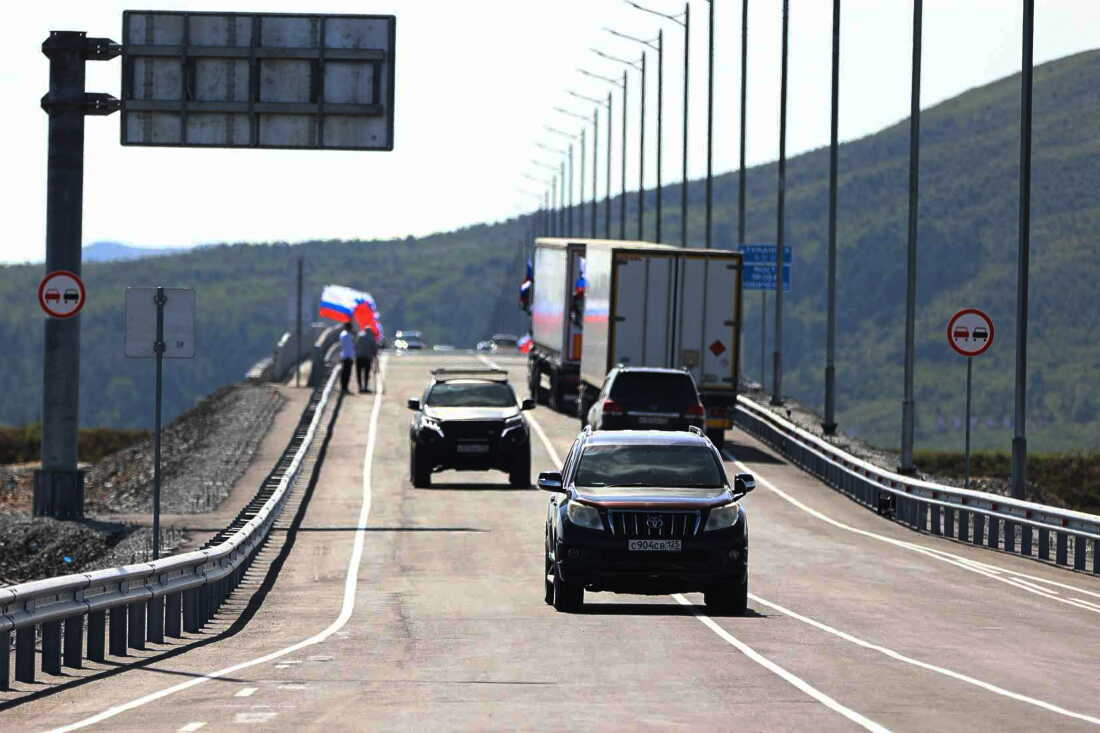
Russia and North Korea have opened the first road bridge linking the two countries, creating a new route for the movement of cargo and passengers across the Tumen River.
The bridge is expected to strengthen trade, tourism and other exchanges between Moscow and Pyongyang, as the two countries deepen relations amid Russia’s ongoing war in Ukraine.
North Korean state media said the new crossing would facilitate “personnel exchanges, tourism and trade.”
Russian Prime Minister Mikhail Mishustin described the bridge as a “new symbol of friendship,” while North Korean Prime Minister Pak Thae Song called its opening a “historical event.”
Mishustin, who appeared at the opening ceremony via video link, said relations between Moscow and Pyongyang were at “an unprecedented high level.”
He said the bridge would provide a “powerful impetus for the further development of trade, economic, scientific, technological and cultural cooperation.”
Related News:
Russia And North Korea Begin Construction Of New Road Bridge To Deepen Ties
Russia Set To Start Construction Of A Road Bridge To North Korea
Belarusian President Lukashenko Presents Rifle To North Korea’s Kim As Both Countries Sign…
Russian state news agency TASS reported that the bridge can accommodate up to 300 vehicles and 2,323 people daily.
The Russian government said the crossing would initially be used for cargo transportation before passenger traffic begins later this year.
However, the opening has also raised concerns over its potential military significance, particularly given the growing defence cooperation between Russia and North Korea.
Ukrainian investigative organisation Truth Hounds said the bridge was intended “primarily to establish a covert military logistics corridor” to support Russia in the Ukraine war.
The organisation said the infrastructure could facilitate the movement of North Korean military personnel, construction workers and senior military officials into Russia, while also allowing Russian technology and resources to flow in the opposite direction.
The concerns come after Russia and North Korea signed a strategic partnership treaty in 2024, under which the two countries pledged to assist each other in the event of “aggression.”
The bridge is about one kilometre long and runs alongside newly constructed access roads, a border checkpoint, support infrastructure and parking facilities, according to satellite imagery reported in May.
Construction began in 2025 following an agreement reached during Russian President Vladimir Putin’s visit to North Korea in 2024. The project took 495 days to complete after delays.
The two countries already have air and rail connections, but their only road link had previously been a makeshift arrangement in which wooden planks were placed across a railway bridge to allow vehicles to cross by special agreement.
The new road connection could have an immediate impact on trade and the movement of North Korean workers and military supplies.
South Korean intelligence estimates that North Korea has already supplied Russia with between $7 billion and $14 billion worth of rockets, missiles and artillery shells by sea.
An estimated 11,000 North Korean troops are also believed to be actively supporting Russian forces in the war against Ukraine.
The road link is expected to further facilitate the movement of North Korean labourers to Russia. South Korean estimates indicate that about 10,000 North Koreans are working in Russia’s construction and logging sectors, despite a United Nations ban on countries employing North Korean workers.
Russian tourists have also travelled to North Korea since Pyongyang began allowing them entry in 2024. They have visited the capital, Pyongyang, as well as the Wonsan-Kalma beach resort, while tourists from most other countries remain restricted.
Victor Cha of the Center for Strategic and International Studies told reporters that the rapid construction of the bridge reflected the growing volume of trade and exchanges between the two countries. “This is spurred largely by North Korea’s provision of troops, weapons, munitions, and labourers for Putin’s war in Ukraine.”
Cha described the new connection as a significant development, noting that before the Ukraine war, the road link between North Korea and Russia was among the least active connections between North Korea and its neighbouring countries.
The opening of the bridge therefore marks a major expansion of physical connectivity between Moscow and Pyongyang, while also underscoring the increasingly strategic nature of their partnership.