


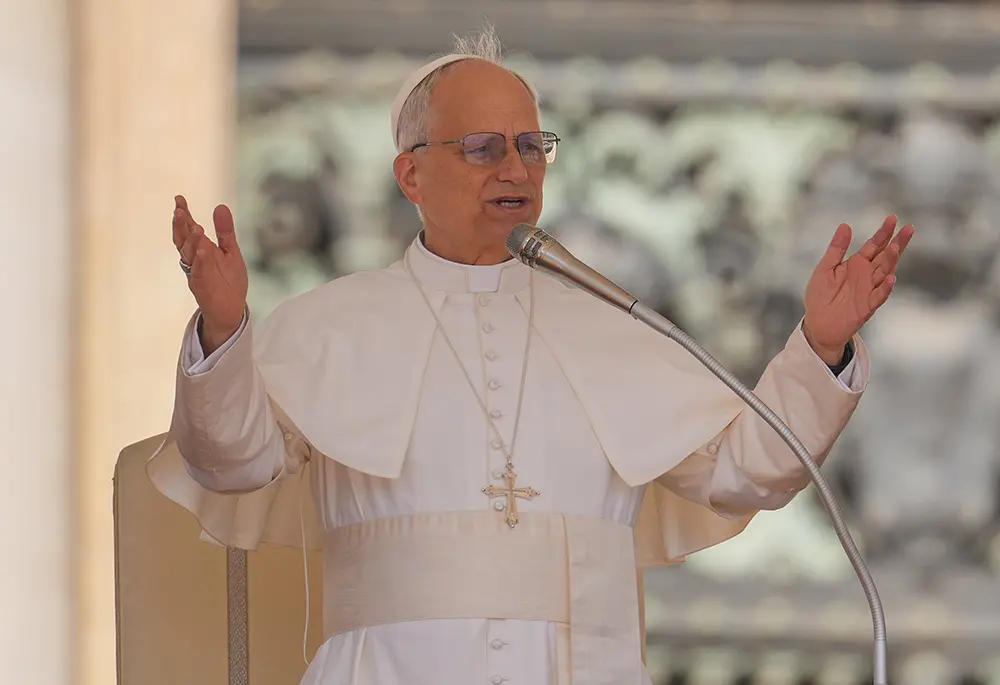
Pope Leo XIV has issued a formal apology over the Catholic Church’s historical role in slavery, acknowledging that the Vatican helped legitimise the practice for centuries and failed to explicitly condemn the trans-Atlantic slave trade, which he described as “a wound in Christian memory.”
The apology was published in his first encyclical, Magnifica Humanitas (“Magnificent Humanity”), released on Monday. In the document, he also reflected on the risks of artificial intelligence and modern systems of exploitation emerging from the digital economy.
In the encyclical, Pope Leo XIV, for the first time, explicitly admitted that earlier pontiffs provided religious justification to European colonial powers, enabling them to seize territories and enslave non-Christians during the colonial period.
“It is impossible not to feel deep sorrow when contemplating the immense suffering and humiliation endured by so many in stark contrast to their immeasurable dignity as persons infinitely loved by the Lord,” the Pope wrote, as quoted by AP News.
“For this, in the name of the church, I sincerely ask for pardon.”
While previous popes had expressed regret over Christians’ involvement in slavery, none had directly acknowledged the Vatican’s institutional role in authorising or legitimising it through formal papal decrees.
The encyclical also drew a link between historical slavery and present-day forms of exploitation tied to technological advancement, particularly labour abuses associated with the extraction of minerals used in artificial intelligence systems.
“We must firmly condemn all forms of trafficking related to the digital technological revolution if we want to avoid the need to ask for pardon again in the future,” he stated.
Historically, the Vatican has maintained that the Church upheld the inherent dignity of all human beings as children of God. However, archival records show that several 15th-century papal bulls empowered European monarchs to expand into Africa and the Americas and enslave non-Christians.
One of the most cited documents, Dum Diversas (1452), issued under Pope Nicholas V, authorised Portugal to “invade, conquer, fight and subjugate” non-Christians and place them “into perpetual slavery.”
Another decree, Romanus Pontifex (1455), reinforced what later became known as the “Doctrine of Discovery,” a framework used to justify colonial expansion and the enslavement of Indigenous peoples across Africa and the Americas.
These permissions granted under Pope Nicholas V were later upheld by subsequent pontiffs, including Pope Callixtus III, Pope Sixtus IV, and Pope Leo X.
Although the Vatican officially rejected the Doctrine of Discovery in 2023, critics say it stopped short of formally cancelling the original papal bulls that authorised enslavement and conquest.
In the encyclical, Pope Leo XIV also admitted that the Church was slow to recognise slavery as fundamentally incompatible with Christian teaching.
“The church has long affirmed the dignity of every human being as the basis of its doctrine, even if it took eighteen centuries for its full incompatibility with slavery to be explicitly recognized,” he wrote.
“This constitutes a wound in Christian memory, one from which we cannot consider ourselves detached.”
The Pope, the first American-born pontiff, is also reported to have ancestral links to both enslaved individuals and slave owners, according to genealogical research published by scholar Henry Louis Gates Jr.
The findings suggest that at least 17 of his American ancestors were recorded in historical documents as Black, Creole, mixed-race, or free people of colour.
Reactions to the apology have been largely positive among scholars and Black Catholic advocates, who described it as a significant but overdue step.
Anthea Butler, a senior fellow at Oxford University’s Koch History Center, said the apology was necessary for the Church’s credibility in addressing modern exploitation linked to technology.
Jesuit priest and academic Christopher J. Kellerman also welcomed the statement, though he said deeper historical clarification is still needed.
“Pope Leo has strengthened the moral credibility of the church with this admission and apology today,” he said.
“Hopefully a future document will explain in more detail the church’s involvement with slaveholding.”
Earlier pontiffs, including Pope John Paul II, had previously apologised for the participation of Christians in slavery during visits to African countries such as Cameroon and Senegal.
However, this encyclical marks the first time a pope has directly acknowledged the Vatican’s institutional role in legitimising slavery through official Church doctrine.