


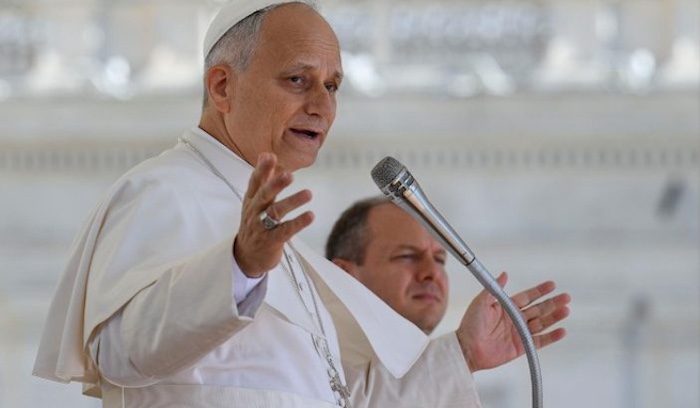
The head of the Roman Catholic Church, Pope Leo XIV, has warned that artificial intelligence must not remain under the control of “a few,” cautioning that the rapidly advancing technology is fueling global conflicts and reshaping warfare.
The Pope made the remarks during the presentation of his first major theological document, Magnifica Humanitas (Magnificent Humanity ), a landmark encyclical focused on the ethical, social and political implications of artificial intelligence.
Presenting the 235-page document at the Vatican on Monday, Pope Leo called for strict ethical regulations on the use of AI, especially in military operations, insisting that the technology must serve humanity rather than dominate it.
“Artificial Intelligence needs to be disarmed,” the Pope declared.
“The word is strong, I know, but deliberately chosen because this moment needs words capable of attracting attention, awakening consciences and indicating paths forward for humanity.”
He warned that AI is already influencing critical decisions affecting human coexistence and changing the nature of warfare across the world.
“Artificial intelligence already touches many areas of our lives and affects decisions that shape human coexistence. It is also dramatically changing how war is waged,” he said.
Pope Leo added that humanity must confront technological transformation “with eyes of faith, with lucidity of reason, with openness to mystery and with cries of the poor and the earth resounding in my heart.”
The encyclical goes beyond technology, addressing broader global crises including war, migration, slavery and social justice.
The pontiff argued that the traditional Christian “just war” doctrine has become outdated, maintaining that military force should only be used strictly for self-defense.
“The construction of a world in a state of perpetual conflict is an evil and must be named for what it is,” the Pope wrote.
He added that “force, violence and weapons” ultimately produce “disastrous consequences for civilian populations,” while urging world leaders to embrace diplomacy, dialogue and forgiveness as tools for resolving disputes.
The Pope also criticised the concentration of technological power in the hands of a few corporations and governments, warning that AI systems are not morally neutral.
“We cannot consider AI to be morally neutral,” he stated. “Every technical tool embodies choices and priorities through what it measures, ignores and optimizes, and how it classifies people and situations.”
Pope Leo further rejected transhumanism and posthumanism, ideologies that promote merging humans with machines or overcoming biological limits through technology.
According to him, such ideas risk undermining the unique dignity and “grandeur of humanity.”
Drawing from the biblical story of the Tower of Babel, the Pope warned that humanity risks creating systems that “dominate and ultimately dehumanize” people if AI development lacks diverse participation and ethical oversight.
He called for stronger legal frameworks, independent regulation and responsible political leadership to ensure AI development protects jobs, human dignity, social justice and the environment.
The Vatican described Magnifica Humanitas as a defining document of Pope Leo’s papacy and one aimed not only at Catholics but at “every person of goodwill.”
In an unusual move, the Pope personally oversaw the unveiling of the encyclical alongside Chris Olah, co-founder of AI company Anthropic, signalling the Vatican’s intention to engage directly with those shaping the future of artificial intelligence.
The encyclical comes amid growing global debates over AI regulation, deepfakes, military applications of artificial intelligence and the impact of automation on jobs and human relationships.
Pope Leo, the first American pontiff, has repeatedly identified AI as a major concern of his papacy. He recently established a cross-department Vatican commission to study the effects of the technology and has previously warned against the rise of “overly affectionate” chatbots and AI-generated religious content.
The Pope also linked his concerns to the legacy of Pope Leo XIII, whose 1891 encyclical Rerum Novarum addressed workers’ rights during the industrial revolution.
According to Pope Leo XIV, the Church now faces “another industrial revolution” driven by artificial intelligence and must respond with moral clarity and social teaching.