


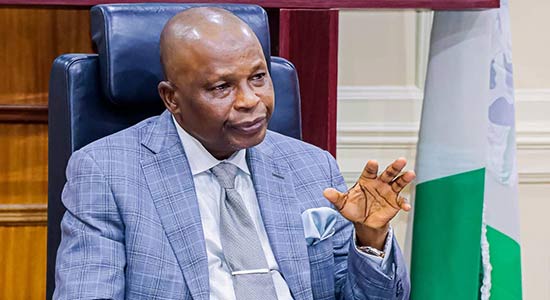
The Federal Government has urged member states of the International Criminal Court (ICC) to uphold principles of cooperation while ensuring respect for Nigeria’s sovereignty and constitutional framework.
The Attorney General of the Federation and Minister of Justice, Lateef Fagbemi, SAN, made this call in The Hague during the opening of the 24th Session of the Assembly of States Parties to the Rome Statute.
Delivering Nigeria’s national statement, the AGF conveyed President Bola Tinubu’s appreciation to the Court and the Assembly for their commitment to strengthening international criminal justice. He reaffirmed Nigeria’s loyalty to the Rome Statute and its resolve to hold accountable individuals responsible for war crimes, genocide, and crimes against humanity.
Fagbemi emphasized that Nigeria’s cooperation with the ICC is anchored on international law and the sovereign equality of states, stressing that such cooperation must always reflect respect for Nigeria’s constitutional order. He highlighted recent initiatives, including the May 2025 High‑Level International Humanitarian Law Dialogue, legislative efforts to domesticate the Kampala Convention, the Rome Statute, and Geneva Protocols, as well as Nigeria’s endorsement of the Political Declaration on Explosive Weapons in Populated Areas.
He noted Nigeria’s continued prioritization of civilian protection and accountability in military operations, citing the Six‑Month Demobilisation, Deradicalisation and Reintegration Programme, which reintegrated over 6,000 former combatants.
Consistent with the ICC’s complementarity principle, Fagbemi stressed Nigeria’s capacity and willingness to investigate and prosecute serious crimes committed within its territory, and expressed hope for the formal conclusion of Nigeria’s Situation before the ICC.
The AGF warned that the ICC’s mandate is more critical than ever amid rising armed conflicts, deliberate targeting of civilians, and destruction of civilian infrastructure. He flagged emerging risks from lethal autonomous weapons systems, raising concerns about accountability and ethical responsibility.
Fagbemi further urged sensitivity to Africa’s peculiar challenges of terrorism, insurgency, and mass displacement, calling for effective cooperation, victim support, technical assistance, and stronger national justice systems. He reiterated Nigeria’s support for strengthening the ICC’s independence, efficiency, and credibility, while integrating African perspectives into ongoing reforms.
Finally, he condemned recent cyberattacks on the ICC’s infrastructure, describing them as deliberate attempts to undermine the Court’s independence, and urged deeper collaboration with experts in emerging technologies and artificial intelligence to safeguard the Court’s integrity.