

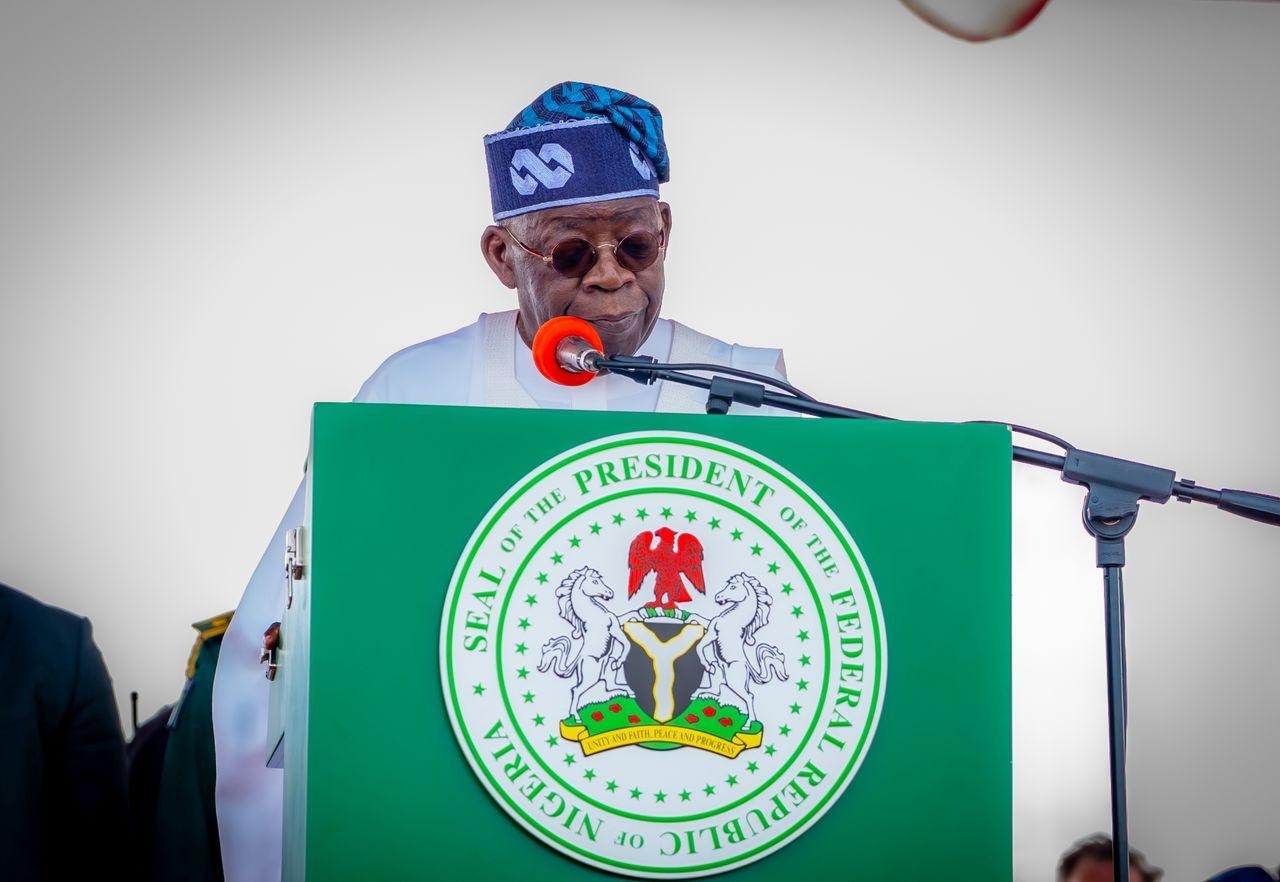
President Bola Tinubu says Nigeria has emerged as a leading country globally in the prosecution and conviction of terrorism suspects.
He said this has demonstrated the country’s commitment to confronting terrorism through both military operations and judicial action.
Tinubu stated this on Monday in Abuja while delivering remarks at the opening of the Chief of Defence Intelligence (CDI) Annual Conference 2026.
Represented by the National Security Adviser (NSA), Mallam Nuhu Ribadu, Tinubu said Nigeria’s counter-terrorism efforts had recorded significant gains through sustained military operations and effective collaboration among security and intelligence agencies.
Tinubu said the country’s achievements reflected its resolve to dismantle terrorist networks, bring perpetrators to justice and strengthen the rule of law in the fight against terrorism.
He said the government remained committed to ensuring that terrorists and other criminal elements were not only neutralised on the battlefield but also subjected to appropriate legal processes.
According to him, the combination of operational pressure and effective prosecution is critical to dismantling terrorist networks and preventing their resurgence.
Tinubu said his administration had intensified efforts to strengthen national security through improved intelligence gathering, inter-agency cooperation and international partnerships.
He noted that the security environment had become increasingly complex, with terrorism, banditry, kidnapping, cyber threats and transnational organised crime posing significant challenges.
The President said recent military successes had demonstrated Nigeria’s growing capacity to dismantle terrorist leadership, disrupt expansion networks and restrict the operational freedom of violent groups.
“Under this administration, four of eight identified senior terrorist leaders have been killed or arrested,” he said.
He listed the successes to include action against Ahmed Ohida’s ISWAP southern expansion network, the elimination of senior Islamic State leader Abu Bilal Mainuki in May 2026, and the arrests of Abu Barra of Ansaru and Mamuda of Mahmudawa in 2025.
He commended the Armed Forces and other security agencies for their sacrifices, stressing that the ultimate objective was to translate operational successes into lasting peace and security.
The President also called for stronger cooperation among the Armed Forces, the Department of State Services, the National Intelligence Agency, the Nigeria Police Force and other security institutions.
He said such collaboration was essential to ensuring effective intelligence fusion, timely responses to emerging threats and the protection of vulnerable communities.
Tinubu further reaffirmed his administration’s commitment to strengthening Nigeria’s international security partnerships, particularly in intelligence sharing, training and technological cooperation. He urged participants at the conference to develop practical strategies to enhance intelligence capabilities and achieve measurable improvements in national security.
The conference has as its theme: “Optimising Intelligence through Technological Innovations and Strategic Partnerships in a Complex Security Environment.”
Tinubu commended the Chief of Defence Intelligence, Lt.-Gen. Emmanuel Undiandeye, and his team for their contributions to strengthening defence intelligence and strategic cooperation. He also commended the efforts of the founding leaders of the DIA, including retired Gen. Aliyu Gusau, for their vision and commitment to national security.
Tinubu urged participants to remain committed to the collective responsibility of making Nigeria safer.
The Chief of Defence Intelligence (CDI), Lt.-Gen. Emmanuel Undiandeye, called for stronger inter-agency collaboration and the adoption of emerging technologies to enhance intelligence gathering and tackle evolving security threats.
Undiandeye said the growing sophistication of terrorism, banditry, transnational organised crime and cyber threats required intelligence agencies to embrace innovative technologies and strengthen cooperation.
“Today, the challenge is no longer simply the availability of information, but our ability to process, analyse and transform vast volumes of data into timely, credible and actionable intelligence,” he said.
Undiandeye identified artificial intelligence (AI), machine learning and advanced data analytics as critical tools for detecting threats, identifying patterns and supporting strategic decision-making.
According to him, integrating these technologies into intelligence operations would enhance security agencies’ ability to anticipate threats rather than merely respond after they occur.
He, however, stressed that technological innovation must be matched with effective collaboration among intelligence and security institutions.
“No single agency can effectively address the complex and interconnected security challenges confronting our nation. We must strengthen collaboration, deepen information sharing and work together towards a common national security objective,” he said.
The CDI called for greater integration of human, signals, financial and open-source intelligence to provide a more comprehensive understanding of threats.
He said that joint intelligence platforms, coordinated operational frameworks and timely exchange of information would improve responses to security challenges across different theatres.
He also advocated stronger partnerships with international intelligence organisations, the private sector, academic institutions and local communities.
Undiandeye said telecommunications companies, financial institutions and technology firms could contribute significantly to intelligence gathering, data analysis and protection of critical national infrastructure.
He added that collaboration with universities and research institutions would help develop local expertise in artificial intelligence, cybersecurity, data science and other emerging fields.
He described the conference as particularly significant as it coincided with the 40th anniversary of the Defence Intelligence Agency and the National Security Agencies Act of 1986.
The CDI said the anniversary provided an opportunity to reflect on the agency’s contributions to national security and reposition its capabilities to address emerging threats.
He urged participants to translate the conference deliberations into practical strategies to improve intelligence coordination, technological innovation and operational effectiveness.
Undiandeye reaffirmed the agency’s commitment to strengthening Nigeria’s intelligence architecture through innovation, professional excellence and strategic partnerships.