
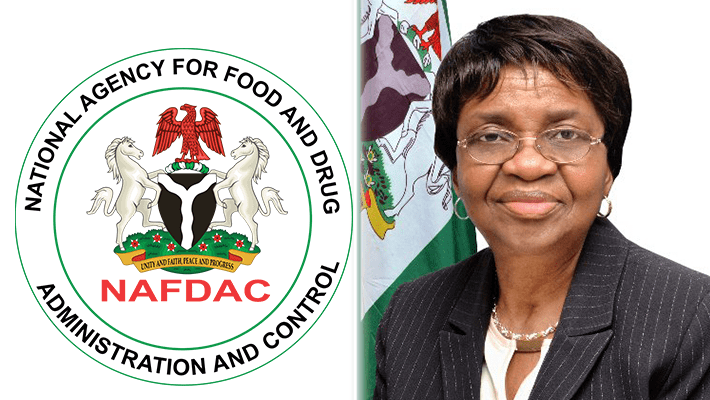
The National Agency for Food and Drug Administration and Control (NAFDAC) has responded to a recent newspaper report and widespread social media discussions about suspected counterfeit and adulterated food products, stressing that many of the claims remain unverified while releasing detailed records of its surveillance and enforcement activities.
This is just as it highlighted that it has secured the conviction of 64 countertfeiters and ensured the removal of 7,210 non-compliant products from circulation.
In a Monday statement signed by Director-General, Prof. Mojisola Adeyeye, the agency noted a Saturday report by a national daily and the accompanying online conversations that flagged yoghurt, palm oil, apples, soy sauce, olive oil, chicken, fish, water and beverages as potentially unsafe.
While acknowledging public concern, NAFDAC said several of the social media allegations cited had not been independently verified.
“Social media allegations do not, by themselves, establish that a product is counterfeit, adulterated, or unsafe,” the agency stated.
Where credible investigations confirm violations, NAFDAC said it takes immediate action, including public alerts, seizures, recalls, disposal and prosecution.
NAFDAC emphasised that its regulatory powers under the NAFDAC Act cover only processed and packaged food products.
It said unbranded and unpackaged items sold in open markets, including palm oil and fufu, fall under the primary responsibility of state and local authorities.
For instance, it said, fresh imported produce, including apples, grapes and oranges, is regulated by the Nigeria Agricultural Quarantine Service (NAQS).
The agency said it continues to engage sister agencies and is pushing for stronger coordination under the National Policy on Food Safety and Quality and its 2023 Implementation Plan.
On specific issues raised, NAFDAC recalled its long-running campaign against the use of calcium carbide for artificial fruit ripening, which began in 2018.
It also expressed “grave concern” over the adulteration of palm oil with azo dyes and hazardous chemicals, as well as reports of bleach being used in fufu production.
In May 2026, after laboratory testing, the agency publicly confirmed that NAFDAC-registered bread products are safe for consumption.
The agency stated that the enforcement of the January 2026 ban on alcohol in sachets and PET bottles below 200ml remains ongoing, with manufacturers already dismantling or reconfiguring affected production lines.
NAFDAC disclosed that between May and July 2026, its Post-Market Surveillance Directorate visited 6,233 facilities nationwide and removed 7,210 non-compliant products from circulation.
It said food and water products accounted for the highest volume of removals (3,633), followed by drugs and herbals (2,459) and cosmetics (911).
The agency identified notable recent actions to include a public alert on counterfeit Colgate toothpaste, sanctions against three companies caught illegally refilling 19-litre CWAY dispenser bottles with unapproved water, and the July 2026 arrest of a suspect found counterfeiting Oral-B toothpaste, who remains in custody.
The agency also listed major enforcement operations spanning 2023 to 2026, including, destruction of products worth over ₦120 billion in 2024 alone; seizure and destruction of more than 137 forty-foot truckloads of counterfeit goods valued at over ₦1.5 trillion in Idumota, Onitsha and Aba (February–March 2025); destruction of fake, expired and banned medicines worth over ₦15 billion in Ibadan in February 2026; and confiscation of over 1,600 bags of counterfeit rice valued at ₦5 billion in Nasarawa in June 2026.
NAFDAC said it has secured 64 convictions for counterfeiting, with sentences ranging from one to seven years imprisonment without the option of a fine.
Notable penalties include seven years for fake antibiotics and five years each for falsified antimalarials and codeine-containing cough syrups.
Adeyeye stressed that the continued presence of counterfeit products does not mean regulatory surveillance is absent.
Achieving a market free of fake and substandard goods, she said, requires collective action by NAFDAC, other agencies and the public.
The agency urged consumers to report suspected non-compliant products through official channels rather than social media, to allow discreet and thorough investigation: Enquiries – 0700-1-NAFDAC, (0700-1-623322; Complaints – 0800-1-NAFDAC, 0800-1-623322.