
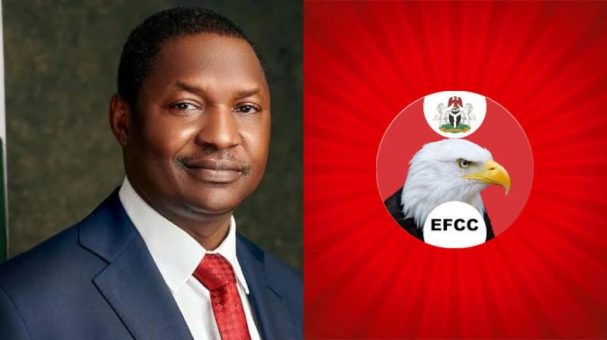
Former Attorney General of the Federation and Minister of Justice, Abubakar Malami, has dismissed allegations suggesting that individuals linked to him attempted to bribe the presiding judge in his ongoing trial.
In a statement issued on Wednesday, Malami’s media aide, Mohammed Bello Doka, described a recent press release by the Economic and Financial Crimes Commission, EFCC, as misleading and deliberately framed to imply an attempt to influence Justice Emeka Nwite of the Federal High Court, Maitama, Abuja.
The statement categorically denied that any member of Malami’s legal team, family, associates, or office approached or attempted to approach the judge for any favour, insisting that such insinuations were false and reckless.
According to the statement, Malami, a Senior Advocate of Nigeria and former Attorney-General, holds the judiciary in high regard and has full confidence in the integrity of Justice Nwite, noting that there was never any reason or intention to seek improper engagement with the court.
The statement further clarified that remarks attributed to Justice Nwite during court proceedings were general cautionary warnings routinely issued to all counsel and litigants appearing before him, and not directed specifically at Malami or any of the defendants.
Malami’s camp accused the EFCC of “weaponising” a routine judicial admonition and turning it into what it described as a sensational narrative aimed at damaging his reputation in the public space.
“The EFCC’s approach reinforces concerns that it is conducting a media trial instead of allowing the matter to be determined strictly on the basis of evidence and due process before the court,” the statement said.
It added that Malami and his co-defendants have submitted themselves to the jurisdiction of the court, complied with all lawful orders, and remain confident in the judicial process.
The statement urged the anti-graft agency to refrain from misleading the public or prejudicing ongoing proceedings through press releases, stressing that allegations should be proven in court rather than in the media.