

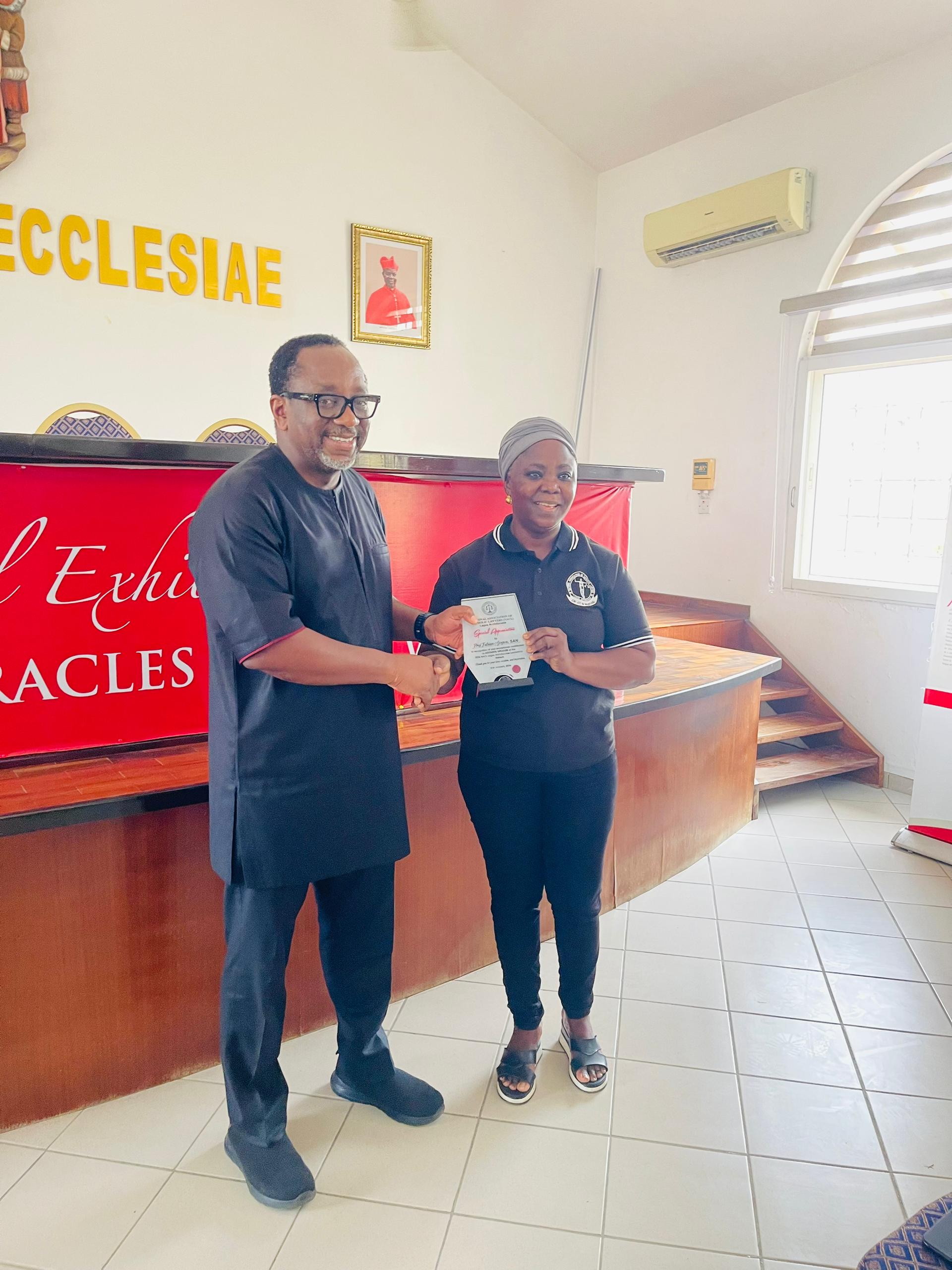
As part of its Leadership and Spiritual Retreat held at Mater Ecclesia Monastery, Sangotedo, Lagos, the National Association of Catholic Lawyers (NACL) Lagos Archdiocese was privileged to host a leadership session delivered through a paper titled “Leading with Legacy, Transitioning with Purpose: Strengthening Governance and Upholding the Mission of Catholic Legal Advocacy” by Professor Fabian Ajogwu, OFR, SAN.
The leadership talk came at a critical moment in the life of the Association, coinciding with a period of transition from the outgoing executive to a new administration. It provided a timely opportunity for reflection on leadership, governance, succession, and the enduring mission of Catholic legal advocacy.
Professor Ajogwu’s central message was clear: leadership is not defined by position or tenure, but by the institutions, values, and people a leader leaves behind. True leadership, he emphasized, is measured by sustainability—by whether an organisation is strong enough to thrive beyond the tenure of any individual. Leaders are therefore called not merely to “tell the time,” but to “build the clock” by putting in place systems, structures, and cultures that endure.
A key focus of the session was the concept of leadership legacy, described as the cumulative impact of a leader’s values, decisions, and institutional contributions. Legacy, the paper noted, begins from the moment leadership responsibility is assumed and is reflected in the strength of governance structures, clarity of vision, ethical culture, and continuity of purpose. Leaders were encouraged to ask a fundamental question: What will endure after my tenure?
The talk further explored the principles of effective leadership, highlighting the importance of character, purpose, responsibility, knowledge, and leading by example. Leadership was presented as a relational and cooperative endeavour—one that requires trust, accountability, and active engagement with those being led. Governance, in this context, was described not as a procedural requirement but as a moral responsibility, essential for safeguarding mission, ensuring transparency, and sustaining institutional credibility.
Particular emphasis was placed on stewardship as a model of leadership. Leaders, Professor Ajogwu explained, are custodians of the organisation’s mission, reputation, and resources, entrusted to act in the collective and long-term interest of the institution rather than for personal gain. This approach aligns naturally with the values of Catholic organisations, where leadership is understood as service.
The session also highlighted the indispensable role of Catholic social teaching in shaping values-based leadership and governance. Principles such as the dignity of the human person, solidarity, subsidiarity, the common good, and care for the vulnerable were identified as essential anchors for Catholic legal advocacy. When embedded into governance structures and daily operations, these principles ensure that the Association remains faithful to its spiritual foundation while responding effectively to contemporary challenges.
In the context of NACL’s leadership transition, the paper underscored the importance of deliberate succession planning, leadership development, and institutional memory. The outgoing executive was encouraged to view transition not as an end, but as a handover of stewardship—ensuring that successes are reviewed, lessons are documented, and clear recommendations are passed on to the incoming leadership.
Overall, the leadership talk provided a profound framework for reflection and action. It challenged current and future leaders of the Association to lead with integrity, intentionality, and faith, while strengthening governance structures that will preserve NACL’s mission for generations to come.
The session reinforced the retreat’s broader objective: to form leaders who are spiritually grounded, ethically guided, and committed to building an enduring legacy of service to the Church, the legal profession, and society at large.