
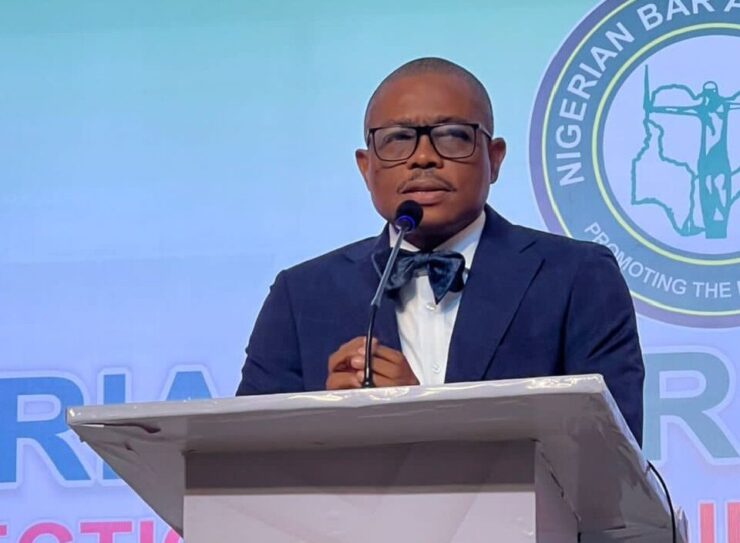
President of the Nigerian Bar Association (NBA), Mazi Afam Osigwe, SAN, has ignited a nationwide debate after describing members of the judiciary and legal profession as the worst perpetrators of bribery in Nigeria, warning that judicial corruption now poses a serious threat to democracy and social justice.
Osigwe sparked nationwide debate on Friday while delivering a lecture at the Ralph Opara Memorial Lecture organised by the National Association of Seadogs in Enugu. The lecture was themed “Judicial Corruption in Nigeria: A Menace to Democracy and Social Justice.”
At the event, the NBA president said members of the judiciary and legal profession were among the worst perpetrators of bribery in the country, lamenting that many court judgments are no longer based on evidence or the rule of law but on what he termed the “fatness of envelopes.”
“The judiciary, once revered as the last hope of the common man, is increasingly perceived as a marketplace where justice is auctioned to the highest bidder,” Osigwe said.
He described the situation as both a moral crisis and a democratic emergency, warning that public confidence in the justice system has been severely eroded.
To support his claims, Osigwe cited a 2024 survey conducted by the United Nations Office on Drugs and Crime (UNODC) in collaboration with the National Bureau of Statistics (NBS), which estimated that public officials received about ₦721 billion in cash bribes in 2023, with judges listed among the top recipients.
He also referenced an Independent Corrupt Practices and Other Related Offences Commission (ICPC) report showing that ₦9.4 billion in bribes flowed through the justice sector between 2018 and 2020, with lawyers and litigants identified as major bribe-givers.
According to him, the impact of corruption is reflected in Transparency International’s 2024 Corruption Perceptions Index, which ranked Nigeria 140th out of 180 countries. He warned that a compromised judiciary allows the wealthy and politically powerful to evade accountability, while the poor and vulnerable are denied justice.
Corruption allegations knock out 34 Federal High Court Judge nominees
No fewer than 34 lawyer, out of 62, nominated for appointment as Judges of the Federal High Court (FHC) were dropped in December 2025 after failing an integrity screening dominated by allegations of corruption and unethical conduct.
Multiple petitions submitted against them during the integrity review raised serious questions about their character, reputation, and suitability for judicial office.
The integrity test, introduced under new guidelines approved by the National Judicial Council (NJC) relies heavily on public feedback to expose misconduct.
Following the publication of the nominees’ names on 17 September 2025, members of the public and legal practitioners submitted petitions alleging bribery, abuse of office, and other corrupt practices.
One high-profile petition accused a female nominee of demanding and receiving bribes in the course of her official duties.
Investigations into the allegations yielded damaging findings, the Police Service Commission (PSC) confirmed that she had demanded and received N1 million bribe in relation to a court matter handled by her office.
Armed with these findings and similar other reports against other candidates, the Federal Judicial Service Commission (FJSC) upheld only 28 nominations, forwarding them to the NJC, while disqualifying the remaining 34 nominees for failing the integrity test.