
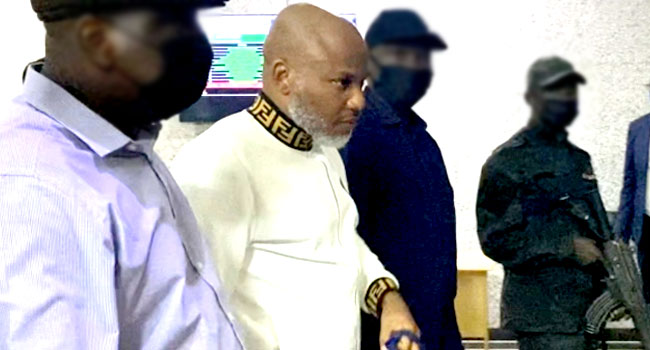
The Federal High Court in Abuja, presiding over the seven-count terrorism charge against the detained leader of the Indigenous People of Biafra (IPOB), Nnamdi Kanu, has reached a tense impasse, compelling the defendant to utilize a final opportunity to present his case or have his defense summarily foreclosed.
The courtroom drama on Wednesday hinged on Kanu’s refusal to open his defense, a position he reaffirmed while addressing the court from the dock. Conducting his own case after dismissing his legal team, the embattled IPOB leader maintained his core argument that the charge brought against him by the Federal Government was fundamentally invalid.
Kanu reiterated his reason for refusing to testify, insisting that the charge pending against him was based on what he described as a “repealed and non-existent law.” He argued that even the Supreme Court, when it upheld his trial, had directed that the charges be amended because they were legally defective. According to the defendant, the Federal Government’s subsequent failure to amend the charge was fatal, as the prosecution could not rely on obsolete legislation.
The crux of Kanu’s defiance was encapsulated in his rejection of the court’s order: “Terrorism Prevention and Prohibition Act has been repealed. I cannot put in defense under a repealed law. I won’t do that.”
Despite the defendant’s calculated resistance, the trial judge, Justice James Omotosho, chose to grant a final concession. The Justice, however, delivered a stern warning, cautioning that this was the very last chance before judicial action would be taken.
Justice Omotosho stated: “We had adjourned till today for the defendant to put in his defence or be deemed closed. But, I am bound to give him another opportunity to put in his defence. If he does not, I will deem him closed. I know that he is an Economist and not a lawyer. I will give the last opportunity to the defendant to put in his defence, failure of which he would be deemed closed.”
The judge anchored the decision on a commitment to fairness, saying the ruling “was anchored on tenets of justice that required that the defendant should be granted sufficient opportunity to exonerate himself.” The case was consequently adjourned to November 7 for Kanu to open his defense.
Conversely, the Federal Government’s counsel, Chief Adegboyega Awomolo, SAN, argued for the immediate closure of the defense, noting that Kanu had already squandered five of the six days allocated for his defense. The prosecution counsel drew the court’s attention to the defendant’s firm stance, arguing that Kanu’s insistence that the charge was defective reflected his “conclusive stance not to open his defence as directed.” Awomolo prayed for the court to close the defense and proceed to final written addresses.
Following the judge’s intervention, Kanu requested permission to consult with four lawyers who had previously represented him: Nnaemeka Ejiofor, Aloy Ejimakor, Maxwell Okpara, and Mandela Umegborogu, whom he referred to as his “consultants.”
Justice Omotosho granted the request but used the moment to issue a cautionary mandate. This followed a complaint from the prosecution counsel, who accused Kanu’s former lawyers of undermining the trial by granting media interviews and posting prejudicial commentary on social media. The Justice warned the named lawyers to refrain from discussing the court proceedings in the media.
This development marks a significant turning point after Kanu, who had initially named politically influential figures—including serving governors, ministers, and former security chiefs—among his 23 proposed witnesses, abruptly shelved his plan to defend the charge, opting instead to challenge the entire legal basis of the prosecution.