


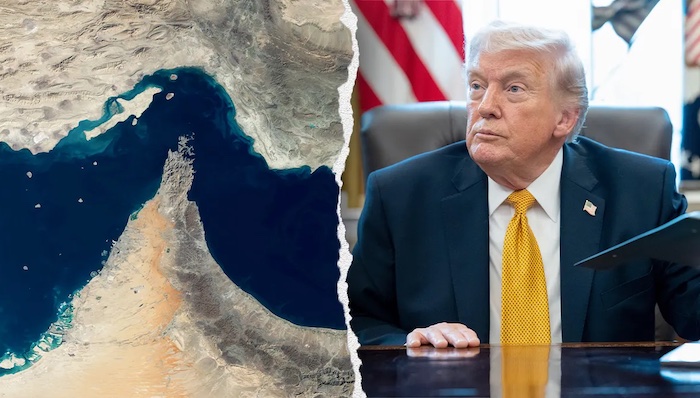
Iran has tied the reopening of the strategic Strait of Hormuz to a series of concessions from the United States, including compensation for damage caused by attacks, an end to sanctions and military threats against Tehran.
Iranian Foreign Minister Abbas Araqchi said an agreement with Oman on new shipping lanes through the strait was in its “final stages”, but stressed that the waterway would not reopen until Washington met Tehran’s conditions.
The development came after a US official said on Friday that Iran and Oman were close to an agreement that could pave the way for the restoration of safe passage through the strategic waterway, a major route for global oil and gas shipments.
Araqchi said the proposed agreement with Oman would establish new shipping lanes to be used once the United States fulfilled Iran’s demands and the strait was reopened.
Iran and Oman have been negotiating arrangements for shipping through the waterway after Iran blocked the strait in response to US and Israeli attacks on Tehran that began in late February.
Araqchi said Tehran was not prepared to reopen the channel solely on the basis of an agreement with Oman.
He also said Iran and the United States were not engaged in direct negotiations and that Tehran would not enter direct talks while Washington remained in breach of an interim agreement signed in June. Messages between the two sides, were being exchanged through intermediaries.
US President Donald Trump, speaking to Axios, said Washington was “low-keying” its engagement with Iran. “We are only semi-negotiating with them. We are just watching Iran with its huge inflation and the fact they have no money.”
Iranian officials have set out a broader list of conditions for restoring unrestricted shipping through the Strait of Hormuz.
Araqchi said the United States would have to compensate Iran for damage caused during the widespread attacks on the country.
Mohammad Baqer Zolqadr, secretary of Iran’s top national security body, separately listed an end to further US threats against Iran, an end to aggression against Iran and its allies in Lebanon, Palestine, Yemen and Iraq, the removal of a US naval blockade in the Gulf, the lifting of sanctions and the release of frozen Iranian assets.
The United States and Israel launched air strikes against Iran more than five months ago, with Trump saying the military campaign was aimed at preventing Tehran from developing nuclear weapons and reducing its ability to threaten the region.
Washington and Tehran subsequently agreed to a ceasefire in June, but the United States reimposed a blockade on Iranian shipping in the Gulf in July.
Tehran said the move violated the ceasefire, which had already begun to unravel.
A US official said Washington would lift the blockade of Iranian ports once an agreement was announced to restore commercial shipping without impediments. “Once the deal is announced to restore commercial shipping without impediments, the United States will lift the blockade of Iranian ports.”
The official added that US actions would depend on Iran implementing its commitments under any agreement.
The proposed arrangement has raised concerns among shipping operators, particularly over reports that it could give Tehran control over vessel traffic entering the Gulf through the strait.
Shipping industry sources have questioned whether such an arrangement would be practical.
The diplomatic developments have also unfolded amid renewed tensions around commercial vessels in the region.
The United Arab Emirates said Iran had attacked a vessel affiliated with its state oil company. Iran did not immediately comment on the allegation, although its Revolutionary Guard Corps has previously attacked ships it said attempted to cross the strait without Iranian permission.
The tensions around Hormuz have coincided with increased attacks by Iran-aligned Houthi forces in Yemen, who have targeted shipping around another major energy chokepoint between the Red Sea and the Gulf of Aden.
The Houthis last month declared a naval blockade against Saudi Arabia, saying it was in response to what they described as a Saudi siege in Yemen. Riyadh has denied the allegation.
The group also claimed responsibility for an attack on Saudi Aramco’s Jazan refinery on Sunday, two days after Saudi Arabia signed a defence pact with Turkey and Pakistan amid growing regional instability.
Saudi Arabia’s Energy Ministry confirmed that a fire broke out at the refinery but said it was later extinguished without injuries. It did not identify the cause.
Turkish Foreign Minister Hakan Fidan said the new defence alliance was not directed against Iran or any other country but was intended as a broader commitment to regional security.
Meanwhile, fighting between the Houthis and Yemeni government forces has intensified, with the Yemeni military saying seven people, including military personnel and civilians, were killed in a Houthi attack on the Red Sea port city of Mocha.
The military said air defences intercepted and destroyed 11 Houthi drones involved in the attack.