


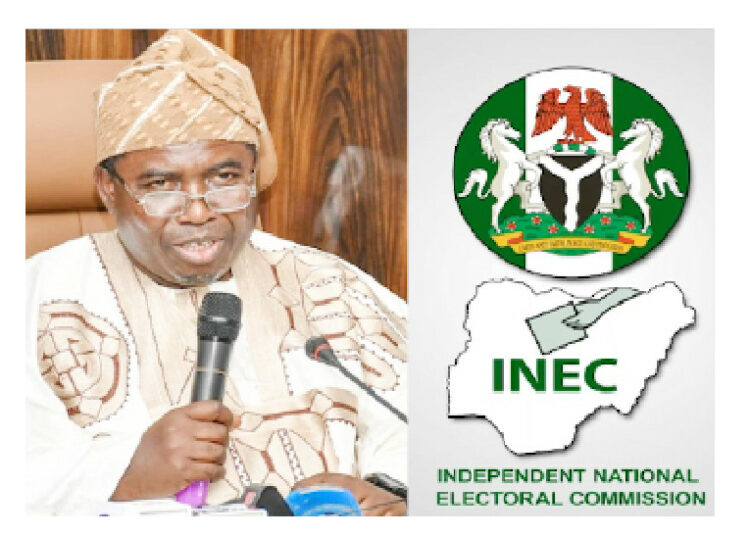
The Independent National Electoral Commission (INEC) has unveiled fresh measures to prevent a recurrence of the challenges that marred the 2023 general elections. The commission assured Nigerians that only verified results from polling units will be uploaded to its Results Viewing Portal (IReV) ahead of the 2027 polls.
Already, the Commission has fixed November 28, 2026, for a nationwide mock accreditation and voting exercise ahead of the 2027 general elections to test upgrades to its Bimodal Voter Accreditation System (BVAS) and electronic results transmission.
INEC Chairman, Prof. Joash Amupitan, disclosed this on Thursday while speaking on the Commission’s preparations for Nigeria’s 2027 general elections during a dialogue at Chatham House in London, organised in partnership with the Kimpact Development Initiative, on the theme, “Nigeria’s 2027 Elections: Democratic Trajectory and Regional Stability Beyond the Ballot.”
He said the commission had identified polling centres as the major source of result-management problems during the 2023 elections and was introducing additional checks to ensure that figures were properly verified before transmission. Amupitan said the Commission had learnt important lessons from the previous election and was determined to strengthen public confidence in the electoral process.
According to him, the Commission is introducing a new verification process to ensure polling unit results are verified by party agents before they are uploaded to IReV.
Responding to a question on why Nigerians should trust him to conduct credible elections, Amupitan cited the outcomes of recent off-cycle elections, particularly those in Anambra and Osun states, as evidence of improvements under his leadership.
Since taking over, he said INEC had conducted the Anambra governorship election, the Federal Capital Territory (FCT) Area Council elections, the Ekiti and Osun governorship elections, as well as 16 by-elections to fill vacancies in the National Assembly and state Houses of Assembly. He explained that the commission had treated each election as an opportunity to identify operational weaknesses and improve subsequent exercises.
According to him, Anambra and Osun were particularly challenging states because of their history of inconclusive governorship elections. He recalled that the Anambra governorship election in 2021 took about five days to conclude, but the recent exercise was completed much faster.
Amupitan, however, acknowledged that the credibility of the 2027 elections would depend not only on the outcome of off-cycle polls but also on the transparency of the entire electoral process.
He identified insecurity, logistics and result management as three major areas the commission was prioritising, saying INEC was working with security agencies to ensure that election materials and personnel reached polling units on time.
On result management, the chairman said the commission’s review of the 2023 elections showed that some of the major challenges occurred at collation centres, rather than at polling units. He said INEC had consequently introduced additional safeguards to ensure that results were checked for accuracy at polling units, in the presence of party agents, before they were transmitted to the INEC Result Viewing Portal (IReV).
“We decided that whatever is going to be uploaded from the polling unit is accurate. Because in 2023, there were all manner of things: results that were not correct, results that were full of over-voting, while you were uploading on the IReV. But now we have devised a safeguard.
“The moment it goes to IReV, you can believe what you see on IReV. And then this issue of inconsistency will be removed so that what will now be done at the collation will just be a matter of formality,” he said.
Amupitan also urged Nigerians to trust his leadership, acknowledging that the controversies surrounding the 2023 presidential election had significantly damaged public confidence in the electoral commission. “First and foremost, let me speak about what happened in 2023, which resulted in a significant trust deficit for INEC—damage so large that the Commission has not yet fully recovered from it,” he said.
The chairman also disclosed that security intelligence had uncovered a plot by bandits to attack INEC ad hoc personnel, particularly members of the National Youth Service Corps (NYSC), in a bid to disrupt the 2027 elections. He said the plot was uncovered through intelligence gathered under the Inter-Agency Consultative Committee on Election Security and the suspects were being prosecuted at the Federal High Court by the Department of State Services (DSS).
As part of the preparations, Amupitan announced that INEC would conduct a nationwide mock accreditation and voting exercise on November 28 to test its readiness for the 2027 presidential election. The exercise, he explained, would allow the commission to test its equipment and procedures, particularly voter accreditation and electronic transmission of results, before the general elections.
On concerns about his neutrality following allegations linking him to a controversial X account, the INEC chairman insisted that he had never operated the account and said the matter had been reported to security agencies. “I state here again that I have never operated an X account,” he said.