
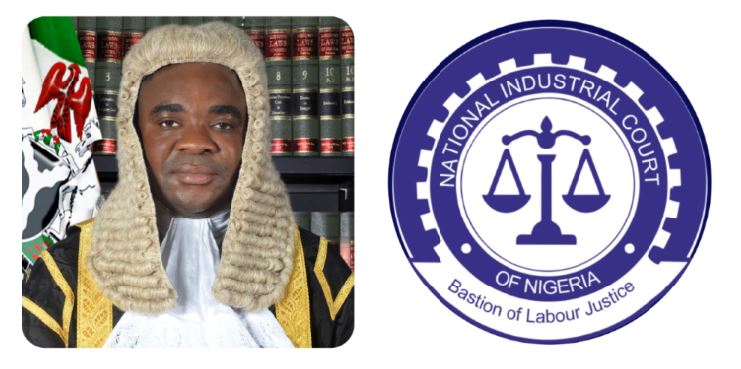
The National Industrial Court of Nigeria, Yenagoa Judicial Division, presided over by Hon. Justice Polycarp Hamman, has dismissed in its entirety the suit instituted by Mr. Tomvi against the National Identity Management Commission (NIMC) over the alleged unlawful stoppage of his salaries and entitlements.
Justice Hamman held that the claimant failed to establish any legal entitlement to the salaries, allowances, and damages claimed, having acted in breach of the Public Service Rules by embarking on an unapproved course of study.
From the record, Mr. Tomvi was employed in the Federal Public Service and subsequently deployed to serve under NIMC in various capacities. He contended that his employment remained valid and subsisting, and that NIMC unlawfully stopped his salaries and allowances from August 2013 without issuing a formal letter of termination or dismissal. He claimed over ₦26 million as accumulated salaries and emoluments for 125 months, together with interest, damages, and litigation costs.
In response, NIMC maintained that the claimant absented himself from duty without approval after his application for study leave with pay was expressly refused. The Commission stated that disciplinary measures were taken in line with the Public Service Rules, including queries for absenteeism and invitations to appear before a disciplinary committee. His salary stoppage, NIMC argued, was a lawful consequence of abandoning his duty post without authorization.
Counsel to NIMC, C. C. Nwaede Esq., submitted that an employee who absconds from duty cannot lawfully claim salaries for periods not worked, urging the Court to dismiss the suit for want of proof.
In a well‑reasoned decision, Justice Hamman held that although Mr. Tomvi’s employment enjoyed statutory flavour, such protection does not exempt an employee from complying with the same statutory rules governing service. The Court emphasized that the claimant was afforded fair hearing through queries and invitations to disciplinary proceedings, which he failed to honour, thereby undermining his allegation of procedural unfairness.
The Court further noted that Mr. Tomvi did not specifically identify or prove the provisions of the Public Service Rules allegedly breached by NIMC, as required in claims of wrongful disciplinary action.
Quoting the Court: “The law does not permit a party to benefit from his own wrongdoing. An employee who disregards lawful directives and absents himself without approval cannot turn around to demand salaries and damages from the employer.”
The Court consequently found no merit in the claims and dismissed the suit in its entirety, without any order as to costs.