


By Chinelo Audrey Ofoegbunam
Introduction – Justice Delayed by Infrastructure
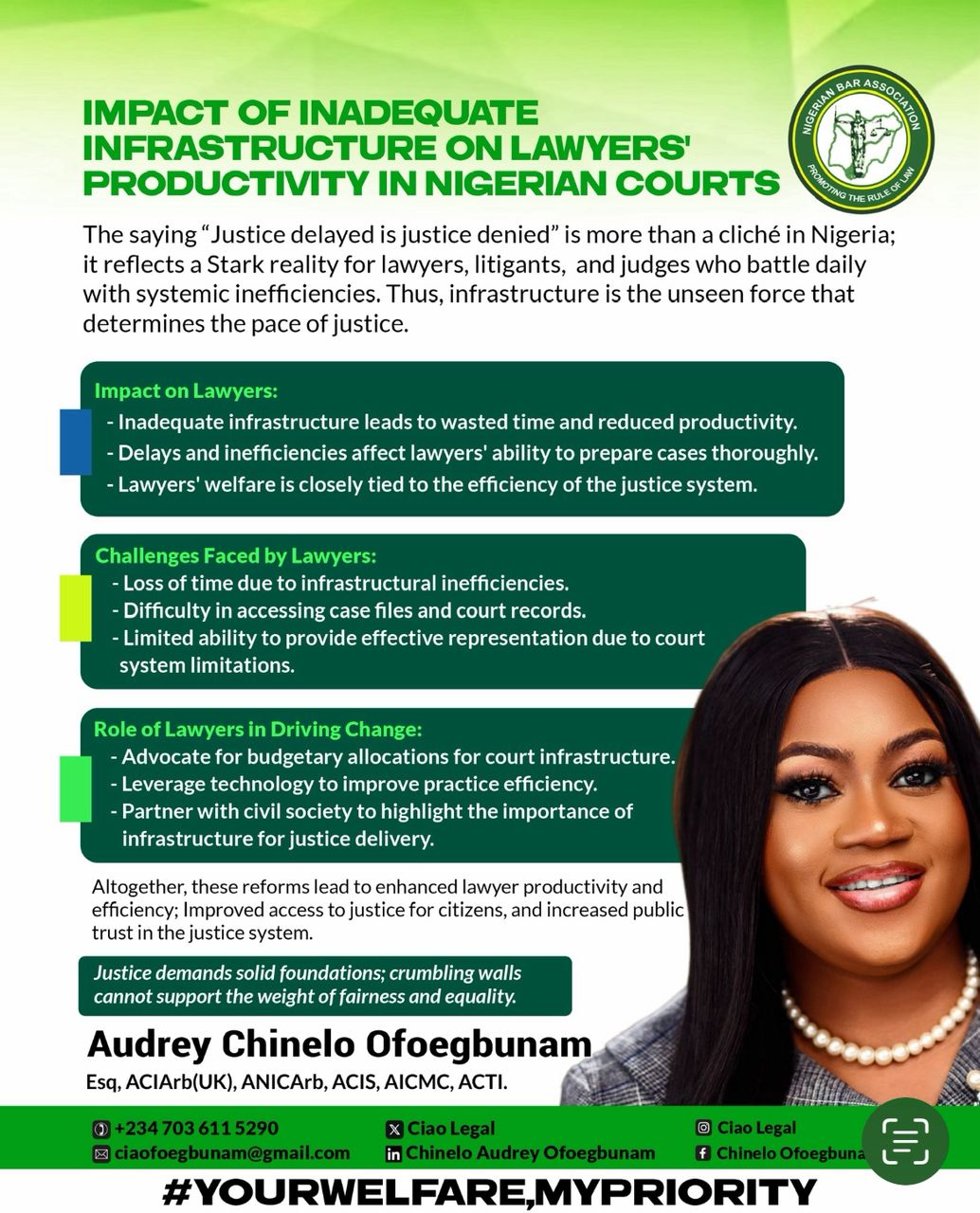
The saying “justice delayed is justice denied” is more than a cliché in Nigeria; it reflects a lived reality for lawyers, litigants, and judges who battle daily with systemic inefficiencies. While conversations about the Nigerian judiciary often revolve around legal reforms, judicial independence, or the need to expedite trials, there is another less glamorous but equally devastating challenge that undermines the promise of justice: the absence of adequate infrastructure in our courts.
Courtrooms across the country frequently operate under conditions that are far from conducive to the serious business of justice. Many have no functional air conditioning or ventilation, making proceedings uncomfortable and sometimes unbearable for judges, lawyers, and litigants who must sit for long hours. Power outages routinely stall hearings, forcing courts to adjourn cases simply because electricity is unavailable to power microphones, lighting, or recording devices.
Equally troubling is the lack of modern technological tools. Courts that should be equipped with functional audio-visual systems, e-filing platforms, and digital case management solutions often struggle with outdated or broken equipment. In an era where justice systems around the world are leveraging technology to improve access and efficiency, Nigeria’s infrastructural deficit leaves its courts lagging far behind.
These are not minor inconveniences to be brushed aside—they are structural barriers that shape the productivity of lawyers, prolong the journey of litigants, and diminish the credibility of the judiciary itself. A justice system cannot inspire public confidence when it is held hostage by broken furniture, missing files, or electricity failures. For lawyers, every infrastructural setback translates into wasted preparation, lost time, and diminished capacity to advocate effectively. For citizens, it often means more adjournments, mounting legal costs, and in too many cases, the denial of justice altogether.
Understanding Infrastructure in the Judicial Context
When most people think about judicial infrastructure, their minds immediately go to court buildings and furniture. But infrastructure, in the context of justice delivery, extends far beyond physical spaces. It represents the totality of systems, tools, and resources that enable the courts to function smoothly and uphold the rule of law.
1. Physical Facilities: This includes not only courtrooms and judges’ chambers but also libraries stocked with updated legal texts, organized filing systems, and adequate waiting areas for lawyers and litigants. A courtroom should symbolize dignity and order, yet many fail to meet even basic standards.
2. Technological Resources: In the 21st century, justice cannot thrive without technology. Computers, projectors, audio-visual aids for evidence presentation, case management software, and e-filing systems are no longer optional—they are global best practices. Their absence widens the justice gap and slows down proceedings that could otherwise be streamlined.
3. Utilities: Justice is paralyzed without reliable electricity, internet access, running water, and climate control. A judge cannot hear a case in a pitch-dark courtroom. Lawyers cannot file or retrieve documents if internet connectivity is unreliable. Even the simple absence of water supply can disrupt the dignity of proceedings for those present in court.
4. Human Support Systems: Courts are powered not only by judges and lawyers but also by a workforce of registrars, bailiffs, clerks, and administrative staff. When these individuals are ill-equipped, overworked, or undertrained, the entire justice system suffers. Their effectiveness depends on access to training, digital tools, and adequate remuneration.
For lawyers, these facilities are not luxuries. They are the minimum enabling conditions that determine whether they can present arguments effectively, manage their time efficiently, and represent clients adequately. Without them, productivity drops, costs rise, and ultimately justice delivery is compromised.
The Current State of Nigerian Court Infrastructure
Sadly, the condition of many Nigerian courts paints a troubling picture. From physical decay to technological stagnation, systemic inadequacies create an environment where justice struggles to survive.
1. Dilapidated Buildings
Although most courts buildings have been renovated, Inadequate lighting and poor ventilation still creates unbearable conditions for long sittings. Beyond discomfort, this also erodes the dignity of the judiciary and diminishes public trust in the system.
2. Electricity Challenges
Frequent blackouts are a constant threat to the smooth running of courts. Without reliable backup power supply, proceedings are often stalled, forcing adjournments and wasting precious judicial time. For lawyers, every interruption means lost billable hours, extended client engagements, and increased financial strain.
3. Overcrowding
In high-volume jurisdictions like Lagos, Abuja, and Port Harcourt, courtrooms are filled beyond capacity. Lawyers often struggle to find seating, with some forced to wait outside until their matters are called. Overcrowding not only reduces comfort but also contributes to disorderliness, distractions, and heightened stress for all involved.
4. Limited Technology
While a few jurisdictions have piloted e-filing systems and digital case management, implementation is inconsistent and often poorly maintained. Many lawyers still physically travel long distances to file documents, sometimes queuing for hours. The absence of reliable audio recording and transcription tools further slows down trials, as judges must take handwritten notes, a practice that consumes valuable court time.
How Inadequate Infrastructure Impacts Lawyers’ Productivity
Lawyers are at the frontlines of justice delivery, and their productivity is inseparably tied to the quality of the court environment in which they work. Inadequate infrastructure does not merely inconvenience lawyers; it fundamentally alters the way they plan, execute, and sustain their practice.
1. Wasted Billable Hours
Time is a lawyer’s most valuable asset. Yet, in many Nigerian courts, hours are lost to avoidable disruptions—power outages, adjournments due to malfunctioning recording systems, or judges unable to sit because of infrastructural breakdowns. Lawyers often spend entire days in court only to discover their matter will not be heard. These lost hours are rarely recoverable and represent a significant drain on productivity and income.
2. Increased Financial Costs
Beyond wasted time, infrastructural inadequacies translate directly into higher operating costs. Frequent adjournments mean repeated journeys to and from courts, sometimes across states. Lawyers incur costs for transportation, accommodation (when hearings are in distant jurisdictions), and endless printing due to the absence of reliable digital systems. These expenses reduce profitability, especially for young practitioners who already operate on slim margins.
3. Emotional and Mental Strain
The practice of law is demanding even under ideal conditions, but in Nigeria, inadequate infrastructure amplifies stress. Imagine preparing intensively for a case only for the hearing to be adjourned because electricity failed or the courtroom was too congested to accommodate all parties. The cycle of frustration, coupled with financial strain, contributes to burnout and diminishes focus. Over time, this erodes the passion and zeal that many lawyers once brought into the profession.
4. Reduced Client Confidence
To the ordinary litigant, the lawyer is the visible face of justice. When cases are delayed or adjourned repeatedly due to infrastructural failings, clients often misdirect their frustration towards their counsel. They assume inefficiency, incompetence, or a lack of diligence on the lawyer’s part, damaging the client-counsel relationship. Trust is eroded, referrals decline, and the lawyer’s professional credibility suffers—through no fault of their own.
Comparative Insights – What Other Jurisdictions Get Right
A glance at other legal systems underscores how infrastructure directly improves justice delivery:
1. United Kingdom: Courts operate with advanced digital filing and scheduling systems. Lawyers can file documents electronically, track cases online, and avoid unnecessary physical appearances. The reduction in paperwork and adjournments saves both time and costs.
2. South Africa: Many courts are equipped with modern libraries, reliable electricity, and adequate facilities for staff and practitioners. This creates an environment where lawyers can prepare effectively and where proceedings are less frequently interrupted by technical breakdowns.
3. United States: Remote hearings through video conferencing have become mainstream, particularly since the pandemic. This not only reduces travel costs but also accelerates the pace of litigation. Lawyers and clients save valuable time while still accessing justice.
These examples show that when infrastructure is prioritized, lawyers’ productivity increases, client satisfaction improves, and justice delivery becomes more efficient.
Hidden Costs of Inadequate Infrastructure
The consequences of inadequate judicial infrastructure stretch beyond lawyers; they touch the entire society and economy.
1. Justice Delays: Lawyers who lose time to infrastructural inefficiencies cannot prepare cases as thoroughly, and courts cannot hear matters promptly. This worsens the already congested dockets across Nigerian courts.
2. Economic Implications: Investors consider reliable dispute resolution mechanisms before committing capital. A court system plagued by delays and infrastructural failings discourages foreign investment and undermines Nigeria’s economic competitiveness.
3. Erosion of the Rule of Law: A justice system that struggles with leaking roofs, missing files, or power outages cannot command the confidence of citizens. When people lose faith in the courts, they turn to self-help or alternative means of dispute resolution, weakening the authority of the judiciary and the stability of the rule of law.
In sum, inadequate infrastructure is not just a professional inconvenience for lawyers—it is a national problem that affects access to justice, economic development, and the very fabric of democracy.
Pathways to Reform – Building Productive Courts
1. Court Infrastructure Upgrades
Many courts across Nigeria have already undergone partial renovations, with some improvements in seating, air-conditioning, and basic amenities. However, the real challenge lies in maintenance and monitoring. Renovated facilities often fall back into disrepair because no system exists for routine upkeep. To build truly productive courts, infrastructure upgrades must be complemented by a structured maintenance plan, periodic inspections, and accountability for those responsible for neglect. A culture of sustainability, rather than ad hoc renovation, is what ensures long-term functionality.
2. Digitization and E-Filing
E-filing platforms and digital registries have already been introduced in many jurisdictions, but they often suffer from downtime, poor user support, or inconsistent application. What is needed now is continuous system maintenance, timely software upgrades, and stronger IT support for lawyers and staff. Courts must also put in place monitoring mechanisms to ensure digital platforms are consistently used and not circumvented. Retraining staff and sensitizing lawyers on proper usage will ensure that digitization achieves its purpose—speed and transparency.
3. Reliable Power Supply
Solar systems, inverters, and standby generators have been installed in some court complexes, but many are either non-functional or poorly managed. The reform pathway here is not necessarily new installations but sustaining what already exists. This requires proper monitoring, strict accountability for neglect, and budgetary allocations for regular servicing of backup power systems. Courts that fail to maintain these resources should have responsible officers sanctioned, serving as deterrents for others.
4. Training for Court Staff
Several training programs have been conducted for registrars, bailiffs, and administrative staff on case management tools and digital processes. However, training cannot be a one-off event. There is a need for continuous retraining, refresher courses, and monitoring of implementation. Staff who fail to apply learned skills should be held accountable, while outstanding staff should be incentivized. Enforcement of professional standards is as important as the training itself.
5. Remote Hearings
COVID-19 accelerated the introduction of virtual court sittings, but many courts have since reverted to physical-only hearings. To make remote hearings productive, courts must encourage and institutionalize virtual sittings for non-contentious and preliminary matters. Judges should be given discretion to mandate virtual hearings where appropriate, thereby saving time, decongesting courtrooms, and improving access to justice. Proper monitoring of technological infrastructure and retraining of staff on virtual platforms will ensure these hearings run smoothly.
Role of Lawyers in Driving Change
Lawyers themselves are not passive victims. They can:
• Advocate for budgetary allocations for court infrastructure.
• Leverage technology in their own practices (e.g., electronic filing, virtual consultations).
• Partner with civil society to highlight the link between infrastructure and justice delivery.
By raising their voices, lawyers can push for systemic reforms that benefit both the profession and society.
The Future of Nigerian Courts – A Vision of Efficiency
Imagine a Nigerian court system where:
• Every case file is accessible online.
• Lawyers attend hearings virtually when physical presence is unnecessary.
• Courtrooms are fully equipped with electricity, internet, and modern facilities.
• Proceedings are recorded and transcribed instantly.
Such a system would not only enhance lawyer productivity but also restore public trust in justice delivery.
Conclusion – Infrastructure as Justice Itself
Infrastructure is not a peripheral issue in justice—it is justice. When lawyers spend hours waiting in dilapidated courtrooms or chasing missing files, their productivity declines, clients suffer, and justice delivery stalls.
Nigeria’s courts cannot afford to operate on 20th-century infrastructure in a 21st-century world. By prioritizing infrastructural development, both the productivity of lawyers and the credibility of the justice system will be restored.
Justice must not only be fair and timely; it must also be built on solid foundations. The gavel cannot drop effectively if the walls around it are crumbling.
Connect with me on Social Media:
X: CIAO Legal
LinkedIn: Chinelo Audrey Ofoegbunam
Instagram: CIAO Legal
Facebook: Chinelo Ofoegbunam