

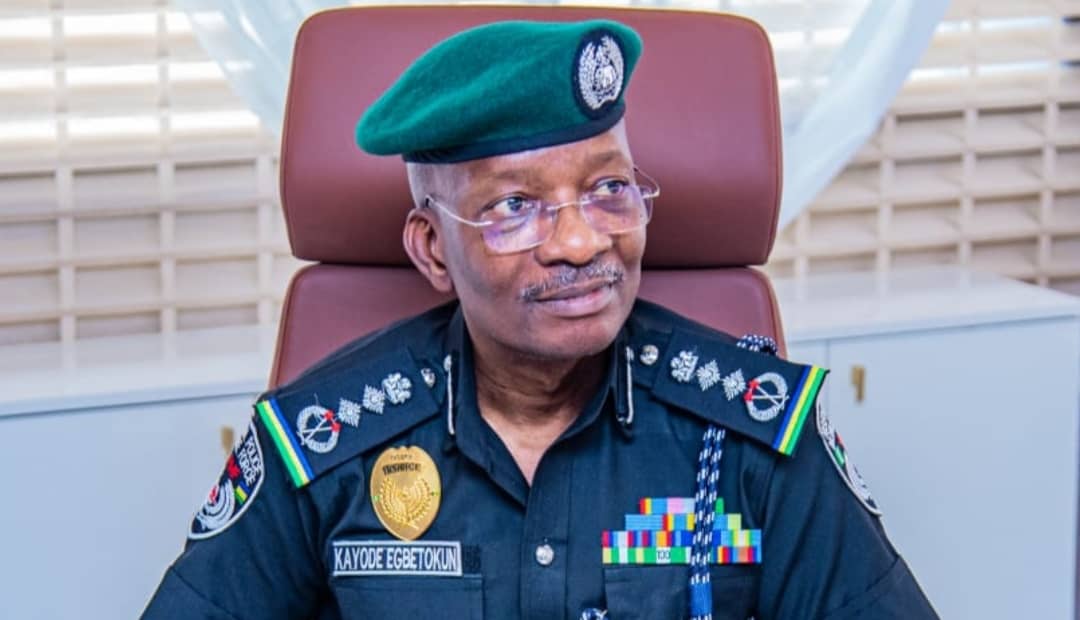
The Inspector-General of Police, IGP, Kayode Egbetokun, has described Nigeria’s banking sector as a vital national asset and directed an urgent, intelligence-driven offensive against cybercrime rings, internal collaborators, and cross-border financial syndicates undermining the system.
He made this known during a strategic engagement with the Chartered Institute of Bankers of Nigeria and the Body of Bank Chief Executive Officers in Lagos, where he said the Nigeria Police Force was shifting from reactive policing to proactive dismantling of organised criminal structures targeting banks.
According to him, the financial sector remains central to national stability.
He said:“The Nigerian banking industry is not merely a driver of economic activity; it is a core component of our national stability architecture.
The integrity, continuity, and resilience of the financial system are directly linked to public confidence, investor perception, and the credibility of Nigeria’s economic governance.”
Egbetokun also unveiled a major operational change, announcing that regular police personnel would no longer be assigned to routine cash-in-transit duties or non-essential private-sector VIP protection. He noted that the move aligns with manpower optimisation and national security priorities.
“This policy adjustment is not designed to diminish the security framework supporting the banking industry. Rather, it reflects a deliberate transition towards a more sustainable, professional, and institutionally governed model of security support,” he said.
He warned that traditional threats such as armed robbery and cash-in-transit attacks have been overtaken by more advanced and technology-driven crimes.
“These threats are adaptive, technologically sophisticated, and often coordinated across borders. They include cyber-enabled fraud, identity compromise, insider facilitation, organised financial crime, and illicit financial flows,” he told the bankers.
The IGP further stressed that disruptions in banking operations now carry global reputational risks, especially under standards set by the Financial Action Task Force and Anti-Money Laundering/Combating the Financing of Terrorism requirements.
He said: “In an era shaped by FATF standards, AML/CFT obligations, and heightened scrutiny of financial flows, the strength of a nation’s enforcement and security architecture is now directly relevant to investor confidence and market stability.”
The police leadership also highlighted the need for rapid response and stronger collaboration, noting:“The speed and sophistication of cyber-enabled fraud illustrate the urgency of integration.
Delayed reporting windows can render enforcement ineffective, while rapid escalation, evidence preservation, and coordinated response can significantly improve disruption, recovery, and prosecution outcomes.
“Modern financial crime operates at a pace that requires equally modern security coordination.”
Egbetokun revealed that covert operations had been intensified against kidnapping gangs, illegal arms dealers, and organised crime networks threatening commercial activities.
He added that collaboration was being strengthened with the Economic and Financial Crimes Commission, the Nigeria Financial Intelligence Unit, and the Central Bank of Nigeria to close enforcement and regulatory gaps.
He emphasised that lasting security requires continuous engagement rather than fragmented efforts, calling for formal cooperation frameworks between banks and law enforcement.
“Security is not merely the absence of crime; it is the presence of stability that enables productivity, investment, and growth. A secure banking environment supports savings mobilisation, credit expansion, financial inclusion, and the confidence of both domestic and international investors.
“When citizens trust financial institutions, participation in the formal economy increases. When investors perceive a stable internal security environment supported by credible enforcement, Nigeria becomes more bankable, more investable, and more competitive.
“The outcome of this meeting should not be limited to dialogue. It should produce structured liaison mechanisms between law enforcement and the banking sector, clear operational protocols for high-risk areas, joint capacity building, and lawful information-sharing.
“The Nigeria Police Force stands ready to work with the banking sector not merely as an enforcement institution, but as a strategic partner in safeguarding the integrity, stability, and international credibility of Nigeria’s financial architecture,” he said.
Earlier, Chairman of the Body of Bank Chief Executive Officers, Oliver Alawuba, commended the police leadership for security interventions and recalled past industry support.
He said: “The Bankers’ Committee was responsible for the renovation of over 42 police stations that were destroyed during the EndSARS protests. We stepped in when police infrastructure was in ruins. Today, we expect that same urgency when our own infrastructure is under digital siege.”
Also speaking, CIBN President, Pius Olarenwaju, warned that cyber threats were outpacing conventional law enforcement responses.
“The banking sector plays a pivotal role in Nigeria’s economic development, and our critical functions can only flourish in a secure and stable environment. But we are fighting a war where the enemy no longer carries guns , they carry laptops and exploit system vulnerabilities in milliseconds,” he told the IGP.
He added that digital expansion had widened exposure to cyber risks.
“As we deepen financial inclusion and expand digital channels, we also expand the attack surface for cybercriminals.
The same technology that empowers the unbanked also empowers fraudsters operating from jurisdictions where Nigerian law enforcement has no reach. This is the new reality, and we need the police to evolve with it,” he said.
The meeting was attended by managing directors and chief executives from leading banks, including Union Bank of Nigeria, Signature Bank Nigeria, Parallex Bank, Standard Chartered Bank, Keystone Bank Limited, Coronation Merchant Bank, Guaranty Trust Bank, and United Bank for Africa, among others.