

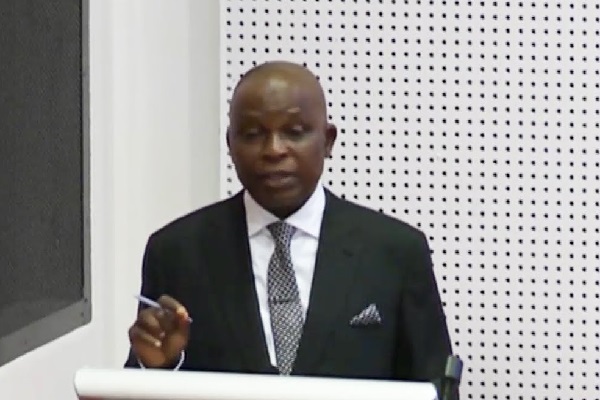
The Attorney-General of the Federation and Minister of Justice, Prince Lateef Fagbemi, SAN, has challenged Nigerian lawyers attending the International Bar Association, IBA, Annual Conference in Copenhagen, Denmark, to return home with practical ideas, partnerships and solutions capable of strengthening Nigeria’s justice system.
Fagbemi gave the charge on Tuesday at an official reception he hosted for the Nigerian delegation to the conference at The Plant CPH, Raffinaderivej, Copenhagen.
The reception, which was moderated by Channels TV’s Deputy News Editor & judiciary correspondent, Shola Soyele, brought together Senior Advocates of Nigeria, members of the Nigerian legal delegation, government officials, members of the Nigerian community in Denmark and other invited guests.
Speaking at the event, the Attorney-General said the IBA conference offered Nigerian lawyers an opportunity to engage the global legal community, exchange ideas and learn from developments in other jurisdictions.
He, however, stressed that the greater responsibility was to consider how such knowledge could be adapted to address Nigeria’s own justice-sector challenges.
“Our greatest responsibility is not simply to learn what the world is doing, rather it is to examine what Nigeria must do better,” he said.
Fagbemi described lawyers as occupying a unique position in national development, noting their role in defending liberty, strengthening institutions, resolving disputes and giving practical meaning to the rule of law.
He said no single institution could provide all the answers to the challenges confronting the justice system, making collaboration among the Bar, Bench, government, academia and the private sector imperative.
“Government does not have all the answers. The private Bar does not have all the answers. The Bench does not have all the answers.
“But when the Bar, the Bench, the government, academia and the private sector bring their experience together, we can build a justice system worthy of the aspirations of our people,” he said.
The Attorney-General said the administration of President Bola Ahmed Tinubu remained committed to strengthening the rule of law, improving access to justice, modernising the administration of justice, strengthening prosecution and law-enforcement institutions, promoting respect for human rights and creating a legal environment in which citizens could have confidence.
He acknowledged, however, that significant work remained to be done.
“There is still much work to be done. Justice must become faster. Our institutions must become stronger. Technology must increasingly support the delivery of justice.
“And above all, the Nigerian citizenry must increasingly feel the presence of justice, not merely read about its prominence in our statutes,” Fagbemi said.
The Minister also reminded the delegates that their conduct and professional contributions at international gatherings had implications for Nigeria’s global image.
“Wherever Nigerian lawyers gather internationally, we carry more than our practising certificates. We carry Nigeria’s reputation. Our conduct, competence and contributions tell a story about our heritage,” he said.
Fagbemi urged the delegates to use the conference to build meaningful partnerships and identify global best practices that could be adapted to Nigeria’s circumstances.
He said the goal should be more than attending sessions and expanding professional networks.
“I therefore encourage every member of the delegation to use this IBA conference not merely to collect souvenirs but to collect ideas, not merely to build networks but to build bridges, and not merely to discuss global best practices but to ask how those practices can be adapted to strengthen our justice system,” he said.
“Let us return with knowledge. Let us return with partnerships. Let us return with solutions.”
The Attorney-General also called for a closer relationship between the Federal Government and the legal profession, saying disagreements between government and the Bar should ultimately contribute to strengthening Nigeria’s constitutional and institutional framework.
“There should never be an artificial wall between the government and the Bar. We may sometimes disagree. Indeed, lawyers are professionally trained to disagree, but a disagreement must ultimately serve the same objective, a stronger constitution, stronger institutions, justice for our people, and a better Nigeria,” he said.
Fagbemi described the reception as an opportunity for friendship, fellowship and partnership among members of the Nigerian legal community, urging participants to strengthen existing relationships and establish new ones.
Also speaking, Nigeria’s Ambassador to Sweden, with concurrent accreditation to Denmark, Finland and Norway, Ambassador Sulola Akande, welcomed the Nigerian delegation to Copenhagen and expressed optimism about deeper cooperation between Nigeria and the Nordic countries.
Akande said Nigeria’s participation in the IBA conference demonstrated the country’s active contribution to the development of law both nationally and internationally.
She identified trade and investment, innovation, technology and knowledge exchange as areas with considerable potential for stronger cooperation between Nigeria and the Nordic countries.
The Ambassador disclosed that she presented her letters of credence to the King of Sweden on September 16, 2026, and was scheduled to present her letters of credence to the King of Denmark on October 8, 2026.
Akande said she looked forward to working closely with the Nordic countries to deepen relations with Nigeria.
She described the Embassy’s role as building bridges among governments, businesses, institutions and people, with responsibilities spanning political and economic diplomacy, trade and investment promotion, consular protection and assistance, protocol and people-to-people relations.
According to her, the IBA conference came at an important time in Nigeria’s engagement with the Nordic region, particularly as the country seeks to deepen trade, investment, innovation and institutional cooperation.
She stressed that a strong understanding of the legal and regulatory frameworks governing such relationships would be essential, adding that the Nigerian legal profession had an important role to play.
In a goodwill message, the Minister of State for Water Resources and Sanitation, Bello Muhammad Goronyo, commended Fagbemi for his leadership and for organising the reception for Nigerian lawyers attending the IBA conference.
Goronyo said the gathering provided an opportunity for members of the Nigerian legal profession to reflect on the development of the profession and Nigeria’s capacity to compete in the international legal market.
He called for the emergence of larger Nigerian law firms capable of competing effectively for international legal assignments.
According to him, Nigerian lawyers must look beyond individual interests and work towards building stronger institutions and law firms capable of competing with major international firms.
He also urged participants to take lessons from the IBA conference back to Nigeria and apply them to the development of the legal profession and professional gatherings.
“The time is now; we can’t wait till tomorrow, because tomorrow will be too late,” Goronyo said.
The reception organized by the Attorney General of the Federation and the Federal Ministry of Justice as part of activities surrounding Nigeria’s participation in the 2026 IBA Annual Conference in Copenhagen had in attendance notable names like the Chairman of the Economic and Financial Crimes Commission, Ola Olukoyede, the 1st Kuliyan N’geri of the historic Ilorin Emirate, Professor Yusuf Ali, SAN and a Justice of the Court of Appeal, Justice Olasumbo Goodluck.
Others are the Director General of the Nigeria Law school, Mrs Gbemi Odusote, the Attorney General & Commissioner For Justice, Lagos, Mr. Lawal Pedro (SAN) former Attorney-General and Commissioner for Justice of Ekiti State, Wale Fapohunda, SAN as well as Attorneys General of several other states.