
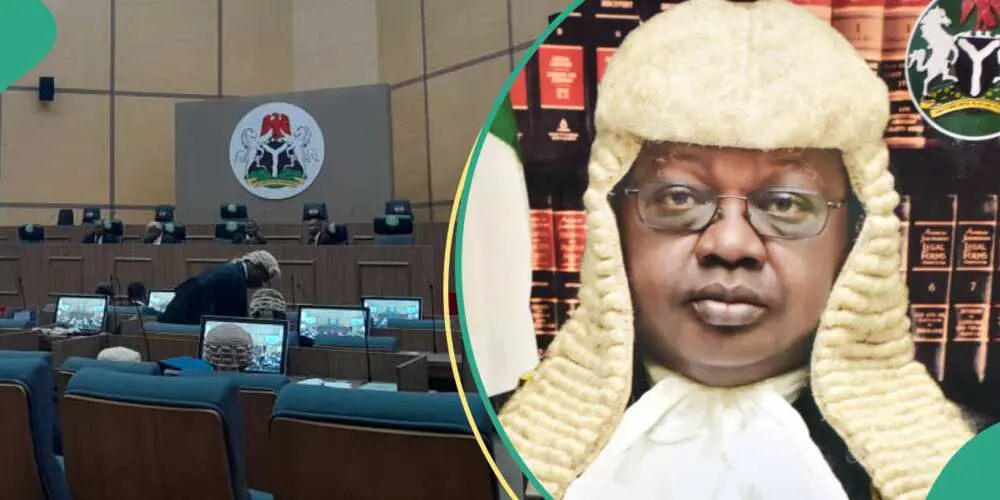
A retired Justice of the Supreme Court of Nigeria, Hon. Justice Musa Muhammad Dattijo, has firmly denied claims by former Kano State governor and national leader of the New Nigeria People’s Party (NNPP), Rabiu Musa Kwankwaso, that he visited the homes of Supreme Court justices to plead over Abba Yusuf’s governorship election dispute.
Justice Dattijo made it clear that his response was strictly personal, stressing that at no point during his tenure on the Supreme Court did he meet Kwankwaso or Governor Yusuf, either in relation to the election case or any other matter.
His clarification followed public remarks by Kwankwaso, who alleged that after the 2019 Kano governorship election was declared inconclusive, he personally took Yusuf to the residences of all Supreme Court justices to seek intervention.
Kwankwaso made the claim while addressing supporters at his residence in a video circulated by his media aide, Saifullahi Hassan. In the footage, he said:
“I had forgotten that in 2019, I took him to the homes of all the Supreme Court justices in Nigeria to beg them. The governor and I met them in their villages and towns.”
However, Kwankwaso did not name any of the justices he allegedly visited or provide details of the meetings.
In a statement obtained by Law & Society Magazine, Justice Dattijo—who retired from the Supreme Court on October 27, 2023—challenged Kwankwaso to substantiate his claims with specifics, while cautioning that his response should not be taken as a collective denial on behalf of the judiciary.
“I speak only for myself,” the retired justice said, emphasizing that he was a serving justice at the time of the alleged visits and never held such a meeting with Kwankwaso or Governor Yusuf.
He added that if Kwankwaso stands by his account, he should disclose when and where the meetings took place, who was present, and which justices were involved, warning that sweeping statements risk tarnishing the reputation of judicial officers who may have had no connection to the matter.
Justice Dattijo cautioned politicians against dragging judges into partisan controversies, noting that unverified allegations further deepen public distrust in the judiciary.
While acknowledging that public confidence in Nigeria’s courts has declined over the years, he recalled a sentiment from his valedictory speech in which he described public attitudes toward the judiciary as “witheringly scornful and monstrously critical.” Nonetheless, he stressed that accountability must be pursued through evidence and due process, not political narratives.
“My intervention is not intended to defend or indict anyone else,” he said. “It is simply to clarify that I was not part of any such engagement.”
He referenced the 1999 Constitution, noting that although freedom of expression is guaranteed, it is not absolute—particularly where statements risk damaging reputations or undermining public institutions.
Justice Dattijo also framed his response within his faith, citing Qur’an Chapter 4 (An-Nisa), Verse 135, which urges believers to stand firmly for justice, even against themselves or those close to them. He warned that societies decline when wrongdoing is ignored, normalized, and ultimately celebrated.
Quoting organisational psychologist Adam Grant, the retired justice added that integrity demands loyalty to principles rather than personalities, arguing that meaningful judicial reform must be rooted in honesty, restraint, and collective responsibility.
Kwankwaso made his remarks amid political tension following Governor Abba Yusuf’s defection from the NNPP to the All Progressives Congress (APC)—a move he described as the greatest political betrayal of his life. He said it would have been preferable for Yusuf to join a new political platform rather than defect to what he called political adversaries.
Revisiting the 2019 election, Kwankwaso described the process as unjust. That election, in which Yusuf was the Peoples Democratic Party (PDP) candidate, was declared inconclusive after Yusuf led with 1,014,353 votes against 953,522 votes scored by then-Governor Abdullahi Ganduje of the APC, with over 100,000 votes cancelled.
Following a supplementary poll across 28 local government areas, Ganduje was declared winner. The Supreme Court later dismissed Yusuf’s appeal in January 2020, affirming Ganduje’s victory.
Kwankwaso and Yusuf subsequently defected from the PDP to the NNPP, on whose platform Yusuf won the 2023 Kano governorship election, backed by the Kwankwasiyya political movement. Although Yusuf’s victory was initially overturned by the election tribunal and the Court of Appeal, the Supreme Court in January 2024 reinstated him, faulting the lower courts and restoring cancelled votes.
That judgment remains one of the most consequential electoral rulings in Nigeria’s recent democratic history.
Governor Yusuf formally resigned from the NNPP last Friday, citing internal crises and prolonged leadership disputes within the party, a development that has intensified political tensions in Kano.
Justice Dattijo’s intervention has sharpened the controversy by drawing a clear line between personal denial and institutional judgment, while shifting the burden of proof back to Kwankwaso.
As of the time of this report, Kwankwaso had not responded to the retired justice’s challenge to provide specific details of the alleged visits, including dates, locations, and the identities of the justices involved.