

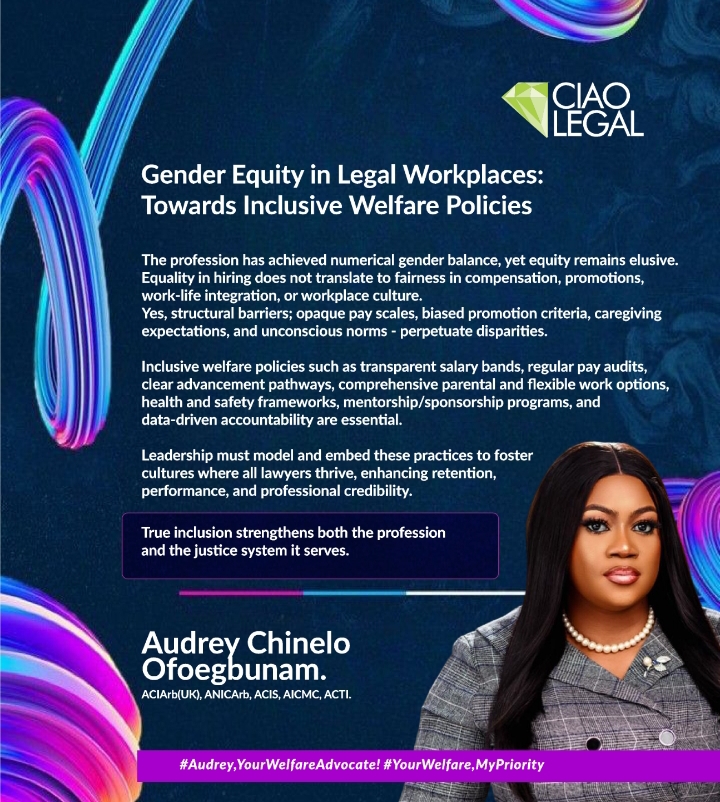
By Chinelo Audrey Ofoegbunam
Introduction
Over the past decades, the legal profession has made visible progress in gender representation. Lecture halls are filled with talented women. Admission lists reflect growing balance. In many jurisdictions, women now enter the profession in numbers equal to—or exceeding—their male counterparts. On paper, this signals advancement.
Yet representation alone does not guarantee equity. Numerical equality measures presence; substantive equity measures experience. A workplace may appear balanced in composition while remaining uneven in opportunity, compensation, visibility, or support. When welfare outcomes differ despite similar representation, the issue is no longer access—it is structure.
True inclusion requires policies that reflect lived realities. It is insufficient to count how many women occupy seats in chambers or boardrooms; institutions must examine how those professionals experience workload distribution, promotion pathways, caregiving expectations, and workplace culture. Welfare policies must be responsive to the realities of professional life, not merely symbolic affirmations of equality.
Gender equity is therefore not a peripheral concern. It is central to institutional sustainability and professional excellence. Workplaces that fail to address structural disparities risk losing talent, weakening morale, and perpetuating avoidable inequities. Conversely, inclusive welfare policies strengthen retention, performance, and reputation. A profession built on principles of justice must embody those principles internally.
1. Understanding Gender Equity in Legal Context
Gender equity in legal workplaces begins with conceptual clarity. Equality and equity are not synonymous. Equality treats individuals the same regardless of circumstance. Equity recognizes that different realities may require different forms of support to achieve fair outcomes. In workplace policy, equality ensures uniform rules; equity ensures that those rules produce balanced results.
Structural barriers often operate subtly. They may not arise from overt discrimination, but from longstanding systems designed around traditional professional norms. For example, career advancement models built on uninterrupted service may inadvertently disadvantage professionals who take caregiving leave. Evaluation criteria emphasizing constant availability may overlook alternative forms of productivity.
It is important to distinguish between individual challenges and systemic patterns. When disparities consistently emerge along gender lines—whether in compensation, leadership representation, or retention—attention must shift from personal explanations to structural analysis. Systems, not individuals, require adjustment.
Workplace systems can unintentionally disadvantage certain groups through opaque promotion processes, informal networking cultures, or unstructured allocation of high-value assignments. Without deliberate safeguards, opportunities may circulate within familiar networks, limiting access for others.
Inclusive welfare policies benefit the entire profession. When compensation structures are transparent, all lawyers gain clarity. When parental leave policies are normalized for both men and women, caregiving becomes a shared responsibility. When psychological safety is prioritized, professional performance improves across the board.
Gender equity is not a concession to one group; it is a refinement of institutional design. By ensuring that policies produce fair and sustainable outcomes, legal workplaces reinforce their commitment to justice—not only in advocacy, but within their own structures.
2. Pay Equity and Transparent Compensation Structures
Compensation is one of the most measurable indicators of workplace equity. Yet across many legal institutions, disparities in earning patterns persist. These differences may not always arise from explicit discrimination; they often reflect accumulated structural imbalances differences in client access, assignment allocation, visibility in high-value matters, or negotiation leverage.
Opaque compensation systems frequently intensify these disparities. When salary determinations, bonus structures, or profit-sharing formulas are unclear, informal dynamics tend to dominate. Decisions influenced by personal discretion, undocumented performance factors, or private negotiations create uneven outcomes. Transparency, by contrast, introduces accountability.
Structured salary bands provide one safeguard. Clear compensation ranges aligned with role, experience level, and performance criteria reduce subjectivity. When lawyers understand how pay progression works, confidence in institutional fairness increases. Objective performance metrics such as billable targets, business development contributions, client feedback, and leadership responsibilities can further standardize evaluation.
Regular pay audits are equally important. Reviewing compensation data disaggregated by gender, practice area, and seniority level allows institutions to identify patterns early. Where disparities emerge, corrective measures can be implemented before inequities become entrenched. Accountability mechanisms whether through internal committees or external review processes reinforce institutional commitment.
Pay equity is not simply a fairness issue; it is a retention issue. When compensation structures are perceived as inconsistent or biased, morale declines and attrition rises. Transparent and equitable systems, on the other hand, signal that talent and contribution not informal advantage determine reward.
3. Promotion Pathways and Leadership Access
Compensation disparities often mirror broader inequities in advancement. While entry-level representation may be balanced, senior leadership positions frequently reveal a narrowing pipeline. Barriers to partnership, senior counsel roles, or executive leadership are rarely singular; they are cumulative.
One barrier lies in ambiguous criteria for advancement. When expectations for partnership or leadership are not clearly defined, progression may depend on informal sponsorship, subjective impressions, or cultural alignment rather than transparent benchmarks. Clear criteria covering revenue generation, technical competence, leadership capacity, and institutional contribution create a more predictable pathway.
Bias in evaluation and performance reviews can also shape advancement outcomes. Subtle differences in how assertiveness, communication style, or leadership potential are perceived may influence assessment. Structured review processes, diverse evaluation panels, and standardized scoring frameworks reduce room for unconscious bias.
Access to high-value assignments and client-facing opportunities plays a critical role in promotion readiness. Without deliberate allocation systems, these opportunities may circulate within established networks. Ensuring equitable distribution of significant briefs and leadership responsibilities strengthens the promotion pipeline.
Sponsorship programs can meaningfully support equitable advancement. Unlike mentorship, which focuses on guidance, sponsorship involves advocacy senior leaders actively recommending and positioning talented lawyers for visibility and opportunity. Structured sponsorship initiatives ensure that advancement does not depend solely on informal relationships.
Promotion pathways that are transparent, fair, and accountable benefit institutions as much as individuals. Leadership diversity strengthens decision-making, broadens institutional perspective, and enhances credibility. When advancement reflects merit within an equitable framework, the profession moves closer to aligning its internal systems with its external values of justice and fairness.
4. Work-Life Integration and Caregiving Policies
One of the most significant determinants of gender equity in legal workplaces lies in how institutions respond to caregiving realities. Legal practice has historically been structured around uninterrupted availability and long, inflexible hours. While dedication and diligence remain essential, modern welfare policy must recognize that caregiving responsibilities are not anomalies they are predictable features of professional life.
Parental leave policies are foundational. Comprehensive maternity, paternity, and adoption leave frameworks demonstrate institutional commitment to equity. Importantly, such policies must extend beyond formal entitlement to practical support. Leave should not be accompanied by implicit penalties such as diminished advancement prospects or reduced access to high-value work upon return. When parental leave is equally encouraged for all genders, caregiving becomes normalized rather than stigmatized.
Flexible work arrangements further strengthen integration. Hybrid models, adjusted hours, and remote work options where compatible with professional obligations allow lawyers to balance caregiving and practice without sacrificing competence. Flexibility does not equate to reduced commitment; rather, it recognizes that productivity can be measured by output and quality rather than physical presence alone.
Reintegration support after caregiving breaks is equally critical. Structured return-to-work programs, transitional workload adjustments, and updated training ensure that lawyers resume practice with confidence rather than apprehension. Without such measures, career interruptions may produce long-term stagnation.
Ultimately, caregiving must be reframed as a shared professional reality. Policies that accommodate only women risk reinforcing stereotypes. Policies that support all caregivers regardless of gender foster a culture of shared responsibility. Work-life integration, when designed inclusively, strengthens loyalty, reduces attrition, and enhances long-term sustainability.
5. Health, Safety, and Psychological Well-being
Gender equity also requires attention to health, safety, and psychological well-being within legal environments. Professional competence cannot flourish in environments where safety is uncertain or stress is normalized without support.
Certain health considerations intersect uniquely with gender realities. Institutions should ensure access to health insurance plans that reflect diverse medical needs and provide flexibility for medical appointments without professional penalty. Physical demands of litigation, extended court appearances, travel, and unpredictable scheduling should be managed in ways that do not disproportionately burden those balancing additional responsibilities.
Harassment prevention remains a critical pillar of welfare policy. Clear anti-harassment frameworks, confidential reporting channels, and impartial investigation processes are essential. Policies must move beyond written statements to active enforcement. Training programs that clarify acceptable conduct and reinforce respectful communication help cultivate healthier environments.
Ensuring safe court and office environments extends to both physical and psychological safety. Secure facilities, appropriate security measures in high-conflict cases, and responsive administrative structures contribute to a sense of stability. Psychological safety—the ability to voice concerns, ask questions, or report misconduct without fear of retaliation—is equally important.
When professionals feel unsafe or unsupported, productivity declines and turnover increases. Conversely, environments grounded in respect and security enable lawyers to perform at their highest level. Gender-sensitive health and safety policies therefore serve not only protective purposes, but also performance objectives.
In building equitable workplaces, institutions must recognize that welfare encompasses more than compensation and promotion. It includes the conditions under which lawyers work, recover, and grow. Prioritizing health, safety, and psychological well-being strengthens both individuals and the profession as a whole.
6. Addressing Bias and Cultural Norms
Not all inequities are deliberate. Many are embedded in habits, assumptions, and longstanding professional norms. Unconscious bias subtle, often unintended can influence how assignments are distributed, how performance is evaluated, and who receives visibility in high-profile matters.
Assignment allocation offers a common example. Without structured systems, complex or high-value briefs may be entrusted repeatedly to those already perceived as “proven,” limiting exposure for others. Similarly, evaluation processes may unconsciously reward traits that align with traditional leadership stereotypes while undervaluing collaborative or measured approaches. Over time, these patterns compound into disparities in advancement and recognition.
Traditional expectations also shape professional perception. Assertiveness may be interpreted differently depending on who expresses it. Availability outside standard hours may be taken as a marker of dedication without equal consideration of structural constraints. Informal networking cultures after-hours meetings or social engagements can inadvertently exclude those with caregiving or personal commitments.
Addressing bias requires deliberate institutional effort. Inclusive leadership training equips decision-makers with awareness of how unconscious preferences operate. Workshops on equitable evaluation practices, assignment rotation frameworks, and bias mitigation strategies can recalibrate institutional habits. Awareness alone is insufficient; it must be accompanied by structural safeguards.
Creating cultures of respect and accountability is the ultimate objective. Equity policies must be reinforced through consistent behavior. When leaders model inclusive conduct, acknowledge diverse contributions, and address concerns transparently, cultural change becomes sustainable. Accountability mechanisms, clear reporting structures, measurable diversity targets, and regular review ensure that equity remains an operational priority rather than an aspirational statement.
Bias may operate quietly, but its impact is tangible. Confronting it constructively strengthens fairness and institutional integrity.
7. Mentorship, Sponsorship, and Professional Support Systems
Professional growth rarely occurs in isolation. Access to guidance and advocacy significantly shapes career trajectories. Yet mentorship and sponsorship, though related, serve distinct purposes and must be structured intentionally.
Mentorship centers on guidance. A mentor provides advice, feedback, and perspective, helping a lawyer navigate professional decisions and refine skills. Sponsorship, however, goes further. A sponsor uses influence to advocate recommending a lawyer for leadership roles, high-value briefs, or partnership consideration. While mentorship builds capacity, sponsorship opens doors.
Formal mentorship programs can reduce reliance on informal networks. Structured pairing systems, defined objectives, and periodic review meetings ensure that guidance is consistent and purposeful. Measurable outcomes such as skill development milestones, exposure opportunities, or progression benchmarks strengthen accountability.
Peer networks and support communities also play a vital role. Structured forums for dialogue allow professionals to share experiences, discuss challenges, and exchange strategies. Such communities foster solidarity and reduce isolation, particularly for those navigating underrepresented pathways.
Cross-gender allyship is equally important. Gender equity cannot rest solely on the efforts of those directly affected. Senior leaders and colleagues across the spectrum share responsibility for fostering inclusive environments. When sponsorship and advocacy transcend demographic boundaries, advancement becomes more merit-based and less dependent on similarity.
Support systems anchored in structure rather than informality help close welfare gaps. They ensure that opportunity is not confined to proximity or familiarity, but extended through transparent and intentional mechanisms.
8. Data, Accountability, and Policy Implementation
Intentions alone do not produce equity; measurement does. Institutions committed to gender-inclusive welfare policies must ground their efforts in data. Without clear metrics, disparities remain anecdotal and reform becomes inconsistent.
Collecting gender-disaggregated data on compensation, promotion timelines, assignment distribution, and retention patterns provides clarity. Patterns that may not be visible in individual cases often emerge when examined collectively. Regular reporting enables leadership to identify where inequities persist and where progress is being made.
Accountability mechanisms must accompany data collection. Diversity and inclusion benchmarks carefully designed and context-sensitive create measurable goals. Periodic pay equity reviews, promotion audits, and workforce climate surveys strengthen transparency. Institutions that publish internal reports or provide summary findings signal seriousness of purpose.
Policy implementation also requires resource allocation. Equity initiatives must be supported with budgetary commitment, staff oversight, and continuous monitoring. Assigning responsibility to a designated committee or leadership role ensures continuity rather than episodic attention.
Ultimately, what is measured improves. Data transforms equity from aspiration into operational reality.
9. The Role of Leadership and Institutional Commitment
Leadership commitment determines whether equity policies succeed or stagnate. Inclusive welfare must be championed from the top. When managing partners, senior counsel, and institutional heads articulate equity as a strategic priority, it permeates organizational culture.
Leadership modeling is powerful. When senior lawyers take parental leave, respect flexible work arrangements, mentor across differences, and speak openly about wellbeing, they normalize inclusive practices. Cultural change accelerates when those in authority embody the values they promote.
Embedding equity into strategic planning strengthens sustainability.
Gender-inclusive policies should not exist as isolated programs; they should align with long-term institutional goals. Recruitment, retention, business development, and client engagement strategies can all reflect commitment to inclusion.
Budgetary allocation further demonstrates seriousness. Investing in mentorship programs, leadership training, data analytics, and welfare initiatives communicates that equity is not symbolic. It is structural.
Institutional commitment also requires responsiveness. Policies should be reviewed regularly and adapted to evolving realities. Engagement with staff feedback ensures that initiatives remain practical and effective.
Leadership, therefore, is not merely administrative, it is cultural. Equity thrives where commitment is visible, consistent, and accountable.
10. Toward Sustainable and Inclusive Legal Workplaces
The pursuit of gender equity ultimately contributes to institutional resilience. Inclusive workplaces retain talent more effectively, enhance collaboration, and strengthen professional reputation. Diversity in leadership broadens perspective and improves decision-making.
Sustainability requires long-term thinking. Short-term adjustments may produce incremental improvements, but enduring transformation depends on embedding equity into systems. Recruitment pipelines, evaluation criteria, compensation frameworks, and welfare policies must operate cohesively.
Aligning internal practices with the profession’s external values reinforces credibility. Lawyers advocate daily for fairness, due process, and justice. Institutions that embody these principles internally strengthen their moral authority.
The broader societal impact should not be overlooked. Legal institutions influence policy, governance, and public confidence. Inclusive welfare policies within the profession signal commitment to fairness beyond the courtroom.
Gender equity is therefore not a specialized initiative it is an institutional refinement that enhances stability, performance, and integrity.
Conclusion
Gender equity in legal workplaces is neither optional nor peripheral. It is foundational to professional integrity. Representation without equitable experience is incomplete progress.
Inclusive welfare policies require clarity, transparency, accountability, and sustained leadership commitment. They demand examination of compensation systems, promotion pathways, caregiving frameworks, safety standards, and cultural norms.
When institutions design systems that produce fair outcomes, they strengthen morale, reduce attrition, and cultivate excellence. Equity benefits not only those historically disadvantaged; it benefits the entire profession.
A legal workplace that reflects fairness internally enhances its credibility externally. By aligning institutional structures with principles of justice, the profession reinforces its commitment to dignity, opportunity, and sustainable growth.
True inclusion moves beyond headcounts. It creates environments where every lawyer regardless of gender can thrive without structural disadvantage. In doing so, it strengthens both the profession and the justice system it serves.
Connect with me on Social Media:
X: CIAO Legal
LinkedIn: Chinelo Audrey Ofoegbunam
Instagram: CIAO Legal
Facebook: Chinelo Ofoegbunam