

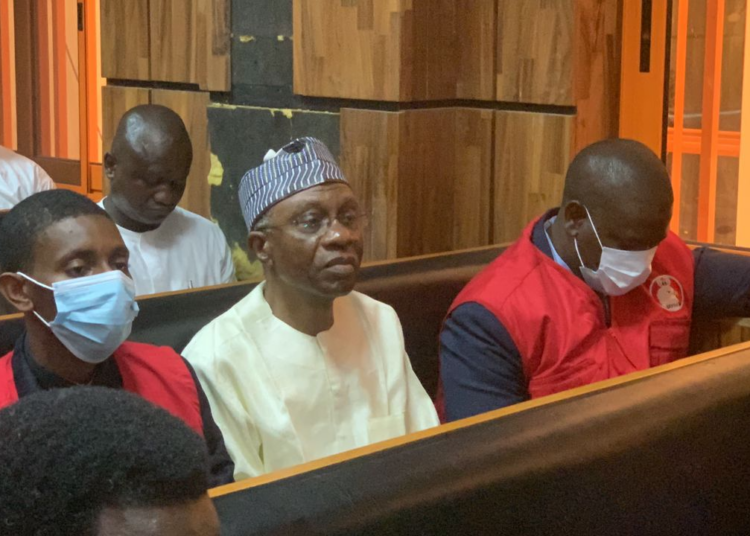
Justice Rahman Oshodi of the Lagos State Special Offences Court in Ikeja will on Monday admit in evidence the extrajudicial statement made by Henry Omoile, the second defendant, in the ongoing trial of former Central Bank Governor Godwin Emefiele.
Justice Oshodi held that the statement made by Omoile to the Economic and Financial Crimes Commission (EFCC) during the investigation is admissible because it was not obtained under duress.
Emefiele and Omoile were arraigned before the court on allegations of accepting gratification, accepting gifts through agents, corruption, and fraudulent property receipts.
The anti-graft agency also accused the defendants of conferring a corrupt advantage on their associates, in contravention of the Corrupt Practices Act 2000.
They, however, pleaded not guilty to the charge.
Omoile had challenged the validity of his statements to the EFCC, claiming they were obtained through oppression and inducement.
The defendant also argued that the prosecution failed to provide independent evidence to support the confession and questioned his lawyer’s presence during the recording, alleging that the lawyer was prevented from effectively performing his duties.
However, the anti-graft agency’s lawyer, Rotimi Oyedepo (SAN), informed the judge that the statement was obtained under the provisions of the ACJA and, although not video-recorded, was made in the presence of the second defendant’s lawyer.
He argued that the statement’s content negates claims of coercion, as the second defendant refused to implicate Godwin Emefiele and appeared to act independently, not under duress.
In his ruling, Justice Oshodi held that the prosecution proved the defendant’s statements on 26 February 2024 were voluntary and not made under coercion or inducement.
He held, “I have carefully considered the evidence presented during the trial-within-trial and concluded that the environment was active, and there was no evidence that the second defendant was physically harmed.
“I am satisfied that the prosecution has proven beyond a reasonable doubt that the statement was made voluntarily,” the judge stated.
The court also ruled that the statements from 26 February 2024 (Exhibits 1–3) were not made under duress and are therefore admissible.
However, Justice Oshodi held that the defendant’s statement on 27 February 2024 was inadmissible because it was not made in the presence of a legal practitioner or recorded on video. The judge then adjourned the case until 26 June for the continuation of the trial.