
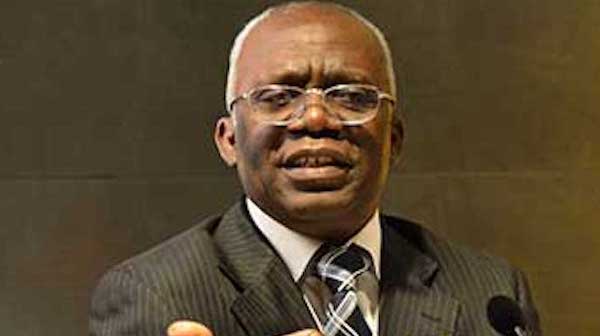
Human rights lawyer and Senior Advocate of Nigeria, Femi Falana, has asked the Economic and Financial Crimes Commission (EFCC) to immediately remit N32.7 billion and $445,000 recovered from officials of the Ministry of Humanitarian Affairs, Disaster Management and Social Development to the National Social Investment Programme Agency (NSIPA).
Falana made this appeal in a statement released on Sunday, August 24, 2025, on behalf of the Alliance on Surviving Covid-19 and Beyond (ASCAB), which he chairs.
The lawyer recalled that in January 2025, President Bola Tinubu had approved the sum of N32.7 billion for the execution of key National Social Investment Programme (NSIP) initiatives, including school feeding, N-Power, conditional cash transfers, and support for small businesses through the Government Enterprise and Empowerment Programme (GEEP).
According to him, the EFCC has already traced and recovered the exact N32.7 billion, along with $445,000, from allegedly corrupt officials within the Humanitarian Affairs Ministry. However, he noted that the funds have not yet been redirected to NSIPA, contrary to the EFCC’s commitment that recovered monies should be returned to their rightful purposes.
“We commend the EFCC and urge it to intensify efforts to recover the outstanding N20 billion still unaccounted for. But more importantly, the recovered N32.7 billion and $445,000 should be transferred to the National Social Investment Programme Agency to help alleviate the hardship faced by over 133 million multi-dimensionally poor Nigerians,” Falana stated.
He further urged governments at all levels to scale up funding for the NSIP, stressing that recent revenue inflows make this possible. Citing figures, he pointed out that the Federation Account Allocation Committee (FAAC) shared N2.001 trillion in July 2025 from a total gross of N3.836 trillion, while N1.8 trillion was shared in June.
Read also: NDLEA nabs widow using fake pregnancy to traffic cocaine in Lagos
“Governments must go beyond lip service and invest meaningfully in social protection programmes. They must put their money where their mouth is,” he concluded.
Falana’s remarks come amid growing pressure for transparency in Nigeria’s social welfare programmes, especially after several high-profile corruption scandals linked to funds meant to support the poor.