


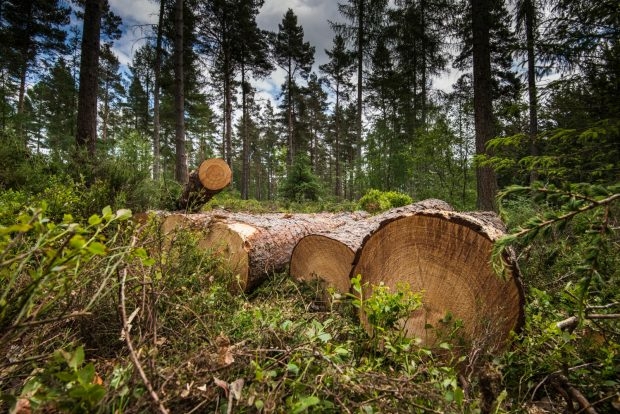
Agricultural experts have called on governments at all levels to strictly enforce laws against indiscriminate tree felling and scale up support for regenerative agriculture to address environmental degradation and secure the future of food systems in Nigeria.
The call was made during a World Earth Day webinar organised by the Foundation for Sustainable Smallholder Solutions (FSSS), themed “Entrenching Resilience through Regenerative Agriculture: A Case Study of the ESTRRA Project.”
The event brought together agricultural experts and development practitioners to explore practical solutions to climate change, deforestation, soil degradation, and declining productivity among smallholder farmers.
Dr. Reuben Solomon, Senior Agronomist at FSSS, stressed the urgency of restoring degraded lands and enforcing environmental regulations.
He described regenerative agriculture as a holistic land management approach that restores soil health, enhances biodiversity, and captures carbon, helping to mitigate climate change.
According to him, the practice improves soil fertility, boosts water retention, and strengthens resilience to climate shocks.
He warned that unchecked tree felling and unsustainable farming methods are accelerating land degradation and desertification, particularly in Northern Nigeria.
Solomon urged governments to not only enforce anti-deforestation laws but also invest in policies that promote land restoration and sustainable agricultural practices.
Also speaking, FSSS Technical Lead, Timothy Azakere, highlighted the role of the ESTRRA Project in promoting regenerative agriculture among smallholder farmers.
He explained that the initiative focuses on keeping soil ‘alive’ through sustainable practices such as fruit forest development, mixed farming, cover cropping, composting, organic manure application, reduced tillage, mulching, crop rotation, and water conservation techniques like earth bunds.
Azakere raised concerns about the declining health of soils in Northern Nigeria, describing many as severely degraded and in urgent need of restoration.
He identified key barriers to adoption, including low awareness, resistance to change, labour demands, limited access to finance and inputs, and delayed returns on investment.
To tackle these challenges, he said FSSS is implementing a Farmers’ Hub model, which provides training, demonstration plots, access to quality inputs, aggregation services, and extension support within farming communities.
He added that the project is actively engaging women and youth by creating opportunities in nursery development, fruit forest establishment, agribusiness services, and climate-smart enterprises, thereby enhancing long-term sustainability and economic resilience.
Providing insights from baseline findings, Philip Ortese, FSSS Monitoring, Evaluation, Accountability and Learning (MEAL) manager, revealed alarming levels of environmental degradation in the project areas.
He disclosed that over 41 per cent of the land is completely degraded, while more than 60 per cent has been deforested.
Ortese noted that factors such as erratic rainfall, declining soil fertility, limited access to extension services and improved inputs, as well as small farm sizes, are contributing to low agricultural productivity.
He emphasised that the project adopts an evidence-based approach, ensuring targeted interventions, continuous monitoring, and improved outcomes.
At the close of the webinar, stakeholders called for coordinated action, urging governments to enforce environmental laws, incentivise land restoration, and expand agricultural extension services.
They also encouraged donors, private sector actors, and farmers to invest in sustainable practices that restore soil health and build climate resilience.
The webinar spotlighted the ESTRRA Project, Empowerment of Smallholders to Thrive and Build Climate Resilience through Regenerative Agriculture, a three-year initiative implemented by FSSS with support from the Heineken Africa Foundation.
The project aims to directly impact 14,000 smallholder farmers and over 75,000 indirect beneficiaries across seven local government areas in Bauchi State; Gamawa, Giade, Katagum, Ja’amare, Zaki, Itas-Gadau, and Shira.
A major component of the initiative includes the restoration of 29,000 hectares of degraded land through earth bund construction, fruit forest development, and community-based support delivered via the Farmers’ Hub model.