

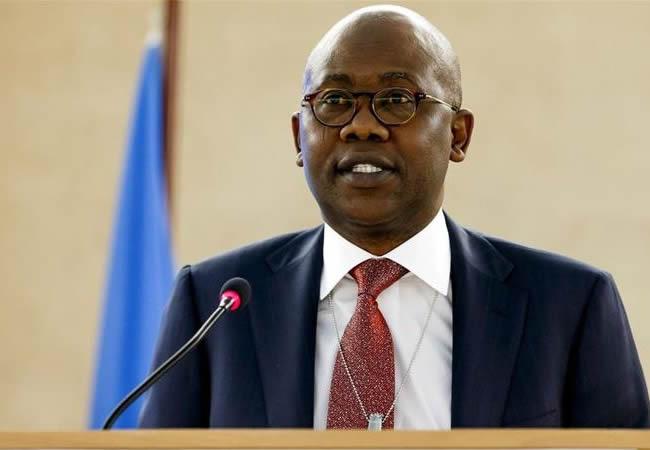
Mohammed Adoke, former attorney-general of the federation (AGF) and minister of justice, says Nigeria’s excessive dependence on courts to resolve electoral disputes is gradually eroding the democratic process and weakening the role of voters in determining political outcomes.
Adoke spoke in Abuja on Wednesday while delivering the keynote address at the 2026 annual law week of the Nigerian Bar Association (NBA) Federal Capital Territory (FCT) branch, themed “Safeguarding Nigeria’s democratic process”.
The former AGF said the country’s electoral process has become excessively “judicialised”, with politicians increasingly relying on the courts rather than the electorate to determine electoral victories.
“The increasing reliance on the courts to determine electoral outcomes is concerning,” he said.
He referenced comments by former President Goodluck Jonathan, who recently warned against the judiciary’s deepening involvement in electoral disputes.
“Recently, former President Goodluck Ebele Jonathan, GCFR, expressed significant concerns about the judiciary’s heavy involvement in Nigeria’s electoral disputes, arguing that ‘the ballot paper, rather than the court, should determine winners’,” Adoke said.
“I couldn’t agree more with him. Nigeria’s electoral circles are preceded and followed by a litany of cases to determine whether a candidate was duly nominated or has been duly elected.
“Consequently, the electorate’s participation in determining their choices for the relevant political offices is gradually eroding.
“The phrase ‘go to court’ has become a silent reminder to the electorate that judges and courts determine who is actually nominated and/or elected.
“While judicial review is essential, excessive reliance on the courts to determine election outcomes risks undermining electoral legitimacy.”
Adoke said while Nigeria has sustained democratic rule since 1999, the credibility of the electoral process continues to decline.
“Democracy in Nigeria has endured since 1999. That, in itself, is no small achievement,” he said.
“But let us be honest: endurance is not the same as excellence, and continuity is not the same as credibility.
“A democracy is not measured merely by how often it holds elections but by how deeply its people trust the outcomes of those elections.”
The former AGF warned that democracy often deteriorates gradually when public confidence in elections disappears.
“Because when the process loses credibility, democracy does not collapse overnight; it erodes. Slowly. Quietly. Almost imperceptibly. Until one day, participation becomes routine, but belief has already left the room,” he said.
He said the 2023 elections worsened public distrust in the democratic process, citing violence, voter apathy and controversies surrounding the conduct of the polls.
‘POLITICAL PARTIES REPLACING INDIRECT PRIMARIES WITH CONSENSUS CANDIDATE’
The former AGF also criticised political parties for undermining internal democracy through candidate imposition and excessive monetisation of politics.
He said the high cost of nomination forms has excluded many Nigerians from the political process.
“On average, the expression of interest and nominations forms announced by political parties for the 2027 general elections range from N5 to N100 million,” he said.
The former minister noted that despite the removal of indirect primaries from the Electoral Act 2026, political parties are gradually replacing the old practice with what he called the “coronation” of candidates through consensus arrangements.
“Care should be taken not to replace them with the ‘coronation’ of candidates through the instrumentality of the consensus arrangement,” he said.
Adoke asked the Independent National Electoral Commission (INEC) to do more to rebuild public trust.
“A situation where the credibility of the electoral management body is called into question (rightly or wrongly), as is the case today, does not augur well for Nigeria’s democratic process,” he said.
“INEC must be manifestly seen by the electorate and the political parties it regulates as operationally independent.”
“Its decisions and actions must not give the impression that it aligns with other vested interests in the political process.”
He urged Nigerians to defend democratic institutions and reject ethnic, religious and financial inducements during elections.
“The electorate must be alive to their responsibilities of determining who governs them,” he said.
“The point is that considerations such as stomach infrastructure, the candidate’s religion, ethnic base, etc. should not play a significant role in the election of candidates.”
He said democracy cannot survive if institutions become weak or compromised.
“If INEC is weak, if the judiciary is compromised, if the legislature is silent, then democracy is rendered bare,” he said.
“Democracy is not preserved by constitutions alone, nor by INEC, nor by the courts. It is preserved by a people who refuse to let it die.”