

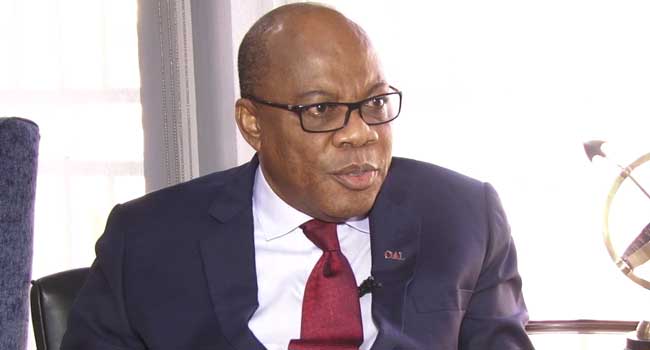
A Senior Advocate of Nigeria, Olisa Agbakoba, has proposed a set of structural reforms to the Federal Government to “unlock over ₦1.5 quadrillion” in economic value.
The reforms, if implemented, could also stabilise the naira.
Agbakoba, a former President of the Nigeria Bar Association (NBA), made the proposal in an open letter addressed to the Minister of Finance and the Coordinating Minister of the Economy, Wale Edun, on Sunday.
In the letter, titled: “Ideas for a Quadrillion Naira Economy in 10 to 15 Years,” the senior lawyer identified land and real estate titling, expansion of a credit economy, and agricultural mechanisation as key drivers that could create tangible economic fundamentals to strengthen the naira and accelerate long-term growth.
He, however, argued that exchange rate volatility remains Nigeria’s most pressing challenge and that the naira’s weakness stems from a lack of real economic fundamentals.
According to him, comprehensive reforms in property titling, credit access, and agricultural productivity will convert “dead capital” into active wealth, deepen naira-denominated asset markets, and create sustainable prosperity for future generations.
Agbakoba’s letter came amidst claims by the federal government on recent economic progress, including growth in Gross Domestic Product (GDP), declining inflation, and stabilised exchange rates.
He urged the federal government to shed light on some critical sectors of the economy to achieve maximum growth and real impacts.
He said Nigeria’s land and real estate sectors hold vast untapped wealth due to defective or non-existent property titles, which prevent assets from being used as collateral or traded in the formal economy.
While citing the World Bank, Price Waterhouse Coopers (PwC), and his firm, Olisa Agbakoba Legal (OAL), the ex-NBA President argued that nearly 90 percent of Nigerian land and real estate remain “dead capital.”
He explained that proper titling could transform these assets into legally recognised property that can generate credit, liquidity, and large-scale investment.
Additionally, he urged the federal government to accelerate the ongoing National Land Registration, Documentation and Titling Programme to digitise land records and harmonise regulations across states, saying the reform could unlock up to ₦1.5 quadrillion in economic value.
Similarly, Agbakoba called for the development of a robust legal and policy framework to support a national credit system.
He noted that Nigeria’s predominantly cash-based economy restricts growth, as citizens can only purchase what they can afford outright.
“A thriving naira credit market will deepen domestic financial markets and make the naira more attractive as an asset, and reduce the speculative attacks that drive exchange rate volatility,” he said, noting that when citizens can access credit in naira to own homes, start businesses, and build wealth, the currency gains intrinsic value and stability.
He added that if 200 million Nigerians each had access to ₦300,000 in credit facilities, it would inject about ₦60 trillion into the economy and create a strong domestic market for naira-based transactions.