
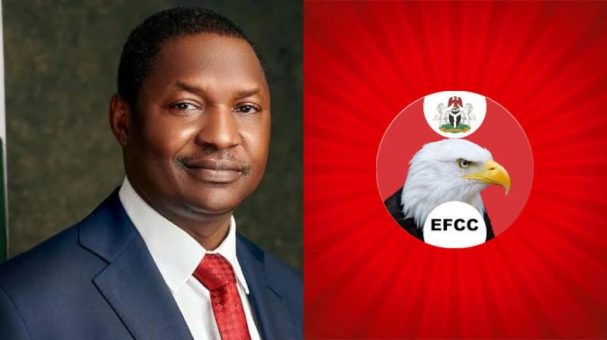
Embattled former Attorney-General of the Federation and Minister of Justice, Abubakar Malami, SAN has condemned the Economic and Financial Crimes Commission (EFCC) over Monday’s siege on his Abuja residence.
In a statement, Special Assistant on Media to Malami, Mohammed Bello Doka described the raid as a flagrant disregard for the rule of law, a gross abuse of power, and a dangerous precedent in a constitutional democracy.
SunOnline learnt that EFCC operatives stormed Malami’s residence in Abuja on Monday morning.
In a video of the incident which circulated online, the ex-AGF can be heard confronting the operatives of the anti-graft commission.
Questioning the legitimacy of the raid, Malami asked, “Where is your court order? Do you want to disgrace me?”
The EFCC operatives were said to have told Malami they had the right to mark the property, claiming it was under investigation.
In the follow-up statement, Malami’s spokesman described the EFCC action as “shocking and unlawful”.
The statement reads, “The Office of Abubakar Malami, SAN, wishes to formally address the shocking and unlawful actions carried out today by operatives of the Economic and Financial Crimes Commission (EFCC) at properties associated with the former Attorney General of the Federation, inclusive of his residential and business premises.
“Earlier today, EFCC officials, in the company of heavily armed security personnel, forcefully invaded and took over residences and offices linked to Malami, marking same without presenting any valid or subsisting court order authorizing such actions. Two people were taken to forceful custody in the course of the said invasion.”
According to the statement, the raid took place minutes after a solidarity visit by former Vice President Atiku Abubakar to Malami’s residence.
Doka said this development raises serious concerns about the intent, timing, and political undertones of the operation.
The ex-AGF’s spokesman queried the rationale for the raid given that the EFCC and Malami’s matter is already pending in court.
Doka said, “The case instituted by the EFCC at the Federal High Court, Abuja Division, presided over by Justice Joyce Abdulmalik (Suit No: FHC/ABJ/CS/20/2026), remains ongoing.
“The Honourable Court has not made any final determination on the issues in dispute, and no order authorizing the invasion and marking of the premises was argued and granted.”
He argued that an interim forfeiture order relied upon by the EFCC has elapsed.
“The ex parte order granted on January 6, 2026 was expressly time-bound for a period of 14 days, which had already elapsed.
“That order has since lapsed and cannot, under any stretch of the law, justify the EFCC’s actions today.
“No valid court order was presented. At the time of the invasion, EFCC operatives were requested to produce a lawful court order authorizing their actions.
“They failed, refused, and/or neglected to present any such order, underscoring the illegality of their conduct,” the statement further reads.
The ex-AGF’s spokesman noted that the “EFCC proceeded, in a show of force, to unlawfully occupy, mark, and assert control over Malami’s houses and offices, in clear violation of due process and established legal procedures”.
He added, “The Office of Abubakar Malami, SAN, unequivocally condemns these actions and states that:
“This is nothing short of a flagrant disregard for the rule of law, a gross abuse of power, and a dangerous precedent in a constitutional democracy. It represents a calculated attempt to harass, intimidate, and embarrass Malami, evidently on account of his political affiliations.
“While Malami remains a firm believer in accountability and the fight against corruption, such efforts must be conducted strictly within the ambit of the law and not through executive lawlessness or institutional overreach.
“We wish to reiterate that Malami will continue to fully cooperate with lawful judicial processes and will defend his rights and reputation through appropriate legal channels.
“The Office also calls on well-meaning Nigerians and the international community to take note of this troubling development and its implications for the rule of law, justice, and democratic governance in Nigeria.”