

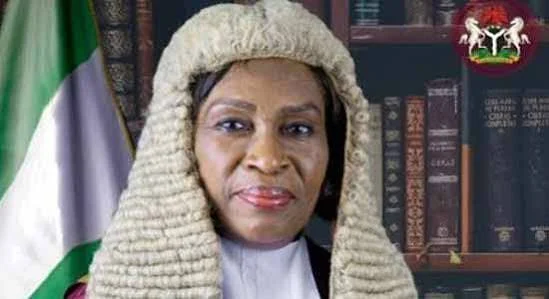
A retired Justice of the Court of Appeal, Oludotun Adefope-Okojie, has warned Nigerian courts against declaring candidates who lost elections winners through judicial decisions, insisting that disputed mandates should be returned to voters where the lawful winner cannot be determined.
She said electoral adjudication must not become an alternative means for politicians to secure political offices they failed to win at the ballot.
Adefope-Okojie spoke on Tuesday while delivering the 2026 GAVEL International Annual Lecture, titled “Electoral Process in Nigeria: Managing the Boundaries of Judicial Intervention”.
“It is not the duty of the Courts to award seats,” she declared, warning that judges must not substitute their decisions for the choices made by the electorate.
She said that where a candidate’s disqualification or serious electoral irregularities made it impossible to establish the lawful winner, the appropriate remedy should generally be a fresh election rather than declaring the runner-up elected.
Highlighting the scale of election-related litigation in Nigeria, the retired jurist disclosed that 1,209 petitions were filed out of 1,280 contested seats after the 2023 general elections, representing 94.5 petitions per 100 seats.
She contrasted the figures with Kenya, which recorded 6.5 petitions per 100 seats in 2022, and Ghana, which had 5.8 petitions per 100 seats in 2020.
Despite the high number of petitions filed in Nigeria, she said only 103 succeeded, raising concerns about the country’s electoral process and the resort to litigation by political actors.
Adefope-Okojie blamed the situation partly on impunity within political parties, citing flawed congresses, imposition of candidates and the unlawful substitution of duly nominated aspirants.
Referring to the Supreme Court’s April 30, 2026 judgment in PDP v. Sule Lamido, she urged judges not to shy away from intervening in internal party affairs where political parties breached their constitutions and relevant electoral laws.
She also cautioned against allowing political parties to hide behind the doctrine of non-justiciability to escape judicial scrutiny.
The retired justice further faulted evidential requirements in election petitions, particularly the insistence that petitioners produce polling-unit officials and witnesses before certified electoral documents could be relied upon.
She argued that such requirements made it excessively difficult for petitioners to establish allegations of electoral manipulation.
With the 2027 general elections approaching, Adefope-Okojie urged judges and members of election petition tribunals to remain impartial and uphold the sovereignty of the electorate.
“The Constitution places sovereignty in the people and makes the Courts the guardians of that sovereignty, not its holders,” she said.
“The final aim of electoral adjudication should be its own decline: a democracy in which elections are won and lost at the ballot box, not in the courtroom.”
Also speaking, human rights lawyer Femi Falana (SAN) called on the National Assembly and the judiciary to reform Nigeria’s electoral litigation framework to prevent election appeals from overwhelming the Supreme Court.
Falana advocated a return to the previous legal arrangement for determining governorship election disputes, saying it would reduce the burden on the apex court.
He lamented that efforts to address the problem had repeatedly stalled since 2011 and criticised what he described as unjustified differences in the appeal procedures for presidential and legislative election petitions.
Citing controversial judgments involving Kogi and Zamfara states, the Senior Advocate expressed concern over instances where judicial decisions had displaced the choices of voters by declaring candidates who lost at the polls winners.
Earlier, the Publisher of GAVEL International, Mustapha Ogunsakin, praised Adefope-Okojie’s judicial career, recalling her leadership of a tribunal established in 2005 by the Lagos State Government to investigate security breaches at the Ikeja High Court.
Ogunsakin said her courage, intellectual rigour and prompt submission of the tribunal’s report, which was commended by the then Lagos State Governor, Bola Tinubu, helped establish a lasting framework for court security across the state.