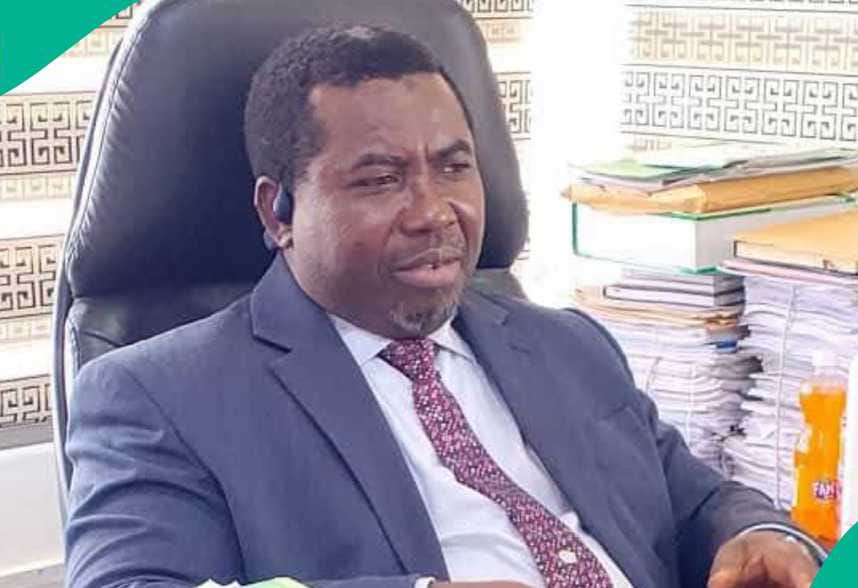
The Chairman of the Independent National Electoral Commission (INEC), Prof. Joash Amupitan, has said the 2026 Electoral Act poses serious challenges for media coverage of the nation’s electoral process.
He said the law is capable of self-censorship by the media.
Speaking at the maiden General Assembly of the Broadcast Organisation of Nigeria (BON) in Abuja, Amupitan noted that despite its progressive aspirations, the Electoral Act 2026 raises a number of concerns that undermine its effectiveness in regulating broadcast media during elections.
The INEC chairman said one of the central weaknesses lies in the indeterminacy of key standards, particularly the notion of “equitable access”.
He stressed that information space plays a dominant role in the nation’s electoral journey to the point that it is often said that elections are won or lost in the information space.
Amupitan said: “Your airwaves have become the primary infrastructure of our democracy. If they are clear, the nation sees the truth; if they are clouded by misinformation, the sovereign will of the people is threatened.”
According to the INEC chairman, the enactment of the Electoral Act 2026 represents a significant milestone in Nigeria’s electoral reform trajectory.
He added that the Act introduced provisions designed to regulate political advertising, guarantee equitable access to broadcast platforms, and curb the dissemination of harmful or inciting content.
Amupitan said: “While these measures are commendable in their objectives, they also raise critical questions regarding their scope, implementation, and implications for media independence and operational viability.”
The INEC chairman said electoral fairness is closely tied to the principle of equal opportunity in political competition and requires that all political parties and candidates have reasonable access to the media to present their programmes to the electorate. .
He added that the Electoral Act 2026 provides the principal statutory framework for the regulation of electoral processes, including the use of broadcast media during political campaigns.
Amupitan said: “Although building on prior electoral legislation, the Act introduces a more structured approach to campaign regulation and media engagement. The relevant provisions are contained in sections 99-101 of the Act.”
The INEC chairman said the key issues include regulation of political campaigns and media use and equal access to media platforms in electoral processes; state apparatus, including the media, shall not be employed to the advantage or disadvantage of any political party or candidate at any election and that media time shall be allocated equally among the political parties or candidates at similar hours of the day.
Read Also: Dangote Refinery refutes increase in pump fuel price, affirms stability
According to him, the provisions of Section 99 are central to the principle of equal access to media platforms in electoral processes, adding that their relevance can be understood from several interrelated perspectives, including non-partisanship obligations on the State.
Amupitan argued that by prohibiting the use of state apparatus, including publicly-owned media, to favour or disadvantage any political actor, the law seeks to prevent incumbency advantage.
The INEC chairman acknowledged that in many electoral systems, governments control significant media infrastructure.
He said without this safeguard, the ruling parties could dominate public discourse and distort electoral competition.
Amupitan stressed that by requiring equal allocation of media time at similar hours, especially during prime time, they go beyond mere formal access and address qualitative equality.
He said this directly supports electoral fairness by preventing unequal visibility among contestants.
According to him, with 21 registered political parties, the Act mandates fairness and balance.
He added: “You must provide a level-playing field, ensuring that no single interest group monopolises the airwaves.
“Equal coverage helps to ensure that no candidate is systematically marginalised in public discourse. Collectively, these provisions give practical effect to the democratic ideal that elections must be free, fair, and competitive.
“Equal access to media platforms enables voters to receive diverse viewpoints, compare political alternatives, and make informed choices. Without such guarantees, the electoral process risks becoming skewed in favour of those with greater access to media power, thereby undermining both the credibility of elections and the legitimacy of the resulting government.
He reminded them that the Act prohibits certain conduct at political campaigns by addressing the content of political broadcasts, particularly by prohibiting the dissemination of hate speech, incitement, and false information capable of undermining electoral integrity.”
The challenge, the INEC chairman noted, lies in defining the boundaries of such restrictions without encroaching upon legitimate political expression.
He said: “While the Act recognises the importance of fairness in media coverage, it does not provide clear criteria for measuring compliance. This vagueness creates room for subjective interpretation and arbitrary enforcement, thereby weakening the normative force of the provision.
“Closely related to this is the potential threat to editorial independence. The imposition of strict regulatory obligations on broadcasters, especially during election periods, may encourage self-censorship as media organisations seek to avoid sanctions.
“In practice, this could lead to overly cautious reporting and the suppression of legitimate political discourse, contrary to the constitutional guarantee of freedom of expression under Section 39 of the Constitution. As scholars have noted, excessive regulatory pressure may inadvertently erode the watchdog role of the media in democratic societies.
“The absence of clearly defined limits on these powers may enable selective enforcement, thereby undermining public confidence in the neutrality of the regulatory framework.
“Furthermore, the Act does not adequately address the economic realities of broadcasting. Restrictions on political advertising, though intended to promote fairness, may have unintended consequences for the financial sustainability of media organisations, many of which rely heavily on advertising revenue during election cycles.
“Without a compensatory framework, such restrictions risk weakening the media sector and, paradoxically, reducing the diversity of voices in the public sphere. These concerns highlight a fundamental tension within the Act, which is that the effort to promote fairness in electoral communication must be carefully balanced against the need to preserve media freedom, institutional integrity, and economic viability.”
Amupitan admitted that, notwithstanding the regulatory framework established under the Electoral Act 2026, the practical management of broadcast media during elections in Nigeria continues to face significant challenges that undermine the realisation of electoral fairness.
He said: “One of the most persistent issues is the dominance of incumbents in media coverage, particularly through state-owned broadcasting outlets. Election observation reports have consistently shown that ruling parties enjoy disproportionate access to airtime and more favourable coverage, thereby skewing political visibility and influencing voter perception.
“This structural advantage weakens the principle of competitive neutrality that underpins democratic elections. Another major challenge lies in the weak and inconsistent enforcement of regulatory provisions.”
He stressed that “as political parties embark on primaries as required by the Electoral Act 2026, broadcast houses must perform their task fairly, within the ambit of the law and in the interest of the country. With 21 registered parties now in the ecosystem, your equal time obligations must be guided by the official leadership records held by INEC”.