
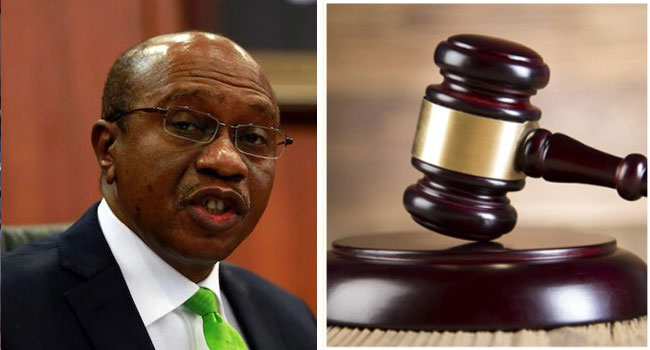
A High Court of the Federal Capital Territory (FCT) in Abuja has issued a final order to the Economic and Financial Crimes Commission (EFCC) to produce its witness against former Central Bank of Nigeria (CBN) governor Godwin Emefiele in the alleged procurement fraud charge brought against him by the Federal Government or close the case.
Justice Hamza Muazu issued the order, ruling that the witness must be brought to court by the anti-graft agency on the April 27 adjourned date or else the court will act in accordance with the provisions of the law.
The judge consequently imposed a fine of N500,000 on the EFCC for its failure to bring its last witness, Deputy Commissioner of Police (DCP) Elohor Edwin Okpoziakeo, to court to give evidence as scheduled.
Emefiele is facing trial before Justice Hamza Muazu in the suit marked FCT/HC/CR/577/2023, brought against him by the EFCC on behalf of the Federal Government, on an amended 20-count charge bordering on criminal breach of trust, forgery, abuse of office, conspiracy to obtain by false pretence and obtaining money by false pretence while serving as CBN governor.
The DCP was one of those who investigated Emefiele for the alleged fraud, but was said to be absent in court to attend to personal matters at the expense of the official engagement.
When trial resumed, counsel to the EFCC, A.O. Mohammed, informed the court that the witness, though notified of the need for his presence in court, was, however, not in court due to administrative procedures.
The prosecutor told the court that he was directed on Monday at the Force Headquarters to write a formal letter to the Inspector-General of Police formally requesting the presence of the DCP as a witness in court.
He said that he promptly wrote the letter to the IGP as directed, but that the DCP later told him that he had a personal matter at the FCT High Court in the Gwagwalada Division, where his personal account was under a garnishee order.
Mohammed pleaded with the judge to grant him an adjournment to produce the witness in court.
He said that the witness was so important to the trial that the court on its own had summoned him for the purpose of testifying in the interest of justice.
“We are seeking the discretion of this court in our favour because the last witness worked closely with the Special Panel that investigated the defendant.”
However, the request for adjournment was vehemently opposed by Matthew Burkaa, SAN, who stood for Emefiele at the proceedings.
The senior lawyer referred the judge to Section 396(3) and (4) of the Administration of Criminal Justice Act, 2015, which limited each party to only five adjournments from the arraignment till final judgment.
In this case, he stated that the EFCC had been granted eight adjournments in violation of the law, and that the prosecution chose to allow the witness to prioritise a personal matter over the official engagement.
Furthermore, the senior lawyer claimed that the anti-graft agency applied for and obtained an accelerated trial for the defendant, and that the court had granted the prosecution eight adjournments from 2023 to the present. He begged the court not to grant another one.
According to the senior lawyer, despite travelling from Lagos to attend the trial, Emefiele never requested an adjournment because he believed in the EFCC’s accelerated trial.
In his ruling, Justice Muazu agreed with the defence counsel that the EFCC had exhausted the five adjournments granted to it by law, but stated that the court retains the discretion to adjourn if it is in the interests of justice.
The judge ruled that an investigator should not be excluded from a case of this nature, but imposed a fine of N500,000 on the anti-graft agency for delaying the trial despite being granted an accelerated hearing.
Justice Muazu then adjourned the case for April 27 and 28 to continue the trial.