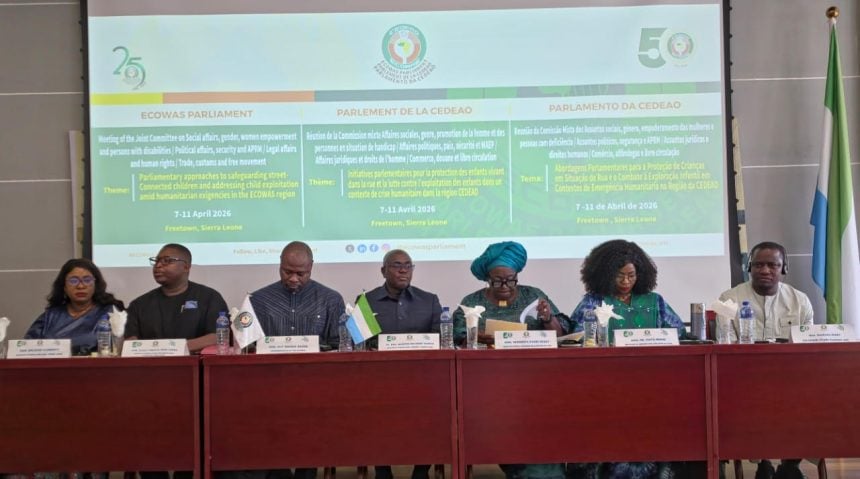
The ECOWAS Parliament has rallied efforts to strengthen legal frameworks and policy coordination aimed at protecting children in street situations, as lawmakers convened in Freetown for a high-level joint committee meeting addressing child exploitation across the region.
Delivering a keynote statement, Sierra Leone’s Head of Delegation to the ECOWAS Parliament, Veronica K. Sesay, said the gathering was designed to drive legislative action and reinforce regional cooperation to safeguard some of the most vulnerable children in West Africa.
She warned that children living and working on the streets across ECOWAS member states remain exposed to exploitation, violence, hazardous labour and substance abuse, stressing that the situation demands urgent, coordinated responses from governments and lawmakers.
“The realities demand our collective attention, strong legislative action and coordinated regional responses,” Sesay said, noting that the meeting’s theme underscores the responsibility of policymakers to protect the rights and dignity of every child.
The four-day delocalised joint committee session brings together committees on social affairs, political affairs, legal matters and trade to review existing national and regional frameworks while identifying practical strategies to strengthen child protection systems.
Sesay said the meeting would also provide a platform for peer learning and dialogue, enabling lawmakers to examine the socio-economic drivers pushing children into street situations and develop actionable recommendations for ECOWAS states.
Welcoming delegates on behalf of President Julius Maada Bio, she reaffirmed Sierra Leone’s commitment to child protection through progressive legislation and inclusive governance.
She highlighted reforms by the Parliament of Sierra Leone, including the Child Rights Act 2025, which strengthens legal protections for children, as well as the Prohibition of Child Marriage Act aimed at ending early and forced marriages.
She also cited the Gender Equality and Women’s Empowerment Act as a milestone in expanding rights and opportunities for women and girls, describing legislation as a critical instrument for advancing social justice and human dignity.
According to Sesay, the meeting will include field visits to institutions and organisations working on child protection, offering lawmakers first-hand insight into the realities faced by affected children and ongoing rehabilitation efforts.
She urged participants to ensure that deliberations translate into concrete outcomes, emphasising the dual responsibility of parliamentarians at national and regional levels to enact laws, provide oversight and advocate policies that protect the most vulnerable.
The meeting, which runs from April 8 to 11 in Freetown, is expected to produce recommendations to strengthen regional cooperation and ensure that children across the ECOWAS region are protected and given opportunities for a better future.
Also addressing the session, the Speaker of the Parliament of Sierra Leone, Segepoh Solomon Thomas, framed the issue as a moral and governance challenge requiring urgent legislative courage and coordinated regional action.
Thomas said children in street situations represent one of the most vulnerable and marginalised groups in society, describing their condition as a reflection of systemic failures, including economic inequality, weak social protection systems and the lingering effects of conflict and instability.
“Their presence in our streets is not merely a social anomaly, but a reflection of systemic gaps,” he said, warning that the situation raises broader concerns around human rights, public security and sustainable development.
Drawing on Sierra Leone’s post-conflict recovery experience, the Speaker noted that while progress has been made in strengthening child protection frameworks, significant challenges remain, particularly in urban centres where child labour, trafficking and exploitation persist.
He emphasised that parliamentary responsibilities extend beyond lawmaking to include oversight, advocacy and accountability, calling for stronger enforcement of existing laws, improved budgetary scrutiny and sustained public engagement to change societal attitudes towards vulnerable children.
Thomas also stressed the need for deeper regional cooperation, noting that child trafficking and exploitation often cut across borders, requiring harmonised legislation and intelligence-sharing among ECOWAS member states.
He proposed the development of a regional legislative model on child protection, enhanced cross-border mechanisms to combat trafficking, and the establishment of a monitoring framework to track progress across the region.
The Speaker further called for increased investment in education, vocational training and family support systems, alongside improved data collection to support evidence-based policymaking.
Reframing the narrative, he said children should not be seen as the problem but as “the promise,” urging governments to shift from reactive measures to preventive strategies that address the root causes of vulnerability.
Quoting Nelson Mandela, Thomas reminded delegates that “the true character of a society is revealed in how it treats its children,” urging ECOWAS lawmakers to translate deliberations into measurable outcomes that will protect children and secure their future.
He reaffirmed Sierra Leone’s commitment to ensuring that no child is left to survive on the streets, calling for sustained regional action to guarantee dignity, protection and opportunity for every child.